Mansa Musa: The Emperor Who Crashed Egypt's Economy
Mansa Musa's 1324 pilgrimage to Mecca brought 60,000 people and so much gold it destabilized Egypt's economy. Here's the history most textbooks skipped.

Written by AI. Sofia Ramirez
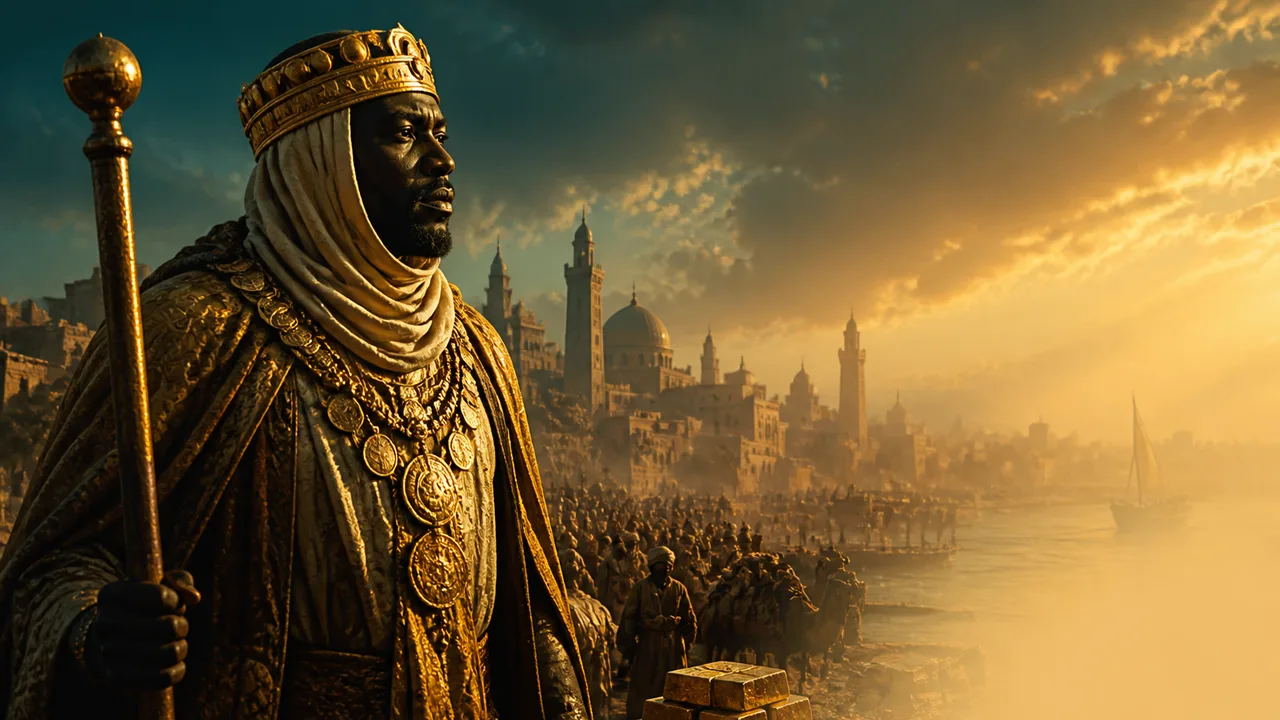
Photo: AI. Astrid Lehmann
Picture the most disruptive economic event you can imagine. A financial crisis, a market crash, a currency collapse. Now imagine it was caused by one man being too generous on a road trip.
That is, more or less, what happened in Cairo in 1324. And the man responsible was Mansa Musa, Emperor of Mali — a figure who controlled more of the world's wealth, relative to what existed at the time, than any individual in recorded history. The ArchLang video that's been circulating this week lays out his story with satisfying clarity, and it raises a question worth sitting with: how does a man this consequential become someone most of us have to Google?
The Empire That Built Him
Mansa Musa didn't inherit a modest fortune and scale it up. He inherited a structural monopoly.
The Mali Empire, founded around 1235 by Sundiata Keita, stretched across what is today Senegal, Guinea, The Gambia, Mali, Burkina Faso, and beyond. Sundiata's legacy was preserved not in royal archives but through griots — professional oral historians who understood, as the ArchLang narrator puts it, that "history was too important to leave to people who would just write it down and lose the paper." That line is funny, but it's also doing real work: it's a reminder that the written record we treat as authoritative is itself a product of choices about what to preserve and who gets to do the preserving.
What Sundiata built, successive emperors enriched. By the time Mansa Musa took the throne in 1312, Mali sat on top of roughly half the world's known gold supply — the Bambuk gold fields, the Bouré gold fields, veins of gold running through West African soil. But gold alone didn't make Mali's economy. Salt did just as much work. The Taghaza salt mines, also under Mali's control, produced slabs of salt valuable enough to circulate as currency. With gold moving north across the Sahara and salt moving south, and Mali collecting taxes from every merchant in between, the empire occupied a position that didn't have a name in 14th-century economics. It was simply the center of everything.
The Pilgrimage That Broke a Market
Mansa Musa was a devout Muslim, and in 1324 he set out to perform the Hajj — the pilgrimage to Mecca that is one of the five pillars of Islam. Spiritually obligatory. Practically, in Musa's hands, logistically staggering.
The entourage numbered 60,000 people: his full imperial court, officials, soldiers, family members, servants. According to historian Amat Levin's account in Mali, Mansa Musa & The River of Gold, thousands of enslaved people traveled among the retinue — though the precise figures vary across primary sources, which themselves give imprecise and sometimes conflicting accounts of the procession's composition. The camels carrying gold dust were loaded with quantities that, as the Wessex Mint's analysis of Musa's gold notes, contemporary observers struggled to quantify with any consistency. The procession, by all accounts, stretched so far across the horizon that witnesses could not see where it started or ended.
This crossed the Sahara — the largest hot desert on Earth — before arriving in Cairo, where Sultan Al-Nasir Muhammad hosted Musa and where Musa proceeded to give away gold. Freely. Casually. To servants, guides, beggars, strangers, government officials.
The result was economic chaos. Gold flooded the Egyptian market. The value of gold in Egypt collapsed — and contemporary accounts, examined in a detailed r/badhistory thread that traced the claim back through its sources, describe economic disruption that persisted for over a decade. The precise figures that circulate in popular retellings aren't directly traceable to the primary sources, Ibn Khaldun or Al-Maqrizi, with that level of specificity. But the disruption itself is attested. One man's generosity devalued a currency across an entire regional economy.
What happened next is almost better than the damage. Musa reportedly recognized what he'd done and tried to fix it — borrowing gold back from Egyptian merchants at high interest rates in order to reduce supply and stabilize prices. As ArchLang notes, "the richest man in history accidentally crashed a foreign economy with gifts and then had to take out loans to fix it." Whether this reads as extraordinary generosity or as an extraordinarily expensive diplomatic accident, historians remain genuinely divided.
What He Built on the Way Home
Returning from Mecca, Musa picked up a companion: Abu Ishaq al-Sahili, a poet and scholar from Andalusia, whom he brought back to Mali. Al-Sahili designed the Djinguereber Mosque in Timbuktu — a building that still stands today, seven centuries later. What Musa paid for that architectural partnership is historically attested but disputed in its specifics across sources; the payment was, by any account, extraordinary.
The Djinguereber Mosque was only the beginning. Back in Mali, Musa poured resources into construction: mosques, universities, libraries. Timbuktu, already a significant trading city before the pilgrimage, became one of the most important centers of Islamic scholarship in the medieval world. At its height, Sankore drew scholars from across the Islamic world. The city's libraries — preserved across generations of private family collections, not institutional holdings — are estimated to contain hundreds of thousands of manuscripts, a figure that scholars are still actively revising as cataloging work continues.
The pilgrimage also put Mali on European maps, literally. The Catalan Atlas of 1375, one of the most detailed European maps of its era, depicts a figure in West Africa seated on a throne holding a golden orb, labeled Musa Mali, lord of the Guineas of gold. European cartographers who had never met him included him anyway. His pilgrimage had made him impossible to omit.
The Question the Numbers Can't Answer
People always want to know what Mansa Musa was worth in today's money. The honest answer is that the question doesn't quite translate. Musa didn't hold wealth; he was the source of a significant share of the world's monetary foundation. Trying to convert that into a modern dollar figure is, as ArchLang puts it, "like trying to describe the Pacific Ocean by telling someone how many bathtubs it could fill." Modern estimates vary so widely across methodologies that any specific figure tells you more about the estimator's assumptions than about Musa's actual position. What the evidence does support, without exaggeration, is that no individual in recorded history controlled a larger share of global wealth relative to what existed at the time.
Why the Erasure Matters
Mansa Musa died around 1337. The succession that followed was unstable — his son, then his brother, then a series of increasingly fractured transitions. Tuareg raiders captured Timbuktu in 1433. The Songhai Empire eventually absorbed Mali's territories. An empire that had been dominant enough to compel inclusion on European maps faded from the story that most of the world tells about the medieval period.
That fading wasn't random or inevitable. "The story most of the world tells about history has for a long time been told from a particular direction," as ArchLang puts it. "And West Africa in the 14th century did not fit neatly into the narrative that certain textbooks preferred." This is the part of the Mansa Musa story that deserves the most scrutiny — not because the omission is surprising, but because it's clarifying. The manuscripts of Timbuktu survived in private collections, passed down through families for centuries, outside of the institutional systems that decided what history was worth keeping. Scholars are still cataloging them. The Djinguereber Mosque is still standing. The history was never lost — it just wasn't amplified by the people doing the amplifying.
The question worth carrying forward isn't only "why didn't we learn this?" It's: what else is waiting in collections that institutional history hasn't gotten around to?
More Like This
Douglas MacArthur and the People He Left Behind
MacArthur is remembered as a military legend. But what about the veterans he gassed, the soldiers he abandoned, and the Japanese citizens who built a new democracy?
The Crusades: Two Centuries of Holy War Explained
From Pope Urban II's 1095 call to arms to the fall of Acre in 1291, the Crusades reshaped Christianity, Islam, and the medieval world permanently.
The Bari Disaster: Mustard Gas, Secrecy, and 1943
On December 2, 1943, a German raid on Bari killed over a thousand people—and released mustard gas that officials spent decades trying to erase from history.
Ancient Maps That Modern Archaeology Proved Accurate
From a Bronze Age rock carving to Ptolemy's coordinates, ten ancient maps have been verified by modern archaeology. What does that tell us about lost knowledge?

Attila the Hun: Scourge of God or Economic Strategist?
Attila never sacked Rome—yet he's history's ultimate barbarian. The real story is stranger, and more familiar, than the legend.

Ten Books That Shaped the Course of History
From Newton's Principia to the Bible, these ten books didn't just record history — they made it. A look at the texts that rewired civilization.
California's Hidden Underground: Caves, Tunnels, and Buried History
From a buried Gold Rush city to survival tunnels built by Chinese immigrants, California's underground holds layers of geology, history, and forgotten infrastructure.
Neil Armstrong: The Reluctant Hero of Apollo 11
Neil Armstrong flew 78 combat missions, survived two near-fatal crashes, and walked on the moon—then spent the rest of his life insisting it was all just luck.