Douglas MacArthur and the People He Left Behind
MacArthur is remembered as a military legend. But what about the veterans he gassed, the soldiers he abandoned, and the Japanese citizens who built a new democracy?

Written by AI. Sofia Ramirez
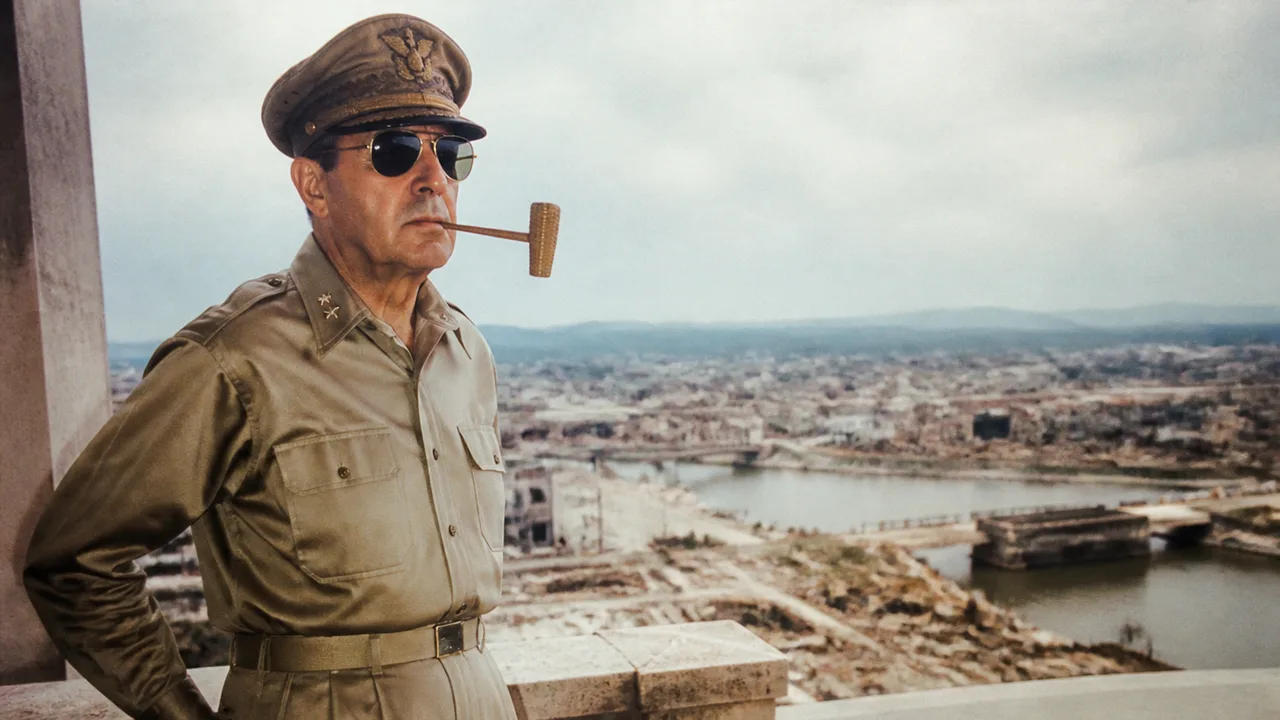
Photo: AI. Marcel Dubois
In the summer of 1932, tens of thousands of World War I veterans — historians put the number somewhere between 17,000 and over 40,000, with estimates still contested — made camp in Washington, D.C. They called themselves the Bonus Expeditionary Force. Everyone else called them the Bonus Army. They had fought in the Meuse-Argonne, in the Champagne sector, in the Rhineland. They had come home to paychecks that didn't cover rent, to factories that wouldn't hire them, to a Depression that the government that sent them to war showed no urgency in addressing. What they were asking for was simple: pay us what you promised. The army bonuses the government had pledged wouldn't come due until 1945. These men needed them now.
General Douglas MacArthur, then Army Chief of Staff, initially sent camp equipment. Then he ordered tanks and tear gas.
This is the moment that tells you everything you need to know about MacArthur — not because it proves he was a monster, but because it shows exactly how his mind worked. He had convinced himself, on evidence that was at best thin and at worst invented, that the Bonus Army's leadership had been infiltrated by communists. The veterans weren't suffering Americans exercising a constitutional right to petition their government. In MacArthur's framework, they were a security threat. The distinction mattered to him because it let him act. It should matter to us because it's a framework that never fully went away.
The People Profiles documentary on MacArthur covers his entire arc — from his birth in Little Rock in 1880 to his death at Walter Reed in 1964 — with the kind of scope that makes you appreciate just how long this man's shadow fell over American history. His grandfather Arthur MacArthur Sr. had been born in Glasgow and emigrated as a child, growing up largely American before rising to governor of Wisconsin. His father Arthur Jr. won the Medal of Honor in the Civil War and governed the Philippines after the Spanish-American War. Douglas was, as the documentary notes, "an army brat before the term was really used." He never stopped being one. He spent decades living outside the United States — the Philippines, New Guinea, Japan — and when he finally returned to American soil after his firing in 1951, he stepped off the plane into a country that had moved on without him.
That detail is worth holding onto. But first: Bataan.
When MacArthur fled Corregidor Island in March 1942 on direct orders from Roosevelt, he left behind around 76,000 Filipino and American troops who had no way out. What followed was the Bataan Death March — roughly 65 miles on foot through jungle heat, with Japanese guards who beat, bayoneted, and shot men who fell behind. Thousands died on the march itself. Thousands more died in the prison camps afterward. These were Filipino farmers, mechanics, students, and American soldiers from small towns across the country. The march is sometimes mentioned in MacArthur histories as context for the Medal of Honor controversy — framed as a PR problem for his command rather than a catastrophe in its own right.
The documentary describes how MacArthur was awarded the Medal of Honor in 1942 largely, as Eisenhower pointedly observed, to "save face for his abandonment of the Philippines." The men who didn't get evacuated received no such consolation. What happened to them is the story. MacArthur's departure is just the mechanism.
His payment of roughly half a million dollars from the Philippine Commonwealth government — documented by historian Carol Petillo, though the precise inflation conversion depends on your baseline year and methodology — came out around the same time. Whatever that sum amounts to in today's dollars, the optics were not complicated: the general was paid; the soldiers marched.
The occupation of Japan, which MacArthur oversaw from 1945 to 1951, gets remembered as a policy triumph. That's not entirely wrong. But the way we tell it tends to flatten out the part where ordinary Japanese people did something extraordinary.
MacArthur's team drafted a new Japanese constitution in 1946. Embedded in it was Article 9 — the clause by which Japan formally renounced war as an instrument of national policy and agreed not to maintain war potential. It is one of the most radical constitutional provisions in modern democratic history, and it was put to a vote by a Japanese public that had just watched two of their cities atomized, that had just buried sons and husbands and fathers. Women voted on it — for the first time, because the new constitution granted women's suffrage. They voted to ratify it.
Economic historians reasonably debate how much credit MacArthur's occupation governance deserves for Japan's postwar economic rise. The factors involved — land reform, labor organizing, American Cold War investment, the Korean War procurement boom — are complicated enough that attributing Japan's trajectory primarily to occupation policy is contested territory. What's less contested is what Japanese citizens chose to do with the constitutional framework they were given: build a pacifist democracy that lasted, and that remains, to this day, a living rebuke to the idea that militarism is inevitable.
MacArthur understood this in Japan. His instinct to shield Emperor Hirohito from prosecution — keep the figurehead, use the institutional continuity to stabilize the transition — was strategically shrewd. It also meant that accountability for Japan's war crimes in China and Southeast Asia, crimes the documentary rightly notes are often obscured by Europe's Holocaust in popular memory, remained incomplete. That's the tension the occupation's success story doesn't fully reckon with.
The Korea chapter is where MacArthur's career finally broke. After the audacious Inchon landing turned a near-catastrophic retreat into a UN advance all the way to the Yalu River, Chinese forces crossed in massive numbers and pushed south again. MacArthur, frustrated by a war that kept resetting itself along the 38th parallel, began floating the idea of using nuclear weapons — the documentary says he discussed "potentially dozens" targeting Manchuria. That specific figure appears to originate with the documentary's narration rather than a cited primary source, and it should be treated with appropriate skepticism pending verification against the historical record. What is well-documented is that MacArthur did advocate for nuclear use against China, did communicate this advocacy to European allies and diplomats in ways that contradicted official U.S. policy, and did so while still in uniform.
Truman fired him on April 11, 1951.
MacArthur's farewell address to Congress — "like the old soldier of that ballad, I now close my military career and just fade away" — is one of the most quoted lines in American military history. Less quoted is what he did immediately afterward: a national speaking tour criticizing the Truman administration, timed to gauge his prospects for the 1952 Republican presidential nomination. His crowds dwindled. Eisenhower, who had served under MacArthur in the Philippines and understood how to subordinate military ego to political process, won the nomination and then the presidency. MacArthur spent his final years on the board of Remington Rand, living in a suite at the Waldorf Astoria.
So who is this story really for?
Not MacArthur. He gave himself enough monuments. The Bonus Army veterans who got tear-gassed in 1932 are the people whose story connects most directly to where we are now — to every congressional fight over the VA budget, every debate about what the state owes people it sent to war, every protest movement that gets labeled a security threat to justify clearing it out. The men who died on the Bataan Death March because evacuation assets went to the general and not the troops are the people whose story belongs at the center, not the footnotes. The Japanese women who voted for Article 9 — some of them casting a ballot for the first time in their lives, choosing a constitution that said never again — deserve more than a sentence about reconstruction GDP.
The reason we keep relitigating MacArthur isn't really about him. It's about the recurring American question of who gets to decide when military authority ends and democratic accountability begins — and what happens to the people caught in the gap when nobody has a clean answer.
More Like This
The Bari Disaster: Mustard Gas, Secrecy, and 1943
On December 2, 1943, a German raid on Bari killed over a thousand people—and released mustard gas that officials spent decades trying to erase from history.
Sitting Bull: Warrior, Mystic, and Military Strategist
From Hunkpapa war chief to victor at Little Bighorn—the life of Sitting Bull reveals a leader whose complexity American history has rarely done justice.
The Transcontinental Railroad's Forgotten Price Tag
The golden spike ceremony hid a messier truth: fraud, erasure, and collapse. Here's the full accounting of what America's railroad actually cost.
Attila the Hun: Scourge of God or Economic Strategist?
Attila never sacked Rome—yet he's history's ultimate barbarian. The real story is stranger, and more familiar, than the legend.
California's Most Remarkable Abandoned Places
From a concrete ship with a dance floor to nuclear missile bunkers beneath a tourist park, California's abandoned places hold stories the state never bothered to tell.
Neil Armstrong: The Reluctant Hero of Apollo 11
Neil Armstrong flew 78 combat missions, survived two near-fatal crashes, and walked on the moon—then spent the rest of his life insisting it was all just luck.
Egypt's New Delta Project: Green Miracle or Mirage?
Egypt is engineering a new Nile in the desert. But satellite data, groundwater depletion, and a troubling history raise urgent questions about who this is really for.
Ancient Megastructures That Still Puzzle Engineers
From Göbekli Tepe to the Great Pyramid, these ancient sites raise genuine questions about what early human societies were capable of building—and how.