The Transcontinental Railroad's Forgotten Price Tag
The golden spike ceremony hid a messier truth: fraud, erasure, and collapse. Here's the full accounting of what America's railroad actually cost.

Written by AI. David Oyelaran
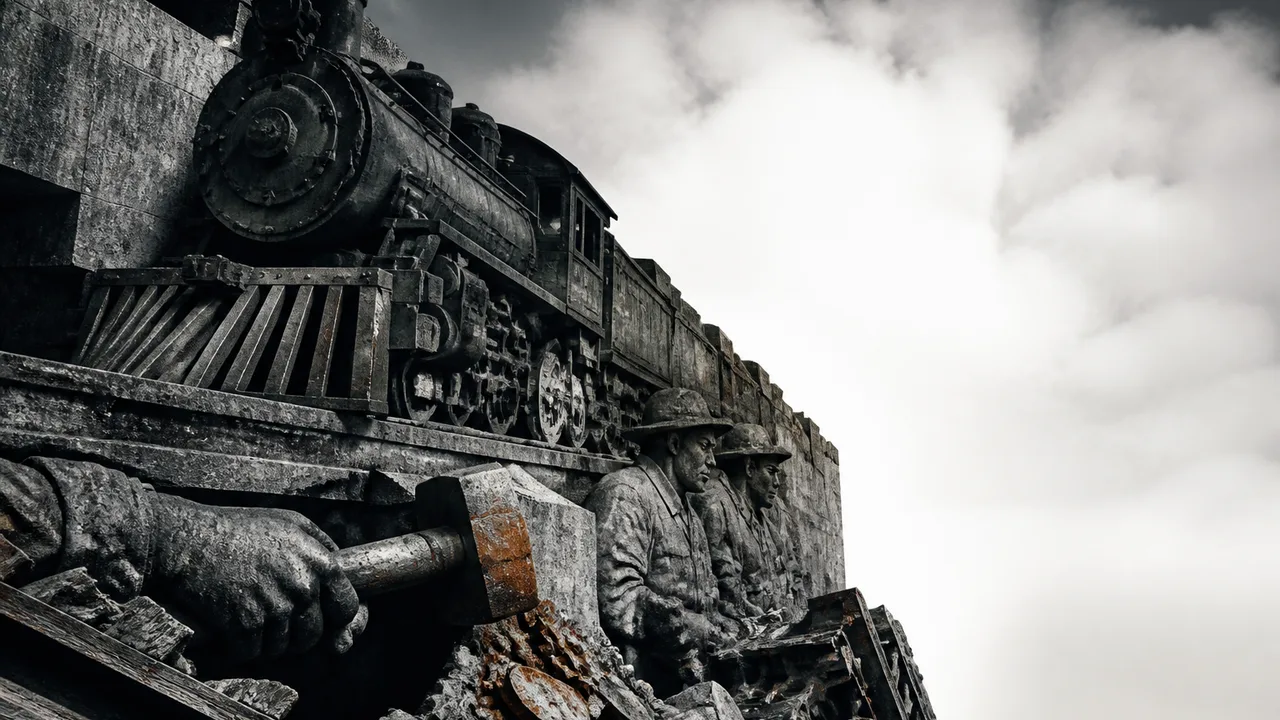
Photo: AI. Kasper Winter
Somewhere in the high desert outside Promontory, Utah, there is a patch of ground that looks like nothing. No skyline. No landmarks. Just scrub and distance and the particular silence of a place the wind has been moving through for a long time. Daniel Steiner, a documentary journalist on YouTube, drove out there recently and nearly missed the reenactment he came to see — showed up just in time to watch them put the trains away.
That comedy of timing feels like the right way into this story, actually. Because the Transcontinental Railroad — the one with the golden spike and the famous photograph and the telegraph message that simply said done — has always been better understood in its aftermath than in its ceremony.
Why It Got Built (And Why That Matters)
The clean version of the story goes like this: visionary Americans connected a continent, bound the nation together, opened the West. What historian Richard White, whose work Steiner draws on throughout his video, offers instead is something more structurally interesting: the railroad wasn't built because people wanted it. It was built because a war made it militarily necessary, and then — once the war ended — because the financial structure created to build it had become its own reason for existing.
Before the Civil War, the idea of a transcontinental railroad had been floating around Congress for years. Entrepreneur and dreamer Asa Whitney had proposed routes and lobbied relentlessly in the 1840s. The geography made sense. The logic was there. But as White explains in the video, there was simply "no reason to build it, quite frankly." No passenger demand. No freight demand. Two thousand miles of empty continent. No railroad company was going to fund that on commercial logic alone.
What changed the calculation wasn't demand. It was the Confederacy threatening to push west and the Union needing to secure California. Abraham Lincoln — who, notably, had been a railroad lawyer in Illinois before the presidency — signed the Pacific Railroad Act in 1862. The route chosen wasn't the most practical. It wasn't the flattest. A southern route existed that was geographically far easier. But that route ran too close to Confederate territory. As White puts it: "You don't want to build them a railroad, which they can seize and take over and use the same railroad."
So the two companies — the Union Pacific building west from Omaha, the Central Pacific east from Sacramento — were handed one of the hardest possible routes across the continent. And they were handed, along with it, an extraordinary amount of public money to do it.
The Machine Built to Defraud
The 1862 Act, it turns out, didn't immediately get anything built. The financial terms weren't attractive enough. Experienced railroad investors looked at the math — pay now, get repaid from profits on a route with no passengers and no freight — and passed. Construction barely moved.
So Congress sweetened the deal. Land grants doubled. Payment terms shifted so that investors would be made whole before the U.S. government, meaning taxpayers would absorb the losses if things went wrong. And then something quietly remarkable happened: the men running these railroad companies figured out they could secretly own the construction companies hired to build them.
The Union Pacific's scheme was called Credit Mobilier of America. The Central Pacific's was the Contract and Finance Company. The logic was elegant in the way that frauds often are: charge the railroad company (which you own) an inflated price for construction (which your other company is doing), pocket the markup, and leave the railroad holding the debt. There wasn't going to be money in running the railroad. There was going to be enormous money in building it.
"The companies managed to lose money for a long time," White says, "but the people running them made money. So, this is the trick of doing that. And these are the guys who first invented that trick."
The numbers, laid out plainly, are staggering. Credit Mobilier charged the Union Pacific $94 million. The Contract and Finance Company charged the Central Pacific $47.5 million. Against the actual cost of construction, Credit Mobilier alone overcharged by $44 million — roughly $1.1 billion in today's terms. The Central Pacific's Big Four, four Sacramento businessmen who controlled the railroad, also handed their construction company $54 million in company stock on top of the inflated fees.
When Credit Mobilier's scheme became public, the scandal spread into Congress itself — a sitting congressman had been distributing company stocks to fellow legislators for favorable treatment. Nobody was ever prosecuted. The Big Four got wealthy enough that Leland Stanford later endowed a university with his share. The U.S. taxpayer made up the difference.
Who Built It and Who Got Photographed
The most immediate cost was paid by people who appear almost nowhere in the official record.
The Central Pacific faced a labor problem from the start. The Sierra Nevada mountains — granite peaks, 40-to-50-foot winter snowpacks, 15 tunnels to blast through — made the work so dangerous and so poorly paid that white workers wouldn't stay. So the company contracted with Chinese labor gangs. The workers were cheaper, and Steiner notes they ended up working more efficiently than their white counterparts. For Summit Tunnel — 1,600 feet of solid granite — they worked around the clock, blasting and hauling in three shifts, and finished in less than half the originally projected time.
The death toll among Chinese workers, as White acknowledges in the video, "number into the thousands." Records were not carefully kept.
On May 10, 1869, when the two trains finally met at Promontory Summit and Leland Stanford drove the symbolic golden spike, photographer Andrew Russell captured an image that Life magazine would later call one of the hundred photographs that changed the world. Dignitaries from Salt Lake City. Railroad executives. Celebrating crowds.
White's read of that photograph is quiet and worth sitting with: "The pictures are revealing by who's not in them. The people who finish the line, who bring it so that the line can be brought together are going to be Chinese workers. But if you look at those pictures, most of them have no Chinese in them."
The Bill That Kept Coming Due
The ceremony at Promontory was not an ending. "People just think it's okay. We drive the Golden Spike. It's done. Onto other things," White says. "It's not done. It's really just beginning."
What came next was decades of financial reckoning. The railroad had been built fast and built badly — General Grenville Dodge's military ethos was good enough to get trains moving, not good enough to build lasting infrastructure. As White describes it, what they built was "two streaks of rust reaching across the continent." Large sections had to be rebuilt, rerouted, and regraded almost immediately. The demand that was supposed to materialize and pay everyone back didn't arrive in volume until well into the 1880s, and by then two more transcontinental railroads had been completed, splitting whatever traffic existed.
The railroad companies went bankrupt. And when they did, they didn't just fall — they took the broader economy with them. Not once. Not twice. Three times. The financial crises of the late 19th century were called, simply, "railroad depressions." The public's response, in cartoons and editorials across the country, cast the railroad magnates as villains — literally as an octopus, its tentacles wrapped around the American economy.
White raises a question the video doesn't quite resolve, and it's the right one to leave open: how much of the settlement of the American West actually required a subsidized transcontinental railroad? Many parts of the West without subsidized lines settled through the ordinary, organic process of building rail as population and demand grew. "The transcontinentals helped," White says, "but they weren't necessarily required for doing that."
This is not a comfortable question for a narrative that has "done" as its climax. If the railroad wasn't economically necessary when it was built, wasn't demanded by the people along its route, was deliberately routed through the hardest terrain on the continent for military reasons that ceased to exist before the project was 2% complete, and was then converted into a scheme to extract public money into private hands — what exactly are we celebrating when we celebrate it?
The railroad made the United States, as White concedes. That is real. What it also made — who it killed, who it erased, what it cost the public, and what it took from the nations living on that land — is equally real and considerably less photographed.
Daniel Steiner's full video, "The Transcontinental Railroad, Explained," is available on YouTube. Richard White's book Railroaded is linked in the video description.
More Like This
Middle Platonism's Hidden Role in Western Esotericism
ESOTERICA's new crowdfunded seminar argues Middle Platonism built the foundations of Hermeticism, Gnosticism, and early Christian theology. Here's what that means.
San Francisco 1906: The Disaster That Was Built
The 1906 San Francisco earthquake wasn't just an act of nature—it was the bill coming due on decades of willful ignorance. Here's what actually happened.
Sitting Bull: Warrior, Mystic, and Military Strategist
From Hunkpapa war chief to victor at Little Bighorn—the life of Sitting Bull reveals a leader whose complexity American history has rarely done justice.
The Gods of Pre-Islamic Arabia, In Their Own Words
Ancient desert inscriptions reveal the polytheistic world before Islam—gods, prayers, sacrifice, and fate, recorded by the nomads who lived it.
California's Ghost Towns Google Maps Can't Find
13 hidden California ghost towns erased by floods, fraud, and water wars—each with a stranger story than anything Bodie ever offered.
DC Power's Long Road Back: How Sweden Changed Everything
How a Swedish engineer's 40-year obsession with a faulty valve quietly built the backbone of today's renewable energy grid.
Homer's Odyssey and What Mortality Means Today
Homer's Odyssey is more than epic adventure — it's a philosophical argument for why a finite life matters, and why immortality might be the real curse.
DNA Names a Revolutionary War Teen Soldier After 245 Years
Genetic genealogy has identified Private John Pumphrey, a Maryland teen who died at the Battle of Camden in 1780 — one of America's oldest John Doe cases.