Daily Life in Ancient Greece: Beyond the Marble Myth
Ancient Greece gave us democracy and philosophy—but also silver mines that killed enslaved workers. A look at who really built the "golden age."

Written by AI. Sofia Ramirez
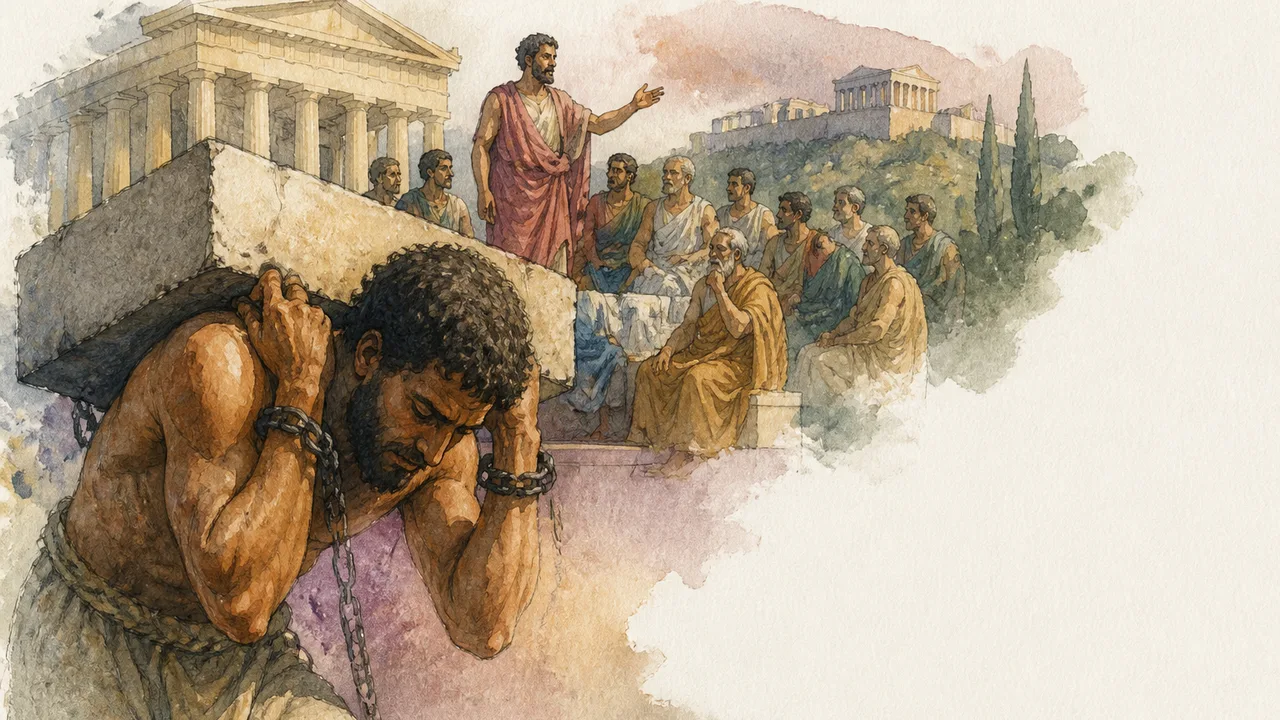
Photo: AI. Júlia Almeida
The ruins are gorgeous, and that's part of the problem.
When we look at the Acropolis—even stripped of color, even half-collapsed—it still communicates grandeur. It was designed to do exactly that. What it was never designed to communicate is what it cost, or who paid that cost, or what was happening in the silver mines of Laurion while philosophers were strolling the Agora testing their theories on passersby.
A recent documentary from Odyssey Ancient History Documentaries takes on that gap—the distance between the Greece we've inherited as idea and the Greece that actually existed as a place where ordinary people woke up every morning and had to figure out how to eat. It's an ambitious sweep across city-states, warfare, religion, theater, and the long argument over Troy. Some of it lands hard. Some of it leans too comfortably into the grandeur it's trying to complicate. The tension between those two impulses is, frankly, what makes it worth watching.
The City That Wasn't a Democracy for Most of Its People
The documentary is at its most useful when it refuses to let the word "democracy" do uncomplicated work.
Athens is the city that gave us the concept, yes. Male citizens were obliged to attend the weekly assembly and received a small payment for doing so. Those too poor to afford theater tickets were given them by the state. One historian in the film gets visibly moved describing the access ordinary Athenians had to their leaders: "You walk in Athens, you could talk to the prime minister, you might say. A carpenter could talk to him. You could argue with him if you didn't agree with him. There was no class. You could talk."
That's a real thing. It's worth honoring.
But it existed alongside a social order in which your standing was measured by the number of enslaved people your household could afford—and the documentary notes that it was rare for even the poorest citizens to own none at all. The Agora, that bustling civic heart where politics and philosophy and commerce converged, was also a place where enslaved people shopped on behalf of their masters. The trireme crews who defeated Persia at Salamis in 480 BC included both free men and enslaved rowers, all laboring in conditions that the poet Aristophanes described as genuinely miserable—"three rows of oarsmen more or less sitting on top of each other with very little freedom of movement," as the documentary puts it.
The worst fate in this society wasn't poverty. It was the silver mines at Laurion. The shafts were narrow, dark, and dangerous enough that one of the historians interviewed calls assignment there "tantamount to a death sentence." This is the underside of the Parthenon's foundations—not metaphorically, but practically. Athenian imperial wealth, the wealth that funded the buildings and the festivals and the state-subsidized theater tickets, ran through those mines.
The Troy Problem
About a third of the documentary wrestles with the Trojan War, which is the right amount of time to spend on something that might not have happened the way anyone says it did.
Heinrich Schliemann's excavations at Hisarlik in Turkey are the anchor here. The documentary gives him his due—he followed a hunch against scholarly skepticism and turned out to be pointing at something real. But it's also honest about his mistakes: the gold he found in what's now identified as Troy II and called "Priam's Treasure" has nothing to do with the legend. It predates the relevant period by about a thousand years.
What archaeologists now generally identify as the Troy of historical interest is the level called Troy VIIa, dated to roughly 1290 BC. According to scholarship published in Troy and the Trojan War: Archaeology, History and the Epic Traditions, this layer shows evidence of burning and destruction—consistent with a city violently ended. But as the documentary carefully notes, that's not the same as evidence of a ten-year siege, a wooden horse, or the specific conflict Homer describes. Battlefields don't preserve themselves. Weapons get salvaged. Scrap gets cleared.
What we're left with is Homer—and Homer is doing something more complicated than reporting. The Iliad, composed centuries after the events it describes, is a document about Greek society at the dawn of civilization as much as it's a document about Troy. It tells us how they understood war, heroism, divine intervention, and the relationship between kings. Whether Helen was real, whether the horse was real—these questions might be permanently unanswerable, and the documentary is admirably honest about that.
What the Agora Was Actually For
One thing the documentary does beautifully is map the layering of the Agora—how the same space held the fish market in the morning and philosophical debate in the afternoon, how the Tholos (the round administrative building where the executive council ate at state expense) stood alongside temples, and how the sacred way wound through all of it up to the Acropolis.
A civic space that is simultaneously a market, a law court, a religious procession route, and a place where people gossip about their neighbors—that's not a contradiction. That's just what cities are. The Greeks didn't separate these functions because they didn't think of them as separate. Religion, commerce, politics, and social life were one continuous texture.
The theater worked the same way. Three consecutive days of performance during festivals, with state-subsidized tickets for the poor, three tragedies and a comedy per day, the audience voting on the best. Aeschylus, Sophocles, and Euripides were working in this context—not the hushed reverence of a modern auditorium but something closer to a civic argument, conducted in verse, watched by people who had opinions and cushions and nowhere else to be. Aristophanes was writing political satire savage enough that the politicians it targeted could be identified by name. The documentary points out, with some relish, that Athenian democracy was corrupt from the start—policies promised and broken, rhetoric substituted for substance—and that Aristophanes saw through it and said so publicly, loudly, in front of the whole city.
Some things don't change.
What the Philosophy Actually Was
The documentary spends time on Pythagoras, Plato, Aristotle, and Socrates—the canonical roster. It's worth pausing on what it actually says, because the framing is more interesting than the usual "Greece gave us reason."
Aristotle, for instance, believed the Earth was stationary at the center of the universe, with stars and planets fixed to crystalline spheres radiating outward. This was wrong. It was confidently, systematically wrong, and it shaped European thought for over a thousand years. The documentary includes this not to mock Aristotle but to show that Greek philosophy was a living argument, not a finished product—ideas that were bold and generative and also, sometimes, completely mistaken.
Plato's Republic imagined equality between men and women and among all citizens. The Athens Plato actually lived in did not resemble this vision even slightly. Girls were taught weaving and household skills at home while boys attended schools that trained them to speak publicly, compose poetry, and perform athletically—preparation for a political life that wasn't available to women at all. Plato was writing against his own world, or at least against part of it. That tension is what makes him worth reading.
The Debt We Keep Misidentifying
There's a version of "we owe everything to ancient Greece" that's really just a way of not looking too closely at what ancient Greece was. The marble, the geometry, the theatrical tradition, the philosophical vocabulary—all real. All genuinely in our water.
But the Agora was also a place where enslaved people ran errands. The democracy excluded women, enslaved people, and non-citizens. The silver mines that funded Athenian glory were, by the documentary's own account, killing people. The oracle at Delphi was, the evidence suggests, an elaborate performance—smoke through hidden passages, priests through secret doors—that people traveled hundreds of miles and paid good money to experience.
"The most fascinating thing about Greece," one of the documentary's historians says, "is the fact that we're still influenced by it today."
That's true. The more useful question might be: influenced how, and in which directions, and by whose version of it?
The ruins are gorgeous. They were built to last, by people who knew exactly what they wanted remembered.
By Sofia Ramirez
More Like This
Belzoni's Tomb: The Strongman Who Found Seti I
Giovanni Belzoni was a circus strongman who became Egypt's greatest explorer. His 1817 discovery of Seti I's tomb rewrote what we knew about the ancient world.
Attila the Hun: Scourge of God or Economic Strategist?
Attila never sacked Rome—yet he's history's ultimate barbarian. The real story is stranger, and more familiar, than the legend.
Ancient Greece: Democracy, Empire, and Extremes
From Homer's epics to Alexander's conquests, ancient Greece shaped the Western world through democracy, warfare, and cultural fusion. Here's what the evidence shows.
How Tectonic Forces Shaped the European Continent
From 3-billion-year-old Norwegian rocks to the Alps still rising today, Europe's geological story is wilder than any human history we know.
Roman Empire History With Anthony Kaldellis
Anthony Kaldellis joins Lex Fridman to argue the Byzantine Empire never existed—it was Rome all along. A historian makes the case across 2,200 years.
Douglas MacArthur and the People He Left Behind
MacArthur is remembered as a military legend. But what about the veterans he gassed, the soldiers he abandoned, and the Japanese citizens who built a new democracy?
Neil Armstrong: The Reluctant Hero of Apollo 11
Neil Armstrong flew 78 combat missions, survived two near-fatal crashes, and walked on the moon—then spent the rest of his life insisting it was all just luck.
The Bari Disaster: Mustard Gas, Secrecy, and 1943
On December 2, 1943, a German raid on Bari killed over a thousand people—and released mustard gas that officials spent decades trying to erase from history.