Prehistoric Drugs That Shaped Human Civilization
From 9,000-year-old fermented rice wine to 5,700-year-old peyote buttons, archaeology is rewriting the story of why humans built civilization.

Written by AI. Sofia Ramirez
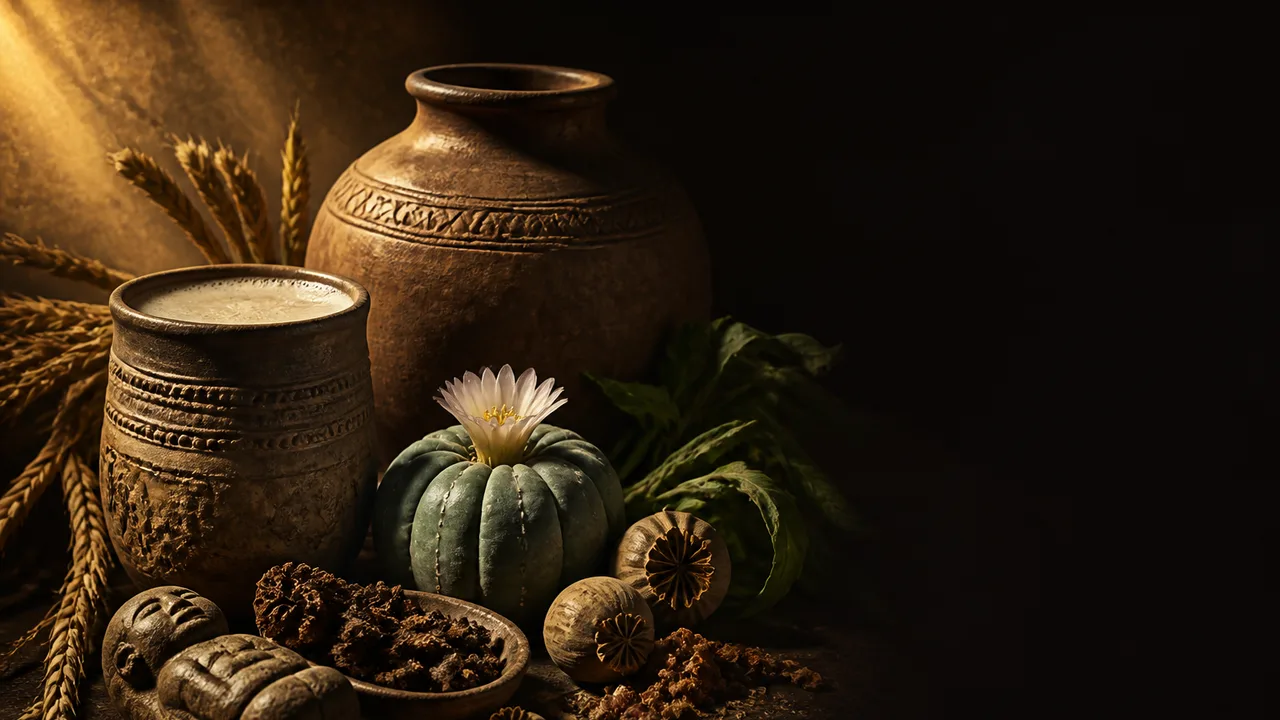
Photo: AI. Liora Goldstein
Start with a pot of cloudy fermented rice and honey, drunk through a straw in a Chinese village nine millennia ago, and ask yourself: what if that was the beginning of everything?
That's the provocation sitting at the center of a recent deep-dive from the YouTube channel Prehistoric Joe, which walks through ten psychoactive substances with confirmed archaeological footprints — and builds a cumulative case that altered states weren't a footnote to early human civilization. They may have been its engine.
It's a thesis that sounds designed to go viral. It also happens to be grounded in real archaeology.
The Beer-Before-Bread Problem
The Jiahu site in China's Yellow River Valley yielded pottery jars whose walls, when chemically analyzed, bore the molecular signatures of a fermented beverage — rice, honey, and hawthorn fruit, brewed together around 7,000 BCE. It is the oldest chemically confirmed alcoholic drink in the human record.
That fact alone reshuffles the standard civilization timeline. But Prehistoric Joe pushes further, into territory that mainstream archaeology has been quietly debating for decades: the "beer before bread" hypothesis.
The conventional story — humans farmed grain, grain produced surplus, surplus built cities — has always had a weakness. Early wild grains were labor-intensive to harvest and process, returning modest calories for enormous effort. Why would mobile hunter-gatherers, living well enough off the land, voluntarily chain themselves to fields of stubborn wheat? The nutritional argument, as the video puts it, "has always been weak."
The alternative hypothesis suggests the first cultivated grains were grown not to feed people but to ferment for them. The desire to brew, to gather around a communal vessel, to share an intoxicating drink in ritual and ceremony may have motivated settlement in ways that hunger alone never could.
Research published in ScienceDirect examining the function of Pre-Pottery Neolithic stone troughs at Göbekli Tepe — the massive ritual complex in what is now Turkey — has found evidence consistent with large-scale grain processing and possible fermentation, lending some empirical weight to this idea, though the findings remain debated among researchers. "The debate is far from settled," the video acknowledges. "Grain served many purposes and beer was surely only one of them. But the mere possibility reframes everything."
That's the honest position. The beer-before-bread hypothesis is not consensus archaeology. It is a live argument with genuine evidentiary support, and it deserves to be taken seriously rather than dismissed as contrarian clickbait.
Sacred Before It Was Anything Else
What runs through every substance the video examines — alcohol, opium, cannabis, betel nut, coca, psilocybin mushrooms, DMT snuff, ephedra, tobacco, peyote — is the same structural observation: these things entered human life as sacred and medicinal tools, not as recreational vices. The vice came later. Usually much later, and usually with colonial or industrial assistance.
Consider tobacco. According to the Association for Nonsmokers in Europe (ANEC), the earliest confirmed archaeological evidence for tobacco use among indigenous North Americans — nicotine residue preserved in pipe walls — dates to roughly 3,000 years ago. That's a relationship with a single plant stretching across three millennia before a corporation ever touched it. The smoke rising from those pipes was not indulgence. It was, across countless indigenous cultures of the Americas, understood as a vehicle — a medium that could carry human intention toward the unseen world. "Prayers were exhaled through it," the video observes. "The rising column of smoke was itself the message."
The same molecule that now underpins one of the most lethal commercial industries in human history began as an instrument of the sacred. Nicotine did not change. What changed was everything humans built around it.
Or consider betel nut, probably the least-known entry on this list to Western audiences. Burial sites across the Philippines and Thailand preserve human remains with teeth stained deep red — the permanent signature of a habit that began at least 4,000 years ago and has never stopped. The mixture of areca palm nut, betel vine leaf, and slaked lime produces a mild stimulant lift: warmth, alertness, a body carried through long labor in tropical heat. A 2026 review in Translational Psychiatry identified betel nut as one of the most widely used psychoactive substances on the planet, with hundreds of millions of regular users across South and Southeast Asia. Most people in the West have never heard of it. That gap in awareness is its own kind of history — whose habits get studied, whose get ignored.
When the Evidence Is in the Body
The video's most arresting section concerns Andean DMT use, and it earns that description because the evidence here doesn't depend on interpretation.
Archaeologists have recovered ornate snuff kits from Andean graves — carved bone tubes, decorated trays — dating back roughly 4,000 years. The powders they contained held DMT and related compounds. But the case doesn't rest on the tools. Researchers tested the bodies themselves: ancient hair from Andean mummies, preserved by the arid cold of high altitude, analyzed for chemical traces. The compounds were there, locked into tissue grown while those people were alive.
"The molecule entered the blood. The blood fed the hair. The hair survived the grave. And thousands of years later, in a laboratory, it confessed."
That's not inference. That's a chemical record of intentional psychedelic use, buried with the tools that made it possible. These were not accidental encounters with a plant. They were engineered experiences, carried into the afterlife as objects of value.
The coca leaf section follows a related logic — the Andes demanded pharmacological adaptation. At 4,000 meters above sea level, the altitude alone is a physiological adversary. Chewing coca leaves with an alkaline catalyst releases stimulant alkaloids that suppress hunger, blunt exhaustion, and ease altitude sickness. This was survival technology. It was also infrastructure: the Inca road system, the terraced fields carved into near-vertical mountainsides, were built by bodies sustained in part by this leaf. That the same plant's concentrated alkaloids would later be synthesized into cocaine represents one of the sharpest ruptures in this entire story. "The plant did not change," the video notes. "We did."
The One That Never Became a Relic
Peyote is where the video ends, and it's the right choice. In the Shumla caves of south Texas, researchers found dried cactus buttons that radiocarbon-dated to roughly 5,700 years old — predating Stonehenge, predating the pyramids, predating writing in most of the world. Chemical analysis confirmed that mescaline, the compound responsible for peyote's profound and long-lasting hallucinogenic effects, was still measurably present in the specimens after nearly six millennia. This is among the oldest direct molecular evidence of psychedelic use in North America.
What makes peyote different from most entries on this list is that the tradition never broke. The practice passed hand to hand across thousands of years, through the collapse of cultures and languages and empires that no longer have names, and it remains central to living ceremonial traditions today. The buttons in those Texas caves are not artifacts of a dead world. They are the earliest surviving record of a practice that is still alive.
That continuity is the thing worth sitting with. We tend to frame prehistoric drug use as primitive — something our ancestors stumbled into before they knew better. The archaeological record makes a different argument. These people were paying attention. The cannabis burned in ritual braziers at the Jirzankal cemetery in the Pamir Mountains around 500 BCE contained unusually high levels of THC — higher than what wild cannabis produces naturally. High THC doesn't happen by accident. It emerges from deliberate selection across generations, from someone who noticed that certain plants hit harder than others and bred toward that strength. "The drive to make the sacred plant stronger," the video argues, "was already present at the roots of civilization."
The Shanidar Cave burial in northern Iraq, where pollen clusters of ephedra — a natural stimulant and decongestant — were found concentrated around a Neanderthal skeleton, introduces the most unresolved question of all. Did a Neanderthal intentionally bury their dead with a medicinal plant? Later researchers proposed that burrowing rodents could have introduced the pollen. The debate remains genuinely open. But the possibility that the impulse to reach for plants that alter the body predates our own species is not one that gets easier to dismiss the more you look at the rest of this evidence.
Somewhere in the distance between a Neanderthal burial and a present-day peyote ceremony, the same instinct runs — reaching past the visible world toward something that might answer back. What we call that instinct has changed many times. The reaching hasn't.
By Sofia Ramirez
More Like This
Ancient Megastructures That Still Puzzle Engineers
From Göbekli Tepe to the Great Pyramid, these ancient sites raise genuine questions about what early human societies were capable of building—and how.

Pandemics That Brought Down Ancient Civilizations
From Cahokia to Constantinople, ancient DNA is rewriting how civilizations fell. Disease was often the hidden accelerant history forgot to record.

Attila the Hun: Scourge of God or Economic Strategist?
Attila never sacked Rome—yet he's history's ultimate barbarian. The real story is stranger, and more familiar, than the legend.
Steve Jobs: Innovation, Ethics, and Tech Culture
Explore how Jobs' leadership at Apple reshaped tech culture and challenged ethical norms.
Do DMT Entities Point to Alien Consciousness?
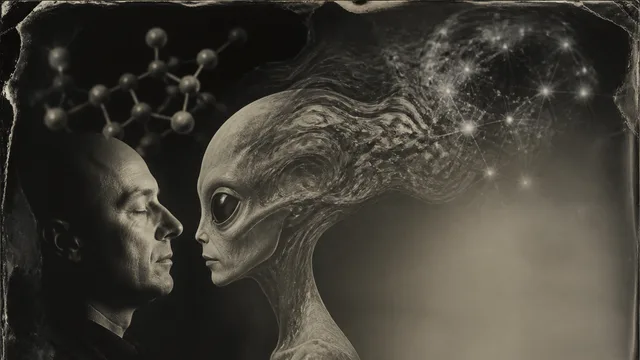
Cognitive scientist Donald Hoffman claims DMT entities may be real alien minds. The math is real. Whether it proves anything about consciousness is a different question.
Colonel John Alexander's Life at the Edge of Official Reality
Colonel John Alexander commanded Green Berets, ran Pentagon psychic programs, and investigated UFOs. His 3-hour Why Files interview maps a career lived at the edge of official reality.
Neil Armstrong: The Reluctant Hero of Apollo 11
Neil Armstrong flew 78 combat missions, survived two near-fatal crashes, and walked on the moon—then spent the rest of his life insisting it was all just luck.
The Bari Disaster: Mustard Gas, Secrecy, and 1943
On December 2, 1943, a German raid on Bari killed over a thousand people—and released mustard gas that officials spent decades trying to erase from history.