385-Million-Year-Old Amber Reshapes Plant Evolution
Amber fragments from the Middle Devonian push back the origin of plant resin production by 65 million years, upending assumptions about early plant defenses.

Written by AI. Priya Sharma
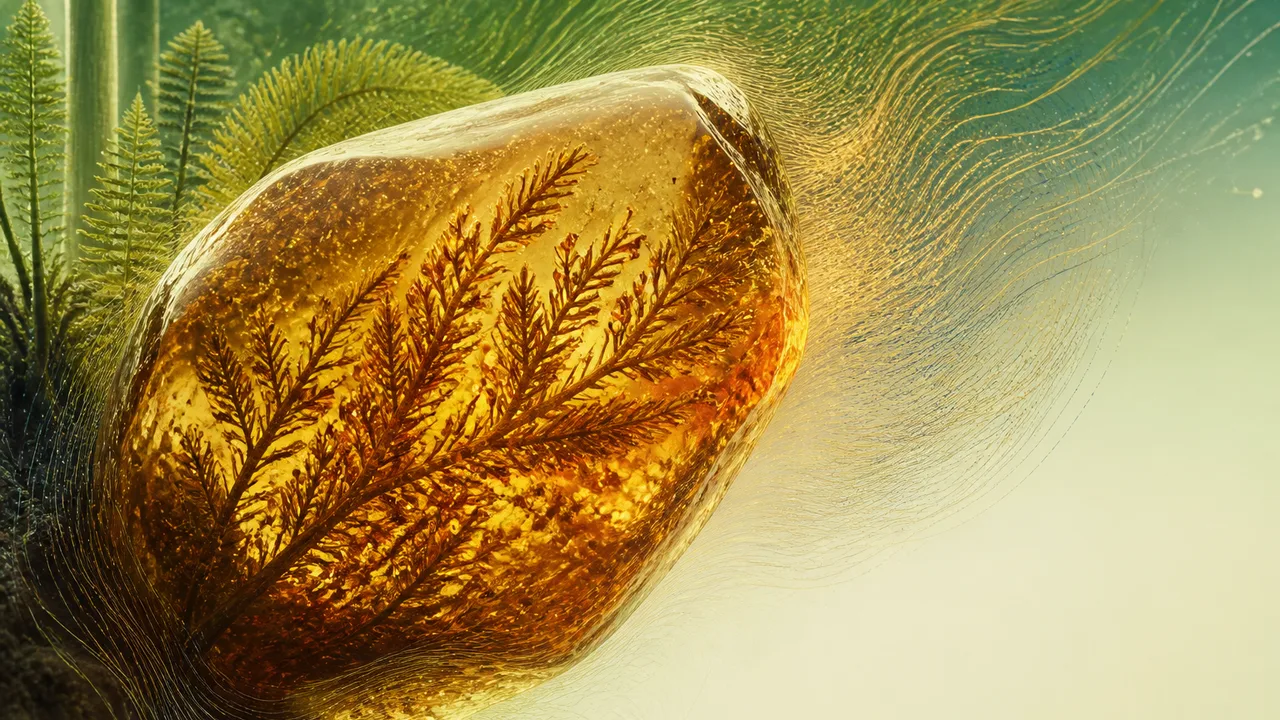
Photo: AI. Dexter Bloomfield
Start with what amber is not. It is not tree sap preserved by geological patience. Sap is mostly water and sugars — the vascular system's cargo, not its armor. Amber is fossilized resin: a chemically distinct, terpene-rich substance produced in specialized cells, secreted specifically when a plant is under attack or physically damaged. The distinction matters because it reframes amber from decorative curiosity to biological evidence — a record of stress, threat, and survival written in plant tissue and then locked in stone.
That reframing becomes considerably more dramatic in light of a recent discovery reported in Science Advances. Researchers working in the Huangjiasite Formation in China identified amber fragments dating to the Middle Devonian, approximately 385 million years ago. As science communicator Anton Petrov describes it in a recent video covering the findings, this pushes "the official record of these somewhat unusual features by at least 65 million years" — placing the origin of resin production well before seed plants existed at all.
That last part deserves emphasis. At 385 million years ago, conifers had not evolved. The resin-producing machinery we associate with pines, redwoods, and spruces — the canonical amber-makers — was still tens of millions of years in the future. What researchers found instead were fragments produced by non-seed vascular plants, early land colonizers whose biology we are only beginning to piece together. The assumption that resin production was a relatively modern innovation, essentially a conifer-era development, no longer holds.
Fragments That Required UV Light to See
The physical modesty of the discovery is worth noting. These were not the amber nodules you see in natural history museum cases. Petrov describes the fragments as "super tiny, with the biggest one being approximately 1.5 mm across." Researchers had to illuminate samples with UV light to find them at all — amber fluoresces blue under ultraviolet, which made the otherwise invisible fragments visible against surrounding rock matrix.
The analytical challenge here is real. Confirming that microscopic, ancient material is genuinely amber — fossilized resin rather than some other organic compound — requires chemical characterization that goes well beyond visual identification. The published research in Science Advances provides that characterization, which is what makes the age claim credible rather than speculative. Small samples and extraordinary claims require correspondingly rigorous methodology, and the peer-reviewed publication is the appropriate venue to evaluate that rigor.
The Wrong Enemy
The intuitive assumption about why plants evolved resin points toward insects. Resin is sticky, toxic, and strongly scented — it traps boring beetles, deters bark-feeding larvae, and signals danger to a range of invertebrates. The Cretaceous amber record, which contains extraordinary numbers of insect inclusions, reinforces this image. But 385 million years ago, herbivorous insects were not yet a significant threat to plants. They had not yet developed the specializations that would later make them formidable plant predators.
So what was the pressure? Petrov's summary of the researchers' interpretation points to two candidates: wildfires and fungi. The Middle Devonian was a period of dramatic terrestrial change — plants were growing taller, developing woody tissue, and forming the first recognizable forests. Atmospheric and volcanic conditions made fire a real hazard. And fungi, which had colonized land earlier and in greater diversity, represented a persistent biological threat to vulnerable plant tissue.
"By evolving resin," Petrov explains, "these early plants very likely found a very easy way to seal up any wound and to heal any physical break. Something that was probably very dangerous to even earlier plants and something that fungi very likely abused all the time."
The fungi hypothesis is consistent with what we know about the Devonian terrestrial ecosystem, where fungal networks were already extensive and parasitic relationships with early plants are well-documented in the fossil record. It also fits the logic of resin as a wound-sealant: its primary function in that scenario is less about repelling predators and more about blocking microbial entry through damaged tissue. The anti-insect properties may have come later, or may be a secondary benefit that evolution subsequently favored more strongly.
This is a hypothesis, not a settled mechanism. The amber fragments themselves do not contain direct evidence of fungal attack or fire damage. The inference is ecological and contextual — reasonable given what we know about the Devonian, but not proven by the discovery alone.
When Resin Production Went Into Overdrive
The Devonian fragments establish a new origin point, but they represent relatively sparse production. The geological record holds a later episode that dwarfs anything before or since in terms of resin output: the Cretaceous resinous interval, a period researchers identify as characterized by a massive global increase in amber production. Most of the world's major amber deposits — those from Myanmar, Spain, and Lebanon — originate from this window.
The conditions were extreme. Atmospheric oxygen levels during this period were substantially higher than today's, and elevated oxygen concentrations correlate with increased fire frequency and intensity. Charcoal is characteristically found in the same sedimentary layers as Cretaceous amber, which Petrov notes is "almost always found in the same deposit" — a geological co-occurrence that supports the wildfire hypothesis for this later surge. By the Cretaceous, herbivorous insects had also become a major ecological force, adding biological pressure on top of fire stress.
The amber that survives from this period is scientifically extraordinary not just for its volume but for what it contains. Unlike compression fossils, which flatten organisms under sedimentary pressure and preserve only two-dimensional outlines, amber entombs its inclusions in three dimensions with chemical stability that can preserve cellular detail. Soft-bodied organisms — insects, spiders, plant material, occasionally vertebrate tissue — survive in amber in a form that compression fossilization simply cannot produce. Behavioral evidence has been recovered from amber inclusions: postures consistent with pollination, proximity patterns suggesting parental care.
Researchers have also extracted gas bubbles trapped within amber to analyze ancient atmospheric composition, providing data points for reconstructing past climate conditions with a precision that other fossil types cannot match. As Petrov puts it, "this is a really important time capsule because in most cases, resin, and specifically amber, is exceptionally good at preserving these samples with extreme detail, and most importantly, in three dimensions."
What the Timeline Now Requires
The deeper implication of the Devonian discovery is about how we model plant evolutionary history. If resin production was already operating 385 million years ago in non-seed plants, it was not a late-stage refinement layered onto an already-complex system. It was part of the foundational toolkit that early vascular plants used to establish themselves on land — to survive fire, resist fungi, seal wounds, and persist long enough to transform terrestrial ecosystems.
The qualification that matters here is phylogenetic. These were not ancestral conifers. They were non-seed vascular plants, a group whose relationship to later resin-producing lineages is not straightforward. Whether resin production evolved once and was inherited across that gap, or evolved independently in seed plants later, is a question the discovery raises more sharply than it answers. That ambiguity is the productive kind — it defines a research program rather than closing one.
What the fragments from the Huangjiasite Formation do establish, with reasonable confidence, is that the biological capacity for resin production is older and more broadly distributed across the plant family tree than the previous record suggested. The assumption that amber is essentially a Cretaceous phenomenon, with a few older outliers, no longer fits the evidence.
385 million years is a long time to be solving the same problem. The question worth sitting with is how many other plant defense mechanisms we're currently dating to the wrong era.
More Like This

How Opponent Recognition Unlocks Cooperation in Evolution
A Rutgers physicist argues that tailoring cooperation to specific opponents—not blanket strategies—may be evolution's simplest path out of the Prisoner's Dilemma trap.
Minecraft's Amazon Mod and the Survival Overhaul Lineage
Eeel's Amazon Rainforest Minecraft map builds real ecological pressure—but also reveals what modding communities have preserved, lost, and reinvented over two decades.
Ancient Dogs Were Already Weird Before Victorians
A 2025 skull study of 600+ canines upends the tidy story that Victorian breeders invented dog diversity. Ancient dogs were already strange—and varied.
What the Dinosaur Asteroid Actually Did to Earth
New research reframes the Chicxulub impact—not just as a mass extinction event, but as a creative force that may have built the Amazon rainforest.
Nuclear Clocks Are Now Real — Here Is What That Means
Two independent teams built working nuclear clocks in 2026. Here's what the thorium-229 breakthrough actually achieved — and what it hasn't yet.
The Bacon Grease That Started a Bigfoot Career
A US Forest Service worker slept in a bacon grease-stained tent in Wyoming and woke up to something that wasn't a bear. What our appetites summon from the dark.
Adam Riess on the Hubble Tension and Cosmic Expansion
Nobel laureate Adam Riess explains why two precise measurements of the universe's expansion rate keep disagreeing—and what that could mean for cosmology.
How Volcanoes Work: Formation, Types, and Real Risk
From shield volcanoes to supervolcanoes, here's what geology actually tells us about how volcanoes form, erupt, and how dangerous they really are.