Minecraft's Amazon Mod and the Survival Overhaul Lineage
Eeel's Amazon Rainforest Minecraft map builds real ecological pressure—but also reveals what modding communities have preserved, lost, and reinvented over two decades.

Written by AI. Sarah O'Brien
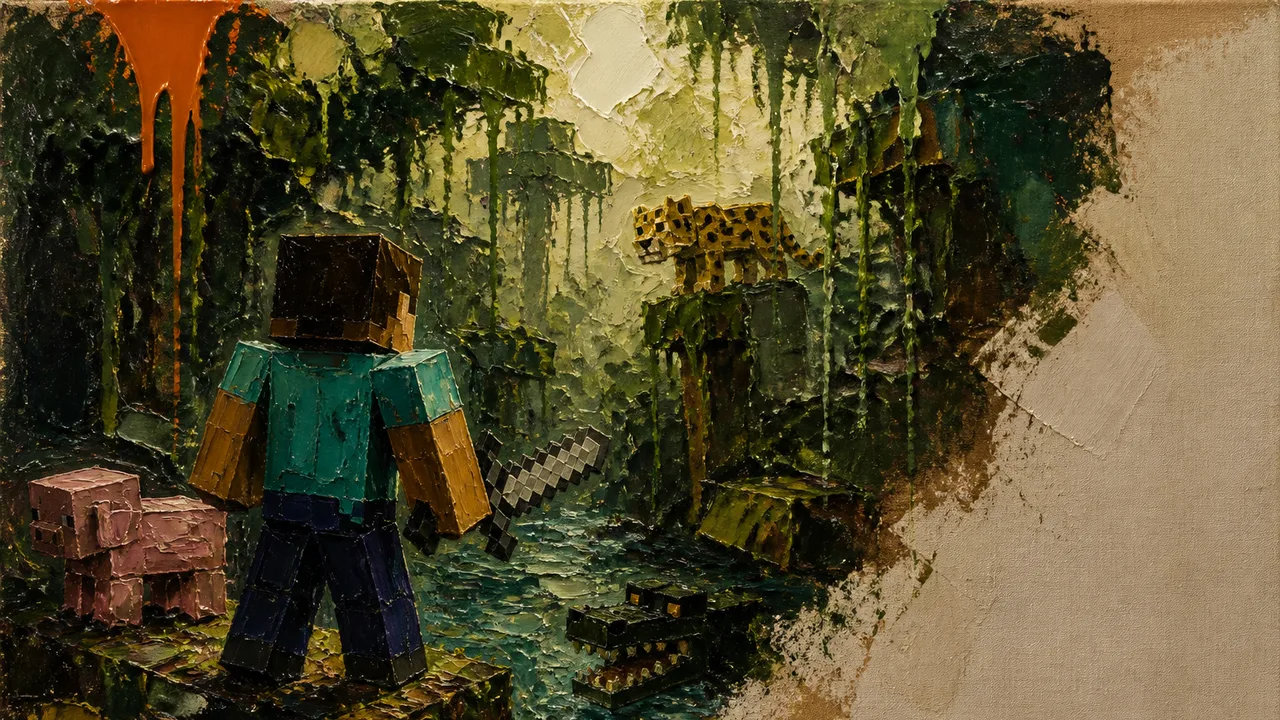
Photo: AI. Saskia Aaltonen
Minecraft launched in 2009, and within about eighteen months the modding community had already decided the base game's survival systems weren't nearly hard enough. I was in my early twenties watching this happen in real time—watching TerrafirmaCraft remake the entire geology system so that stone tools actually required finding the right rock type, watching hardcore survival packs turn a jungle biome from a mild inconvenience into something that could kill you by Tuesday. The base game has matured enormously since then, but it never really closed that gap. The modding community kept building the survival complexity that Mojang kept choosing not to ship.
Which is the context you need to understand what Eeel is doing with their Amazon Rainforest map, and why it lands the way it does.
The video is nearly three hours of Eeel navigating a heavily modded Minecraft environment built around the Amazon basin—dense canopy, a thirst mechanic that makes clean water a genuine priority, and a predator density that turns every ground-level decision into a risk calculation. The mod package is available free via Mediafire, though the full experience requires the map, which Eeel distributes through Patreon. That split matters: the mods without the map aren't the same thing, which tells you something about how much design work went into the map itself beyond just the mod stack.
The first thing that hits you, watching Eeel stumble through the early minutes, is how much work the animal AI is carrying. "Compared to my last two videos, the challenge of surviving in this jungle wasn't the heat or lack of resources, but rather the animals," Eeel says early on—and the next two-plus hours bear that out relentlessly. Jaguars and anacondas don't just occupy the space; they have behavioral states. They sleep. They wake. They track. The anacondas in particular blend into the undergrowth well enough that Eeel is reading their presence from subtitle text rather than visual detection: "I see the anaconda in the subtitles. I'm going to get the stuff and then just get out of here as quick as possible."
That's good design. It's also design with a lineage.
The survival overhaul tradition in Minecraft modding—TerrafirmaCraft, Biomes O' Plenty building out ecological diversity, the whole RLCraft school of punishing the player for not reading the environment—spent years developing exactly this kind of ambient threat. Much of that work is now preserved only in archived forum posts and aging mod repositories, because the communities that built it scattered when the modding ecosystem shifted, when Mojang changed APIs, when creators moved to other platforms or simply stopped maintaining their work. Some of those mods are effectively gone. Eeel's Amazon map is working in that tradition whether or not that lineage is explicitly acknowledged, and it's doing something that tradition always did well: making information itself a resource. The spyglass in this map doesn't just extend render distance—it displays mob threat classifications. "If I look through the spyglass, then it shows information on the mobs at the bottom there. It was also showing whether they were harmful or not." Harmless leaf bugs, cautious lions, dangerous jaguars. You have to earn the knowledge, and until you do, everything is a potential threat.
Here I need to stop and flag something that Eeel doesn't flag: the mod's fauna roster has a significant accuracy problem. Tigers appear early and repeatedly as Amazon predators. Lions show up in the threat-classification system with a "caution" rating. Tigers are native to Asia. Lions are native to Africa and a small pocket of India. Neither animal has ever had a range that includes South America. If the mod is making a genuine claim to represent the Amazon—and the framing of the video suggests it is—then populating it with Asian and African megafauna is an ecological error substantial enough to name. It doesn't ruin the experience, but it's the difference between a survival simulation and a survival fantasy with Amazon branding. The jaguars and anacondas are right. The tigers are not. A mod serious about ecological authenticity has the tools to get this correct; the same wildlife modpack that adds jaguars could add pumas, giant otters, caimans, tapirs. The choice to reach for tigers instead suggests the designer was optimizing for recognizable threat rather than accurate representation.
That tension—between ecological authenticity and engagement optimization—runs through the whole piece. The howler monkeys are a genuinely inventive mechanic: harmless during the day, something else entirely at night. Eeel discovers this the hard way, and the moment reads as genuine surprise rather than performed reaction. The water purification system, requiring sand-smelted glass bottles and campfire purification, creates the kind of multi-step resource chain that the best survival overhauls have always used to make the environment feel like it has rules worth learning. "If I can get sand then I can get glass bottles which I can use to finally fix my water problem. There is also campfires here which I can use to purify the water and that means it won't poison me whenever I drink it." That's TerrafirmaCraft's design philosophy in miniature: every resource has a process, and the process teaches you the world.
The pirate ships on the river are where the map's ambitions and its compromises sit in the same frame. They're well-stocked, structurally detailed, and densely populated with hostile mobs—good encounter design that rewards preparation. They also feel like they belong in a different biome. The pillagers, the skeleton variants, the loot tables heavy with iron and diamonds: this is standard Minecraft dungeon grammar dropped into a space that, at its best, has been running on a different and more interesting logic. The animals make the Amazon feel like a place with its own rules. The pirate ships make it feel like a Minecraft map.
That's not a devastating critique. It's an observation about the difficulty of building coherent world-logic inside a game engine that has its own deeply embedded assumptions about what adventures look like. Every survival overhaul mod has navigated this tension. TerrafirmaCraft solved it by replacing almost everything. Eeel's map works within the existing structure, which means the seams show sometimes.
What's harder to dismiss is that the map is doing something the base game has never managed: making a specific biome feel genuinely dangerous in a way that's rooted in that biome's actual properties rather than generic darkness-spawns-monsters logic. The canopy navigation, the water dependency, the predator behavioral states—these create a spatial grammar that's distinctly Amazonian even when the fauna roster isn't. That's preservation work of a kind, even if no one would call it that. It's keeping alive a design tradition that the official game keeps gesturing toward and never fully committing to.
The modding communities that built TerrafirmaCraft and its successors understood something the base game still hasn't fully reckoned with: that a biome should feel like a system, not a skin. Some of those communities are gone. Some of their work is gone with them. Eeel's map is evidence that the tradition hasn't been entirely lost—just redistributed across individual creators working without institutional support, publishing to Patreon and Mediafire, one Amazon at a time.
The question worth sitting with is whether that's a sustainable model for keeping this kind of design knowledge alive, or whether we're watching the same cycle begin again.
More Like This

The Cherno's Shift: YouTube to Robotics
Exploring The Cherno's career shift from YouTube to CTO at Lucky Robots and the future of Hazel Engine.

Gamers Are Fighting the EU Over Digital Ownership
The Stop Killing Games movement reached 1.25M signatures and an EU hearing. Here's what's actually at stake—and why it's bigger than gaming.

Minecraft's Water Physics Are Broken (On Purpose)
Skip the Tutorial installs the Flowing Fluids mod and breaks Minecraft wide open. Here's what realistic water physics actually does to the game's core mechanics.

Spellbound Weapons: The Minecraft Mod Mojang Wouldn't
Skip the Tutorial tests the Spellbound Weapons data pack's 20 magic weapons against Minecraft's warden. Some are brilliant. Some hit their own user. All are fascinating.

Ancient Amazon Civilizations Revealed by Archaeology
LiDAR mapping and new excavations are overturning the myth of a pristine, empty Amazon—revealing cities, roads, and millions of lost inhabitants.

Minecraft 26.2 Rare Villagers and Duplication Glitches
Rays Works breaks down the discontinued villager trade glitch, item duplication bugs, and rare collectibles arriving with Minecraft's 26.2 update.

WoW GM Cheating Scandal Puts Blizzard Under Scrutiny
A Blizzard game master allegedly death-touched bosses for friends, tainting WoW's competitive record. What this scandal reveals about a 20-year compact between devs and players.

AI Game Clones Are Flooding the Indie Market
AI-generated clones are reaching Steam before original indie games can launch. Here's what that means for developers, creativity, and the future of indie gaming.