Minecraft 26.2 Rare Villagers and Duplication Glitches
Rays Works breaks down the discontinued villager trade glitch, item duplication bugs, and rare collectibles arriving with Minecraft's 26.2 update.

Written by AI. Sarah O'Brien

Photo: AI. Ren Takahashi
There's a particular kind of collector's instinct that Minecraft's technical community has refined into something close to an art form. Not the hoarding of diamonds or the stacking of shulker boxes—something stranger and more specific. The hunt for items that are broken in ways the developers didn't intend and will soon patch out of existence. Errors that, once corrected, become permanent historical artifacts in whatever world was unlucky enough to receive them first.
Rays Works, one of the more methodical voices in Minecraft's technical YouTube scene, spent a recent livestream cataloguing exactly these opportunities ahead of the game's upcoming 26.2 update. The session—equal parts testing lab, content production workflow, and casual community hangout—surfaced several items of genuine interest for players who care about what's obtainable right now versus what will be gone forever once the patch lands.
The Broken Fletcher
The centerpiece of the session is what Ray calls a "discontinued glitched out trade": a master-level Fletcher villager whose tipped arrow trade has its values reversed. Normally, a Fletcher selling tipped arrows presents the deal as emeralds on the left, arrows on the right—you hand over currency, you receive goods. In versions 26.1.1 and 26.1.2, something in the trade generation logic flips this. The emeralds appear on the right side instead of the left.
It sounds trivial. Functionally, for gameplay purposes, it arguably is. But that's not really the point.
"I guess the difference between a rare and a discontinued is a rare is just hard to get, where a discontinued is impossible to get," Ray explains during the stream. That framing is precise in a way that matters to this community. Once 26.2 ships and the bug is fixed, no new villager will ever generate this trade again. Any existing villager carrying it becomes a permanent record of a moment when the game's logic was briefly wrong.
The practical window for obtaining one is specific: load up a world in version 26.1.1 or 26.1.2, work a Fletcher villager up to master level, and you'll have a 66% chance at each of the final two trade slots of landing the reversed trade. Ray spent a noticeable portion of the stream cycling through villagers looking for the glitched version, burning through several that simply didn't have the right configuration. The hunt itself is part of the ritual.
The preservation angle here is also worth sitting with. Ray confirms during the stream that if you collect one of these villagers and then update your world to 26.2, the broken trade persists—it doesn't get corrected retroactively. Your world carries the glitch forward into the fixed version like a fossil in stone. New villagers in the updated world will have the correct trade. Yours won't. That asymmetry is exactly what makes it a collectible rather than just a bug.
The Duplication Layer
Separate from the villager glitch, Ray walks through a suite of item duplication behaviors present in current snapshots—some of which persist into 26.2, some of which are snapshot-only.
The mechanics at work here share a common structure: place an item, the game registers a transaction on one side of a state update without completing the corresponding deduction on the other. The result is that your stack refills. Ray demonstrates this with TNT (place it with a power source, your count resets to 64), wet sponges in the Nether (place them to dry out, pick up the dried sponge, your wet stack is intact), and lava (pour it into a flowing stream to produce obsidian, right-click again and you still have lava to pour).
The golem-and-pumpkin interaction is a slight variation. Build a snow golem, iron golem, or copper golem using a pumpkin as the head-placement trigger, and the pumpkin comes back. You spend the other construction materials; the pumpkin costs you nothing. As Ray notes somewhat drily, you could always recover the pumpkin from a snow golem by shearing it—but this skips that step entirely.
What's notable about Ray's testing methodology is what he also reports not working. He tried sulfur, sniffer eggs, pistons, water-lava combinations in the other direction, concrete (which converts instantly but apparently through a different mechanism), and Wither skulls. None of them triggered the same behavior. "It has to be flowing water for it to work," he concludes about one variant, without being entirely certain why the others fail. The boundaries of the glitch are still somewhat fuzzy, which is honestly where things get interesting—the conditions that make these duplication behaviors possible aren't fully mapped yet.
The TNT and sponge duplication behaviors are present in the snapshot but Ray is careful to flag that some of these tricks require specifically being in 26.2 snapshot number three. "The downside to this trick here is that it only works in a snapshot. So if you want to do it, you have to update your world to 26.2 snapshot number three. And then after being in the snapshot, you can then eventually update your world to the full release of 26.2." That path—snapshot to full release—is navigable, but it requires deliberate version management that casual players may not think to do in time.
The Release Calendar Question
Running underneath the technical content is a more speculative thread: when does 26.2 actually ship, and how much time do players have to act on any of this?
Ray and a collaborator named Crafty spend some time mapping out the probable timeline. Minecraft Live is scheduled for around May 30th. As of the stream date (May 22nd), no pre-releases for 26.2 had dropped yet—let alone release candidates. That absence is significant. Historically, a full release cycle tends to involve several pre-releases followed by a handful of release candidates. Compressing all of that into the two weeks between Minecraft Live and a hypothetical early-June release would be unusually fast.
"I don't think they're going to put out the new update the Tuesday after the Minecraft Live, the 2nd of June," Ray says. "We haven't got any pre-releases, let alone release candidates. So it's unlikely for them to put it out so early." Crafty's estimate lands the official release around June 9th, with some possibility of a June 16th date consistent with how the previous couple of years played out.
That calendar question isn't just logistical for Ray as a content creator—it directly affects how much runway players have to collect the Fletcher glitch, run the duplication tricks, and generally engage with these version-specific mechanics before they're gone. A June 9th release means a narrow window. A June 16th release means a bit more breathing room. Neither is a long time.
What This Reveals About Technical Minecraft
There's something worth pausing on in how this community relates to game updates. For most players, a patch that fixes a bug is unambiguously good news. For technical Minecraft players and collectors, it's a closing door—an opportunity that's about to stop existing. The question of whether to fix a bug faster or slower has preservation implications that the developers presumably don't factor into their patching cadence, but that this community has to navigate constantly.
Ray's work here is, at its core, documentation. He's cataloguing what exists in a specific version window, testing the boundaries of what's reproducible, and creating a record that players can act on before the window closes. That's not nostalgia. That's archival practice applied to a living game.
The broken Fletcher villager will still exist in someone's world after 26.2 drops. The emeralds will still be on the wrong side. And in some future version, when that trade configuration is genuinely impossible to obtain by any means, that world will contain something the game no longer knows how to make.
Whether that matters to you probably depends on whether you think a game's history is worth keeping.
More Like This
The Cherno's Shift: YouTube to Robotics
Exploring The Cherno's career shift from YouTube to CTO at Lucky Robots and the future of Hazel Engine.
Diablo IV: Lord of Hatred Expansion Review
Explore Diablo IV's Lord of Hatred expansion. New classes, zones, and a thrilling campaign await.

Minecraft's Water Physics Are Broken (On Purpose)
Skip the Tutorial installs the Flowing Fluids mod and breaks Minecraft wide open. Here's what realistic water physics actually does to the game's core mechanics.
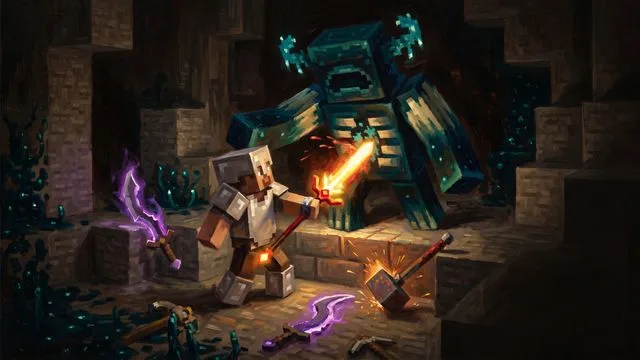
Spellbound Weapons: The Minecraft Mod Mojang Wouldn't
Skip the Tutorial tests the Spellbound Weapons data pack's 20 magic weapons against Minecraft's warden. Some are brilliant. Some hit their own user. All are fascinating.

Esports World Cup Moves from Riyadh to Paris
The Esports World Cup is moving to Paris eight weeks out. For the players and orgs who'd already arranged Riyadh travel, the real story starts now.
Age of Empires' 25-Year Pathfinding Bug Had a Wild Cause
How a compiler flag change accidentally broke Age of Empires pathfinding for years—and why the community was right all along about the units walking through walls.

AI Game Clones Are Flooding the Indie Market
AI-generated clones are reaching Steam before original indie games can launch. Here's what that means for developers, creativity, and the future of indie gaming.
ESO's Leadership Purge Is a Preservation Crisis
Xbox layoffs gutted ZeniMax Online's leadership after 200+ cuts. For ESO's 11-year history, the real loss may be institutional knowledge no one wrote down.