What Minecraft 26.2 Removes and What You Can Keep
Minecraft 26.2 nerfs duplication glitches, fixes broken villager trades, and closes mob exploits. Here's what changes and what carries over.

Written by AI. Sarah O'Brien
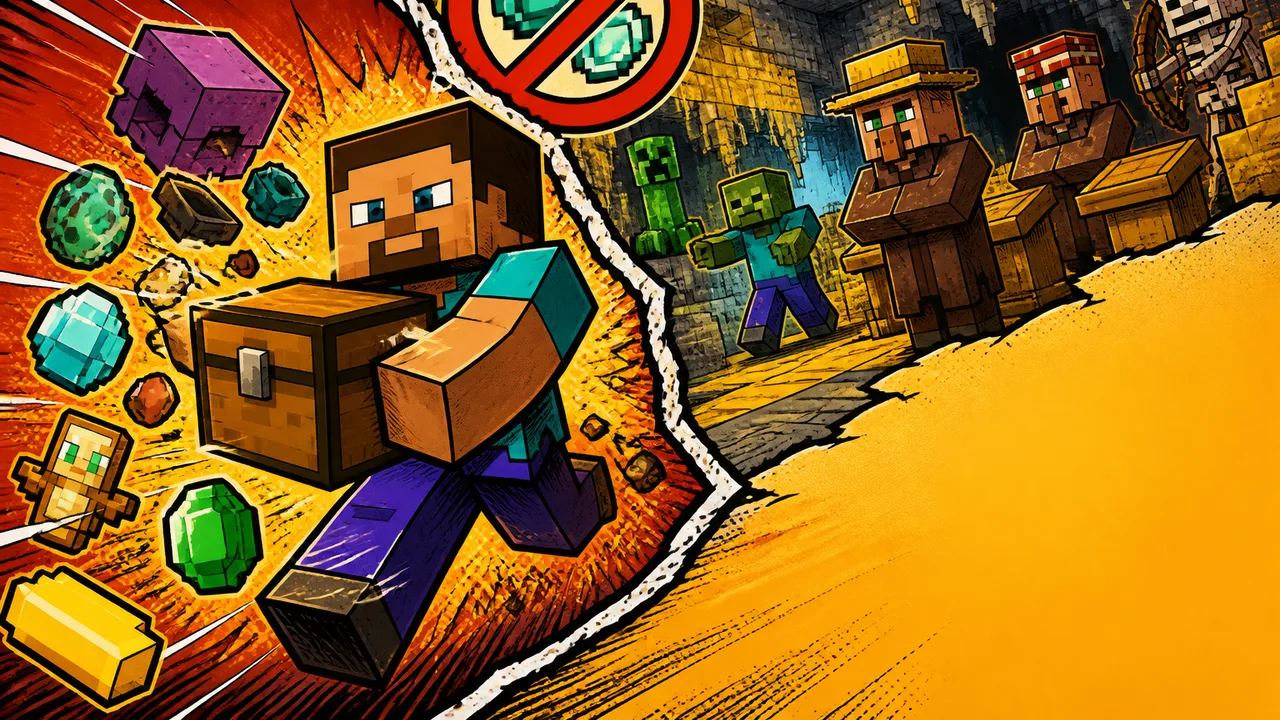
Photo: AI. Marco Velez
Mojang giveth and Mojang taketh away. That's always been the implicit contract of playing Minecraft on the cutting edge — every update brings new content and quietly euthanizes some of the stranger things players had learned to exploit. With 26.2 approaching for Java Edition, the archaeology of what's being patched out is worth doing carefully, because some of these aren't just glitches. A few are the kind of emergent game states that players have built entire collection practices around.
Rays Works, a content creator who has spent the better part of 17 years cataloguing Minecraft's rarest obtainables, dropped a detailed breakdown of what's changing. It's a useful document — part collector's checklist, part patch notes decryption — and it surfaces some genuine tensions in how Minecraft's development treats player-discovered mechanics.
The Duplication Question
The most mechanically interesting item on the list is what Rays Works calls the "infinite TNT dupe." In the current snapshot, placing TNT adjacent to a power source triggers a stack-refresh behavior: the game appears to consume a TNT block, but the inventory stack updates back to its previous count. The detonated blocks are real — they're not ghost blocks — but the source stack never actually depletes.
The same inventory-refresh behavior extends to sponges placed in the Nether (where the biome's heat auto-dries them), to pumpkins used in golem construction, and to lava placed into flowing water. "You can make like infinite obsidian by using this trick here," Rays Works notes, "which is a pretty crazy obsidian farm." The mechanism appears to be a shared bug in how the game handles item consumption when a block immediately transforms or transfers state upon placement.
Worth noting: this specific exploit only functions in snapshot three of 26.2, not in prior versions. To access it, players need to load their world in that snapshot before the full release locks it out. That's a narrow window, and it's a meaningful distinction — Mojang closed the loop between snapshot and release more tightly than players might expect.
The deeper question these duplication behaviors raise isn't really about balance. It's about what duplication means in Minecraft's economy. Sponges, TNT, and lava all have legitimate supply chains in vanilla survival. The dupe bypasses those chains. Mojang's decision to patch it is defensible — and the fact that it's only accessible via a pre-release snapshot keeps it off most survival servers anyway. But it's the kind of thing that players who do have it will carry forward permanently into their worlds, creating a small permanent divergence between their game state and the intended design.
Discontinued Trades and the Villager Archivist
The broken fletcher villager trade is a cleaner preservation case. In versions 26.1.1 and 26.1.2, master-level fletcher villagers have a 66% chance of generating with their tipped arrow trades displaying the emerald on the right side of the trade interface rather than the left — an inversion of the intended UI layout. Rays Works describes it plainly: "Normally, it's supposed to always have the emerald on the left-hand side, but this broken version of it has the emerald on the right-hand side."
Once 26.2 releases, new villagers will have corrected trade displays. But villagers already trained with the broken trade retain it permanently. They become walking discontinuities — mobs that carry evidence of a brief developmental error. For players interested in Minecraft's collector culture, this is exactly the kind of thing that has long-term value, not monetary value, but the kind that comes from having something that can no longer be created.
This is a pattern Minecraft has repeated across its history: patched behaviors leave fossils in existing worlds. The broken trade is unusual only in how clearly the visual indicator distinguishes it from a corrected one.
The Jungle Villager Zombie Bug and What It Means for Rare Mobs
The rarest mob in the game, by Rays Works' accounting, is a jungle zombie villager chicken jockey with the full set of rare properties stacked. Getting one has historically required finding an abandoned village that generated partially inside a jungle biome — a circumstance that determines the zombie villager's texture and enables the jungle variation to spawn as a chicken jockey.
In versions 26.1.1 and 26.1.2, a biome-conversion bug makes this dramatically more achievable. Any zombie villager, regardless of its original biome texture, can be relocated to a jungle biome and cured there. The cure process — weakness potion plus golden apple — converts the zombie into a regular villager, but the game now uses the destination biome (the jungle) rather than the source biome to determine the villager's appearance. The zombie walks in looking like a snowy plains villager and walks out looking like a jungle one.
"Rather than having to start with a rare jungle variation of the villager zombie," Rays Works explains, "you can just start with any biome of a villager zombie and then move it into a jungle biome." This makes the collection pipeline significantly shorter, but the window closes with 26.2.
There's something worth sitting with here: a bug that makes a rare thing easier to get is still being patched. Mojang's position, implicitly, is that the difficulty of the original route was intentional — that the scarcity of jungle villager zombies is a feature. Whether players agree is a separate conversation.
Sulfur Cubes, New Biomes, and What 26.2 Actually Adds
Not everything in Rays Works' breakdown is about loss. The update introduces sulfur caves as a proper biome with its own blocks (cinnabar, sulfur, sulfur spikes), its own mob (the sulfur cube), and its own music disc — "Balance" by Fingers Pit, which Rays Works describes as "very calming."
The sulfur cube itself has some interesting properties. Baby sulfur cubes can be farmed by exploiting their growth behavior: placed on slabs under low ceilings, they clip into the block above each time they jump, which deals gradual damage. When they die, they split into two baby cubes, which grow and repeat the cycle. It's a self-sustaining farm that works entirely within the expected behavior of the mob, making it meaningfully different from the duplication bugs above — this one stays in 26.2 full release.
Cinnabar, however, is non-renewable. It only generates in the sulfur caves biome and can't be farmed, crafted, or duplicated. For players who care about having complete block collections, that biome needs to be found and mined deliberately.
The biome generation itself has specific rules worth knowing: sulfur caves appear near other cave biomes and under mountains or plateaus, can generate under oceans, but never generate under rivers. Surface geyser structures serve as the above-ground indicator. For players who haven't yet explored new chunks, waiting until after 26.2 to do so is the only way to guarantee the biome generates at all.
The music disc situation is particularly interesting. Chest minecarts in mineshafts have a 42% chance of containing the disc — but only if the mineshaft intersects a sulfur caves biome. The same chest outside that biome has a 0% chance. Rays Works demonstrates relocating a chest minecart to an intersecting biome via rail before opening it, which works because the loot table check happens at opening, not at generation.
The Farms That Broke and the Ones That Got Fixed
26.2 also patches out the armor-on-mobs exploit for sulfur cubes (only accessible in the snapshot, not the full release), while simultaneously fixing two broken farms: an AFK fish farm that relied on a sculk sensor failing to detect bobber sounds in 26.1 builds, and a dry grass farm that stopped producing new growth when harvested.
"In all the 26.1 versions, there was a problem where the sculk sensor would not actually hear when the bobber gets pulled down," Rays Works notes. That's the inverse of the usual narrative — a bug that was actively hurting players rather than helping them, now corrected.
It's a useful reminder that patch notes aren't purely about Mojang reining in unintended player advantages. Some of what 26.2 does is simply making the game work as documented.
The interesting thing about Minecraft updates at this point in the game's life is that the community knows the terrain well enough to map exactly what's being added, removed, and broken in each version — sometimes before Mojang publishes formal notes. Rays Works has been doing this work for over a decade and a half. The catalog he's building, version by version, is itself a kind of preservation record: what was possible when, and for how long.
Whether any of the above constitutes things worth preserving before they're gone depends entirely on what you're playing for.
Sarah O'Brien covers retro gaming and preservation for Buzzrag.
More Like This
Monopolizing the End: A Minecraft Masterplan
Explore the ambitious quest to control the End in Minecraft's Lifesteal SMP. A tale of teamwork, strategy, and game mechanics mastery.
Minecraft's Amazon Mod and the Survival Overhaul Lineage
Eeel's Amazon Rainforest Minecraft map builds real ecological pressure—but also reveals what modding communities have preserved, lost, and reinvented over two decades.

Minecraft 26.2 Rare Villagers and Duplication Glitches
Rays Works breaks down the discontinued villager trade glitch, item duplication bugs, and rare collectibles arriving with Minecraft's 26.2 update.

Markiplier's Subnautica 2 Shows Why Survival Games Hook Us
Markiplier's Subnautica 2 Part 5 is a masterclass in survival game pacing — lost footage, the Tadpole sub, and lore that's genuinely unsettling.
Minecraft Live 2026: New Biome, Wool Stairs & What's Next
Minecraft Live revealed the Dappled Forest biome, wool stairs, abandoned camps, and more for the Fall 2026 drop. Here's what it means for builders and creators.
Minecraft 26.1 Snapshot: Game Rules Revamped
Explore new game rule features, time manipulation, and mob changes in Minecraft's latest 26.1 snapshot update.

WoW Midnight's Economy and the Memory Stored in Icons
A WoW streamer's gold-making stream revealed something unexpected: twenty years of item iconography living as folk knowledge inside a player community.
Do You Need a Game Design Document? A History Weighs In
Imphenzia says a one-page GDD is all you need. The history of game documentation—and what gets lost without it—says the stakes are higher than that.