Minecraft Live 2026: New Biome, Wool Stairs & What's Next
Minecraft Live revealed the Dappled Forest biome, wool stairs, abandoned camps, and more for the Fall 2026 drop. Here's what it means for builders and creators.

Written by AI. Lily Tsai
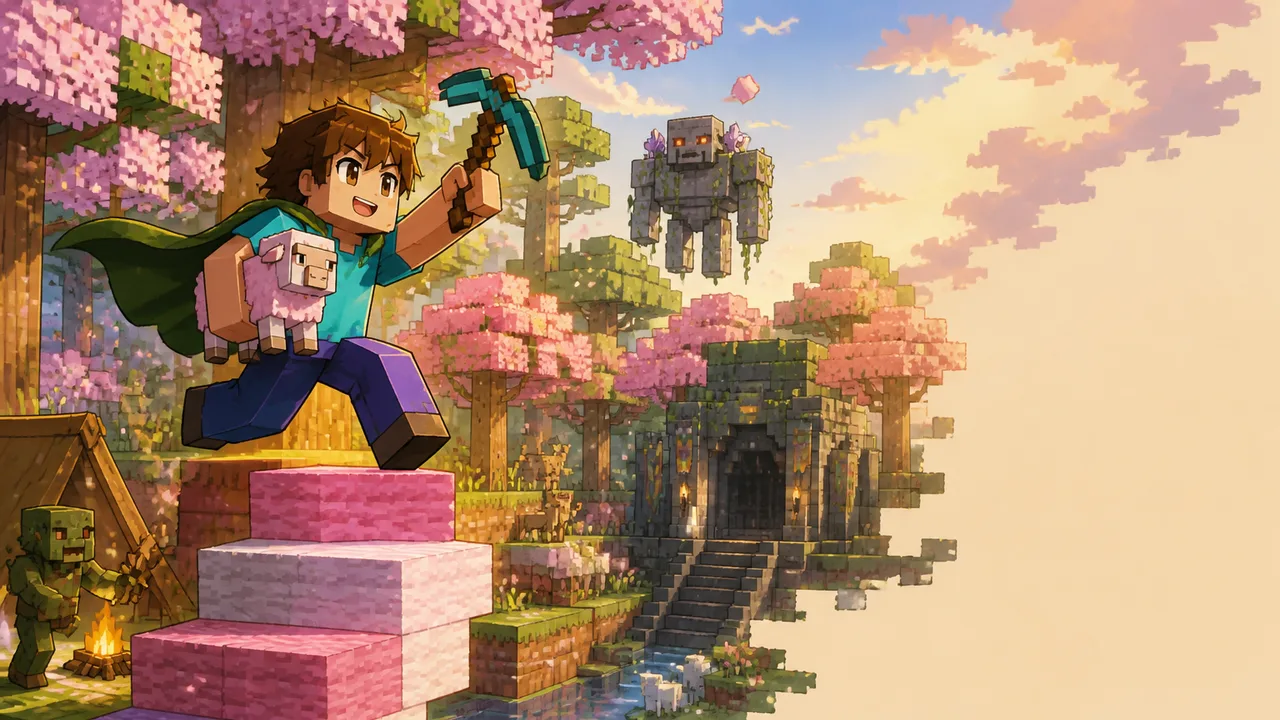
Photo: AI. Mei Fujimoto
Mojang's Minecraft Live event wrapped recently, and the community is doing what it always does: parsing screenshots, debating priorities, and immediately asking for glass stairs. Content creator Ray of Rays Works posted a rapid breakdown of the announcements within hours, and it's a useful entry point — not because Ray tells you what to think, but because he's been close enough to the building community long enough to instinctively flag what actually matters to people who make things in the game, not just play it.
That distinction is where I want to spend most of this piece. Because Mojang's announcements read differently depending on which Minecraft you live in.
The Dappled Forest, and the Palette Problem It Solves
The headline biome for the Fall 2026 drop is the Dappled Forest — poplar trees with red, orange, and yellow leaves, rust-toned grass, red shrubs that retain their color when moved to other biomes, shelf mushrooms on fallen logs, and a new wood type with a darker gray-brown tone. According to Ray, the doors and trapdoors are "vertical looking with these little peek holes which are based off of Swedish doors in real life."
It's a warm, autumnal aesthetic, and the instinct in a lot of coverage will be to say it fills a gap that's always existed in Minecraft's biome map. That framing deserves a little scrutiny. Birch forests already carry a muted, light-toned palette; the existing forests do cycle through some color variation depending on biome temperature. The Dappled Forest isn't technically the first place in the game with fall-adjacent color. But the depth of that palette — rust grass, colored shrubs, distinctly gray-brown wood — is new in a way that matters practically.
Here's who that matters most to: adventure map makers and server operators who've been trying to build north-European or boreal-inspired environments and kept running into the same block problem. Warm tones in Minecraft have historically required either terracotta (which reads as arid and Southwestern) or the Nether palette (which reads as hellscape). If you wanted a cozy autumn village for a story-driven map, you were doing a lot of creative work with very few tools. The Dappled Forest's rust grass and red shrubs are the kind of ambient material that makes a built scene read correctly without requiring the player to manually replace every dirt block.
The poplar wood being darker than pale oak also expands the actual contrast range available to builders. That matters more than it sounds — differentiated wood tones are how community builders create depth and material variation in structures. More wood types with genuinely distinct colors means more legible architecture.
Abandoned Camps, and What Lore Actually Does for Creators
The other major structural addition is abandoned camps: scattered overworld structures containing chests, barrels, campfires, a worn path, and a central tent. Ray notes the obvious question they raise — "What exactly lived in these camps and how long ago was that? Are these the villagers? Are they the Illagers? We just don't know." (The transcript renders this as "illers," which is a transcription artifact — Ray means Illagers, Minecraft's hostile humanoid faction.)
The unanswered lore question is the point, and I think it's the most underrated thing about this feature for a specific kind of creator. Minecraft's environmental storytelling has always worked best when it's suggestive rather than explicit — abandoned mineshafts, strongholds, ancient cities. What these spaces do for adventure map creators and server operators is give them scaffolding to build narrative around. A pre-existing abandoned camp is not just a visual asset; it's a story beat that the game hands you for free, one that a map designer can anchor a quest around or a server lore team can canonize however they want.
The fact that these camps use wool stairs as their primary building material makes them more useful, not less. Wool stairs are a new block type — and their introduction via a lore structure means community builders will immediately see them in context before they start experimenting. That's actually good design pedagogy.
Wool Stairs: The Smallest Feature With the Largest Ceiling
Ray puts it plainly: "Because there's 16 different colors, it'll be a lot easier to make rounded looking objects inside of Minecraft out of any color, not just wood colors."
That's the right read, and it understates the case. Stair blocks in Minecraft are one of the primary tools for implying curves in a fundamentally rectilinear engine. The stair-and-slab combination is how builders fake arches, rooflines, organic shapes, terrain — basically anything that isn't a box. Before this update, that technique was available in stone, wood, and a handful of other materials, all of which carry specific visual connotations. Wood stairs read as wood. Stone stairs read as stone. Wool stairs read as fabric, which is a completely different material language.
What this unlocks for smaller-scale creators — people running single-author adventure maps, small build teams, solo server projects — is the ability to make tents, awnings, banners, draped cloth, soft furnishings, rounded organic structures, and decorative color-blocking without compromising on the material story they're telling. It's the kind of feature that looks modest in a patch notes list and turns out to quietly change a huge amount of what's possible in community builds.
Ray's instinct to immediately ask for glass stairs and slabs next is correct and I fully support this petition.
Dungeons 2 and the Twisted Warden
Minecraft Dungeons 2 got meaningful stage time at the event. Ray described concept art for new biomes and confirmed the Skull Dimension as a major focus — a new environment accessible potentially through portals in ancient cities, which would create a nice through-line with vanilla Minecraft's existing deep lore. The new boss for this dimension is the Twisted Warden, which Ray describes as having "a mouth in its stomach with a little head on top of it."
I'll be honest: without more than concept art and a creature description, there's not much to interpret yet. The Twisted Warden's design philosophy — taking an existing beloved hostile mob and distorting it into something nightmarish — is a clear signal about Dungeons 2's tonal register. The original Dungeons leaned toward accessible, family-friendly action-RPG. If the sequel is willing to go full body-horror on its boss roster, that suggests an appetite for darker territory. Whether that translates into mechanical depth or just visual edge is the question snapshots will answer.
The Multi-Generational Bet, and the Cross-Play Gap
Mojang used part of the event to articulate something like a mission statement: Minecraft as a multi-generational game, with updates designed to feel "Minecrafty" rather than modded. Ray notes that cross-platform multiplayer — a feature that has been conspicuously absent — didn't make the Fall 2026 drop but is flagged as a priority for a future update.
These two things exist in some tension. Mojang's stated goal of keeping Minecraft legible and consistent across generations runs directly into the reality that its playerbase has stratified significantly. Bedrock players, Java players, server community members, casual players, technical players, adventure map creators, speedrunners — these aren't the same community with the same needs, and cross-play is one of the few features that could actually pull them toward the same table. Punting it again is a choice that will land differently depending on which community you're in.
The version numbers Ray cites — Java 26.3 and Bedrock 26.40 — come from his breakdown of the announcements rather than from independently verifiable Mojang documentation, so treat those with appropriate caution until official patch notes confirm them.
The Movie, the Competition, and the Cape
A Minecraft Movie released in April 2025 and performed strongly at the box office. The sequel, announced at the event as Minecraft Movie Squared, introduces Alex as a central character — Ray notes that Alex appeared at the end of the first film, though this is his read of the film's closing, not a detail sourced from official sequel materials. Given that Steve and Alex are the two default player characters in vanilla Minecraft, her expanded role makes structural sense.
The community building competition — where submissions could appear in the actual film and earn creators a credit — is interesting specifically because of what it signals about Mojang's relationship with the builder community. Credits in a major film release are not nothing. They're a form of acknowledgment that the people making things in your game are part of what makes the IP valuable. Whether that acknowledgment translates into anything more durable is a separate question.
The Builder Cape, available through Twitch and TikTok watch rewards until June 14th, has reportedly hit some redemption glitches on the Twitch side. If you're going for it, TikTok may be the safer route — and Ray notes you need to actively click the TikTok icon during the stream to trigger the countdown.
When snapshots drop later this summer, I'll be watching wool stairs first. Not because they're the biggest feature — they're not — but because block addition is where you see the gap between what Mojang imagined a feature doing and what the community actually does with it. The builder community has a long track record of finding uses that weren't in the design brief. New stairs in 16 colors, in a material that can convincingly read as cloth, going into the hands of people who build adventure maps and narrative environments with limited teams and no budget? That's the part of this update I don't think Mojang has fully anticipated yet.
More Like This
Minecraft's Water Physics Are Broken (On Purpose)
Skip the Tutorial installs the Flowing Fluids mod and breaks Minecraft wide open. Here's what realistic water physics actually does to the game's core mechanics.
Minecraft 26.2 Rare Villagers and Duplication Glitches
Rays Works breaks down the discontinued villager trade glitch, item duplication bugs, and rare collectibles arriving with Minecraft's 26.2 update.
Minecraft Java Multiplayer in 2026: Who Pays the Price?
Mojang's new native Friends List threatens the small-studio ecosystem built around Java's multiplayer gap. Here's what that means for how you play.
Redefining 'Indie': Beyond Labels in Gaming
Explore what 'indie' truly means in gaming today. Is it a genre, a spirit, or something else entirely?
Exploring Minecraft Capes and Player Engagement
A deep dive into Minecraft capes, their history, and how they shape player engagement and community culture.
Minecraft 26.1 Snapshot: Game Rules Revamped
Explore new game rule features, time manipulation, and mob changes in Minecraft's latest 26.1 snapshot update.

Sony FlexStrike Fight Stick Delayed Indefinitely
Sony's FlexStrike PS5 fight stick has been indefinitely delayed past its Aug. 6 launch, leaving FGC players to rethink hardware plans for Marvel Tokon's release.
Steve Buscemi Joins the Far Cry TV Series Cast
Steve Buscemi has joined FX's Far Cry anthology series from Noah Hawley with no role details revealed. Here's what the casting signals—and what it leaves unasked.