Minecraft Java Multiplayer in 2026: Who Pays the Price?
Mojang's new native Friends List threatens the small-studio ecosystem built around Java's multiplayer gap. Here's what that means for how you play.

Written by AI. Lily Tsai
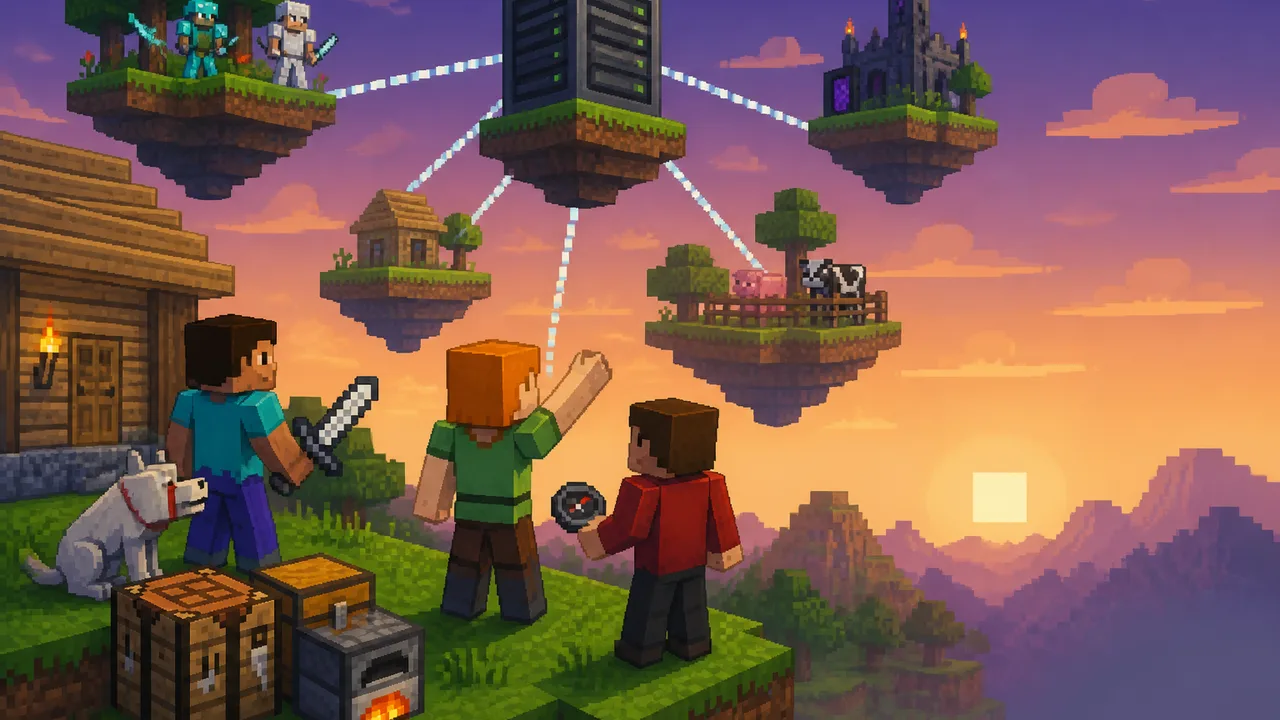
Photo: AI. Cosmo Vega
There's a whole quiet economy that exists because Mojang was slow.
For years, Java Edition had no native way to play with friends outside your local network unless you either ran your own server or joined someone else's public one. That gap didn't just sit empty — it got filled. Server list aggregators like minecraftservers.org grew into substantial community hubs. Tools like Essential Mod built social layers — friend systems, cosmetics, direct world-joining — right into the client. Hosting providers scaled entire businesses around the assumption that Mojang would never close this gap natively. Mod developers built careers on it.
Then Mojang started closing it.
A recent Shulkercraft video walks through every current option for playing Minecraft Java with friends in 2026, and it's a useful map of the landscape. But the most quietly significant item on that map is something Shulkercraft frames as a convenience feature: a native Friends List, reportedly introduced in a snapshot labeled 26.2. I want to flag that I haven't been able to independently verify this feature against Mojang's official patch notes or snapshot changelogs — the 26.2 designation comes from the video itself, and as Shulkercraft notes, "this feature isn't officially out yet, it's in the 26.2 snapshot." Treat it as a preview of where things are heading, not necessarily where they are right now.
But the direction is clear enough to ask the question: what happens to everything that filled the gap, once the gap closes?
The Ladder, Rung by Rung
Shulkercraft structures their guide as a progression from zero-friction to full-control, and it's a genuinely honest framework. At the bottom: public servers. Type an IP, you're in. The tradeoff is total loss of control — server owner can shut it down, you're playing with strangers, and finding unbuilt land often means a very long walk from spawn. These are the servers that gave us the massive community game modes — Bedwars, Skyblock, Prison — but they're not where you build something with your specific friends over time.
LAN play sits one rung up: built-in, zero setup, zero cost. The hard wall is that everyone has to be on the same physical network. It's genuinely the right tool for a household or a LAN party, and it gets slept on. But it doesn't solve the problem most people actually have in 2026, which is that their friends live in different cities.
The native Friends List (once it ships stably) addresses that directly. The setup Shulkercraft describes is elegant: add a friend by username, open a singleplayer world, flip it to multiplayer-online, accept their join request. Done. It's free, it requires nothing from the host except an internet connection, and it works across geographic distances. The limits are real — your world goes offline the moment you log out, performance is entirely dependent on your hardware, there are no backups, and there's no plugin support — but for a casual shared world between two or three friends, those limits might genuinely not matter.
This is where I think the conversation gets interesting.
The Friends List Is a Threat, Not Just a Feature
Tools like Essential Mod didn't spring up because developers were bored. They exist specifically because Java Edition had no native friend system, no easy world-sharing, no social layer. Essential filled that void and built a small but real business around it — cosmetics, a client-side mod framework, a friend-list UI that felt native even though it wasn't. Other mods built proximity voice chat, party systems, shared map tools, all because the base game left so much infrastructure on the table.
Mojang building a native Friends List doesn't kill Essential Mod overnight. But it does change the pitch. "We make playing with friends possible" becomes "we make playing with friends better than the default" — and that's a harder sell, especially to new players who'll never know the game without the feature. The mods that built ecosystems around Mojang's gaps are now competing with Mojang's defaults, and that's a structural shift worth watching.
Server list sites face a different version of the same pressure. They exist partly because Java Edition multiplayer required knowing where to look. A native social layer — if it expands to include server discovery, which feels like an obvious next step — starts to route that traffic through Mojang instead of through community-built infrastructure. Whether that's good or bad depends on who you ask, but the community builders who spent years constructing that infrastructure deserve to have the question asked.
Self-Hosting: Real Power, Real Risk
For the players who need more than a temporary shared world — persistent servers, mods, plugins, full administrative control — self-hosting is still the most powerful free option. Shulkercraft covers it honestly: you run a server from your own PC, it's fully customizable, and the cost is zero in money and high in everything else. Your machine has to stay on whenever friends want to play. Port forwarding is required for anyone outside your home network, and as Shulkercraft notes plainly, that "can expose you to security risks if you don't know what you're doing." DDoS exposure is real, and for players running community servers with strangers, it's not a theoretical risk.
The RAM guidance Shulkercraft gives — 4 to 6 GB for most friend groups — is reasonable as a vanilla starting point, but worth contextualizing. A plain vanilla server with four players runs fine on 4 GB. Add a dense modpack, bump the player count, or run something like RLCraft, and that number climbs fast. "Most friend groups" doing vanilla or light modding: 4–6 GB tracks. "Most friend groups" running a full Forge modpack: plan higher.
The Paid Hosting Conflict
Here's where I have to be direct about something the video doesn't fully surface: Shulkercraft is not a neutral guide here. The channel built and owns WiseHosting, the paid hosting service they recommend. That's disclosed — Shulkercraft says outright, "since I made this site" — but it's buried in a video structured as an objective comparison, and the recommendation of WiseHosting as "the best way to play Minecraft with your friends" lands differently once you know the channel has a financial stake in that conclusion.
That's not a disqualifying conflict. Shulkercraft explains the reasoning: years of running a long-term survival world (their description translates roughly as a world they've maintained for thousands of in-game days across six years of content) burned through multiple hosting providers until they built their own. That's a legitimate origin story. But readers should weigh the recommendation knowing it comes from the product owner, not a disinterested reviewer.
On pricing: Shulkercraft cites $9–$25/month as the range for WiseHosting plans at time of filming. Hosting prices shift, and any specific number from a video will age. Check the current pricing page directly before committing.
The honest case for paid hosting doesn't actually need the conflict — it stands on its own. Your world stays online when you're offline. Backups run automatically. You're not exposing your home IP or hardware to the internet. For a group that plays regularly and has built something they'd be devastated to lose, offloading the infrastructure to someone whose job is infrastructure is a reasonable trade.
The Floor Is Rising
What I keep coming back to is the trajectory. Mojang adding a native Friends List — even in snapshot, even with its current limits — is a signal about where the platform is heading. The floor for what Java Edition does natively is rising. And every time that floor rises, it reshapes what the independent ecosystem around it is for.
The hosting providers, the mod teams, the server list curators — they've all built on Mojang's gaps. Some of those gaps are closing. The ones that are left will need to be filled with something that Mojang genuinely can't or won't provide: community, customization, permanence, trust. That's a narrower brief than "Mojang doesn't have a friend system," but it's not nothing.
The question worth watching isn't whether paid hosting or self-hosting or the native Friends List is the right choice for you right now. It's whether Mojang decides, at some point, that persistent hosting is also a gap worth closing natively — and what that would mean for everyone who built a business on the assumption that it wouldn't.
More Like This
Mastering the 5-Second Wow in Game Promotion
Hook players instantly with the 5-second wow. Discover strategies for game promotion.
34 Self-Hosted Projects That Could Replace Your Cloud Stack
From AI email agents to thermal printer dashboards, these trending GitHub projects show what happens when developers get tired of subscription fees.

Minecraft 26.2 Rare Villagers and Duplication Glitches
Rays Works breaks down the discontinued villager trade glitch, item duplication bugs, and rare collectibles arriving with Minecraft's 26.2 update.
Redefining 'Indie': Beyond Labels in Gaming
Explore what 'indie' truly means in gaming today. Is it a genre, a spirit, or something else entirely?
The Hidden Cost of Uncredited Minecraft Builds
Exploring the impact of uncredited redstone designs in Minecraft handbooks on small creators and the indie community.
Exploring Minecraft Capes and Player Engagement
A deep dive into Minecraft capes, their history, and how they shape player engagement and community culture.

Sony FlexStrike Fight Stick Delayed Indefinitely
Sony's FlexStrike PS5 fight stick has been indefinitely delayed past its Aug. 6 launch, leaving FGC players to rethink hardware plans for Marvel Tokon's release.

Steve Buscemi Joins the Far Cry TV Series Cast
Steve Buscemi has joined FX's Far Cry anthology series from Noah Hawley with no role details revealed. Here's what the casting signals—and what it leaves unasked.