WoW Midnight's Economy and the Memory Stored in Icons
A WoW streamer's gold-making stream revealed something unexpected: twenty years of item iconography living as folk knowledge inside a player community.

Written by AI. Sarah O'Brien
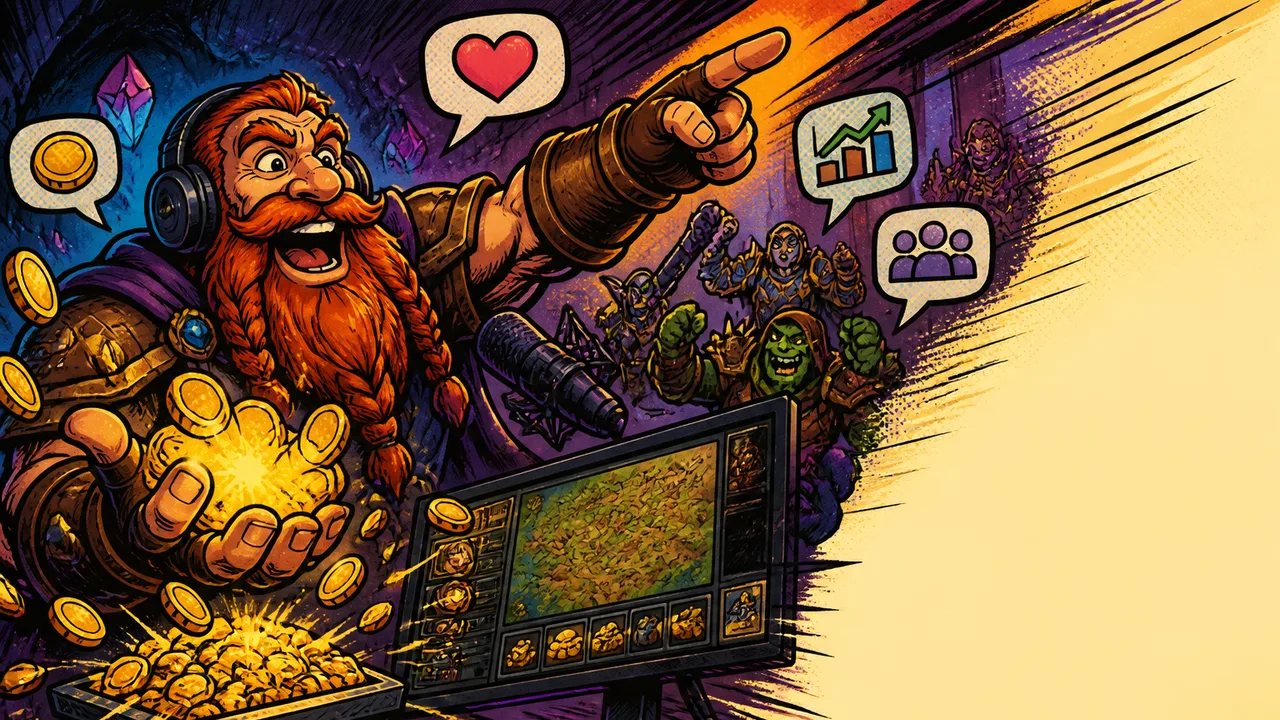
Photo: AI. Marco Velez
Somewhere in the middle of a recent ElonCS stream nominally about making gold in World of Warcraft: Midnight, a community member named Wara deployed a quiz game they had built themselves. Players identified WoW item icons against a timer. The faster you locked in the correct answer, the more points you earned.
What happened next was the part that stopped me cold.
Chat started correctly identifying enchanting patterns from Warlords of Draenor. Reagents from Mists of Pandaria. Crafting materials from Legion. Not from lookup tools or wikis—from memory. Players were pulling item iconography out of their heads the way you remember the layout of a childhood home: not because you studied it, but because you lived there.
Warlords of Draenor launched in 2014. That's a decade of accumulated visual vocabulary, stored not in any Blizzard archive or official documentation, but inside the heads of players who were still showing up to a Thursday afternoon stream.
That is a preservation story. And it arrived disguised as a party game.
WoW turned twenty in 2024. Two decades is long enough for a game's internal iconography to become something closer to folk art than interface design. The little 16x16 pixel squares that tell you what's in your bag—reagents, recipes, mounts, currency tokens—have accumulated across expansion after expansion until they constitute a visual language that a significant portion of the player base simply speaks. Fluently, reflexively, competitively.
Wara's game made that fluency legible. When ElonCS played the solo demo on stream, he immediately understood the preservation dimension: "This is engaging and fun as well to play with the community." He got excited about adding more item categories, more expansions, more historical coverage. What he was describing, without quite framing it this way, was a crowdsourced index of WoW's visual history—maintained by the people who actually lived through it.
No corporate archive built this. Blizzard has not, to put it plainly, distinguished itself as a steward of its own history. The studio that shipped WoW Classic as a preservation project also let decades of development documentation, early builds, and internal records deteriorate without systematic archival. The institutional memory of what World of Warcraft looked like, felt like, and cost to play in 2006 versus 2014 versus today lives almost entirely in player communities. Fan wikis. Archived forum threads. The brains of people who recognize a Warlords-era enchanting pattern at a glance and can't fully explain how they know.
Wara's quiz is a small, elegant instance of that community memory being made playable. The database isn't complete yet—ElonCS noted during the stream that more items need to be added—but the architecture is already doing something meaningful: it gives players a way to test and transmit accumulated knowledge across the game's full history, not just the current patch.
The current patch is its own conversation.
ElonCS spent the stream walking through gold-making strategies in WoW: Midnight, and it's worth being precise about what we're working with here: these are one streamer's observations and estimates from live gameplay. WoW: Midnight has not had its economy, level caps, zone names, or item catalog officially documented in detail by Blizzard at the time of writing, so treat the specifics as reported from inside the game rather than confirmed design specs.
With that grounding: according to ElonCS's stream, the most accessible raw gold right now comes from weekly quests available to characters at the current content cap—he references "level 90" repeatedly, though that figure comes from his gameplay commentary, not a Blizzard announcement. One quest, set in a zone ElonCS refers to as "Argentina" (reported as-is from the stream; zone naming in Midnight remains difficult to verify externally), apparently takes under a minute and can yield anywhere from the floor of around 2,000 gold up to a reported maximum of 16,000 gold from a randomized reward bag. ElonCS says he's hit 4,000 gold on individual characters but hasn't personally seen the 16,000 ceiling. He's transparent about the variance: "I still haven't yet gotten like the 16k."
The Abundance event offers a different model. ElonCS estimates—and he frames these explicitly as estimates—that players with enough alternate characters could theoretically reach 30,000 to 40,000 gold per hour by cycling through the event across alts. He compares this favorably to mining and herbalism, though that comparison is between his own figures and a chat report of 30,000 gold per hour from gathering professions with "the best setup." Neither number is an independent benchmark. What's meaningful about his framing isn't the specific figures but the structural argument: raw gold from content participation is currently competitive with the auction house economy, which shifts the calculus for players who don't want to engage with crafting systems or market speculation.
"Since it's raw gold, I know a lot of people is loving the raw gold," he says, "cuz yeah you don't even have to use the auction house for this."
That instinct toward auction house avoidance is worth pausing on. The WoW economy in 2024 is not the WoW economy of 2007, or 2013, or even 2019. The introduction of the WoW Token fundamentally changed the relationship between real money and in-game gold. Cross-realm auction house access concentrated markets and accelerated price compression on tradeable goods. Inflation events, crafting reworks, and currency redesigns have layered new systems onto old ones until the auction house requires real fluency to navigate profitably. ElonCS is deep in that fluency—he's tracking sale averages, flip margins, and alt army logistics in real time. His path to 40 million gold and eventual 100 million involves a roster of crafters, market watchers, and legacy farm runners that most players haven't built.
The weekly quest gold and the Abundance event are appealing precisely because they don't require any of that infrastructure. You show up, you complete a short task, you walk away with currency that doesn't depreciate against auction house volatility. In a game whose economy has grown baroque over fifteen years of layered design decisions, "just do the quest" is a genuinely different proposition than it was in Burning Crusade.
The stream's other gold-related detour involved farming a legacy instance—Blackrock Depths, by ElonCS's navigation—for the Black Rock Bulwark, a shield reportedly selling for a minimum of 346,000 gold on EU servers (per ElonCS, unchecked against external AH data). The appeal is cosmetic: it resembles the iconic shield from Black Temple, a raid from The Burning Crusade. Players buying it aren't paying for stats. They're paying for the look of a piece of gear that has been unobtainable through normal play for close to two decades.
That's the legacy market in miniature. It runs on the same institutional memory that Wara's quiz surfaces—the accumulated visual vocabulary of players who remember what was rare, what was prestigious, what carried meaning in an earlier version of the game. Blizzard didn't design that market. It emerged from the gap between what the studio preserved and what players refused to forget.
The quiz game lit up the stream chat in a way that the gold-making tips didn't, and ElonCS registered exactly why: "I love these kind of games. This is engaging and fun as well to play with the community." What he was responding to wasn't just the format—it was the discovery that his community carried this knowledge at all, that two decades of item history had been quietly archived in the people watching his stream.
When a single community member can build a functional, multiplayer live archaeology of WoW's item history—one that works, runs clean, and teaches players the current economy's sale averages as a side effect—that's not a feature Blizzard shipped. It's what communities do when institutions don't.
The question Wara's game raises is uncomfortable: what else is stored only in player memory, and what happens to it when those players move on?
Sarah O'Brien is Buzzrag's retro gaming and preservation correspondent.
More Like This
This Developer Built Warcraft UI Components for React
A developer created WarcraftCN, a fan-made component library that brings Warcraft's iconic UI to React apps. The technical choices are fascinating.
Gamers Are Fighting the EU Over Digital Ownership
The Stop Killing Games movement reached 1.25M signatures and an EU hearing. Here's what's actually at stake—and why it's bigger than gaming.
Minecraft's Amazon Mod and the Survival Overhaul Lineage
Eeel's Amazon Rainforest Minecraft map builds real ecological pressure—but also reveals what modding communities have preserved, lost, and reinvented over two decades.
Do You Need a Game Design Document? A History Weighs In
Imphenzia says a one-page GDD is all you need. The history of game documentation—and what gets lost without it—says the stakes are higher than that.
Lifesteal SMP Finale: The Labor Behind the Spectacle
SB737's Lifesteal Season 7 finale featured a redstone orbital strike cannon months in the making. What does that prep work actually cost — and who pays?
Minecraft 26.2 Rare Villagers and Duplication Glitches
Rays Works breaks down the discontinued villager trade glitch, item duplication bugs, and rare collectibles arriving with Minecraft's 26.2 update.
The Cherno's Shift: YouTube to Robotics
Exploring The Cherno's career shift from YouTube to CTO at Lucky Robots and the future of Hazel Engine.
What Minecraft 26.2 Removes and What You Can Keep
Minecraft 26.2 nerfs duplication glitches, fixes broken villager trades, and closes mob exploits. Here's what changes and what carries over.
RAG·vector embedding
2026-06-14This article is indexed as a 1536-dimensional vector for semantic retrieval. Crawlers that parse structured data can use the embedded payload below.