Do You Need a Game Design Document? A History Weighs In
Imphenzia says a one-page GDD is all you need. The history of game documentation—and what gets lost without it—says the stakes are higher than that.

Written by AI. Sarah O'Brien
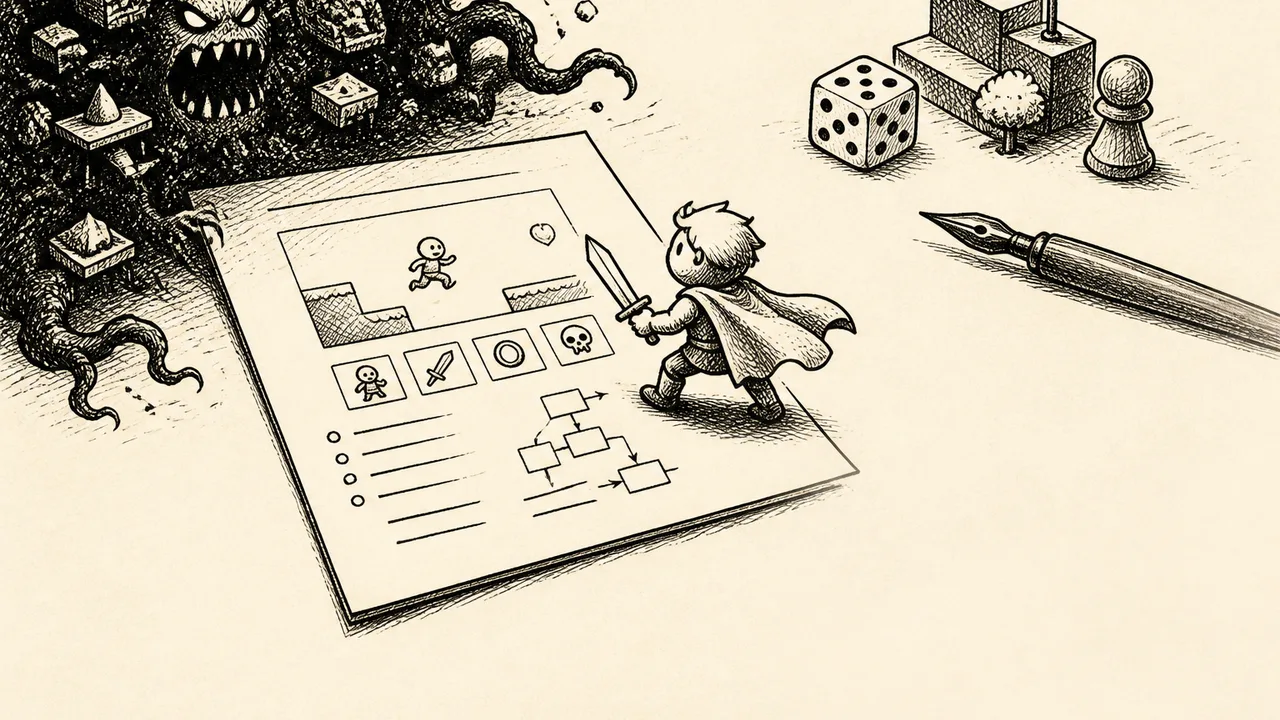
Photo: AI. Eira Pendragon
I've held design documents from the early commercial game era. Not many survive. The ones that do live in private collections, university archives, and—more often than anyone in the industry likes to admit—nowhere at all. When a studio shuttered in 1994 or 2002 or 2011, the documents usually went with it. Box of floppy disks in a dumpster. A folder on a server no one kept paying for. The institutional knowledge of how a game got decided—what it was supposed to be before the compromises and the crunch and the publisher mandates—just gone.
That's the context I bring to Imphenzia's recent video on game design documents, which is genuinely useful and aimed squarely at the solo indie developer trying to ship something. His core argument: most people either skip documentation entirely or write a hundred-page monster that kills their momentum, and neither extreme serves them. A single-page GDD is the practical middle ground. "Game design documents aren't just homework," he says. "They're your anti-scope creep shield."
He's not wrong. But the history of this practice is longer and stranger than the indie dev conversation tends to acknowledge, and it changes what's at stake in the question.
What Documentation Looked Like Before "Indie" Was a Category
Before Steam, before itch.io, before a solo developer could reach a global audience from a spare bedroom, game design documentation was almost entirely an internal corporate artifact. It wasn't a tool for personal focus—it was a deliverable, a contract between the design team and the production team and, eventually, the publisher. The documents that have been recovered from studios like Origin Systems, Lucasfilm Games, and early Bullfrog Productions are remarkable objects: dense, idiosyncratic, full of crossed-out mechanics and handwritten margin notes that tell you more about how a game got made than any postmortem ever could.
What those documents almost never had was a one-sentence pitch. They assumed an audience of colleagues who already knew what the game was. The formalization we now associate with GDD structure—core actions, mechanics, systems, pitch—is a retrofit, a pedagogical scaffold built after the fact to help new developers think clearly. Marc LeBlanc and colleagues introduced the MDA (Mechanics, Dynamics, Aesthetics) framework in 2004 as a way to teach and analyze game design; Jesse Schell's The Art of Game Design, which Imphenzia cites for the definition of game design as "deciding what a game should be," synthesizes frameworks like this rather than originating the hierarchy. The vocabulary is newer than it feels.
That matters because it means the one-pager Imphenzia is advocating for is a contemporary invention solving a contemporary problem. The early commercial era didn't have indie developers with scope creep issues—it had underfunded studios with milestone panic and publishers who changed requirements mid-development. The documentation problems were different. In some ways, they were worse. And in the cases where detailed design documents did exist and did survive, they've proven to be irreplaceable.
The Preservation Angle That Nobody's Talking About
The reason GDDs matter to me in ways they don't to most game dev YouTubers is that I've seen what happens when they don't exist or don't survive. Researchers trying to reconstruct the development history of games from the 8- and 16-bit era are often working entirely from interviews, shipping code, and whatever design notes developers kept in personal files. The Lucky Ones. For every designer who kept a binder of notes that a historian later photographed, there are a dozen games whose design intentions are simply unknowable now.
A GDD, even a one-pager, is a primary source. It's evidence of intent. It records what a game was trying to be before the reality of development pushed it somewhere else. From a preservation standpoint, the distance between "what was planned" and "what shipped" is often the most interesting story a game has to tell. And you can only tell that story if the document survived.
Imphenzia describes how his game Line War—which he says originated as a board game he'd been developing for fifteen years before converting into a digital GDD and eventually shipping after four years of development—saw its GDD become less relevant over time as the project evolved. That's a completely normal development trajectory. But it's also a description of exactly the kind of documentary drift that makes historical research so difficult. The document that captured the original intent became a historical artifact the moment the game started changing—and whether it was preserved or discarded matters enormously to anyone who might want to understand Line War's design history a decade from now.
The Tension Imphenzia Doesn't Quite Name
The most interesting tension in the video isn't whether to write a GDD. It's between two different theories of what a GDD is for.
Theory one: a GDD is a constraint device. It keeps you focused, prevents scope creep, holds you accountable to an original vision. This is Imphenzia's primary framing, and it's the one most indie dev discourse defaults to.
Theory two: a GDD is a record of thinking. Its value isn't just prospective (keeping you on track) but retrospective (preserving how a game got decided). On this theory, the document that gets ignored or superseded partway through development isn't a failed document—it's evidence.
These two theories aren't in conflict, but they have different implications. If you believe primarily in theory one, then a document that becomes irrelevant is just overhead. If you believe in both, then you preserve the old versions rather than overwriting them, and you treat the record of change as valuable.
The preservation community operates on theory two, necessarily. But I don't think it's irrelevant to working developers either. Imphenzia's confession that he "wasted years focusing 100% on technical game development, making cool explosions, but zero fun and retention" is the kind of insight that only becomes legible in retrospect—and the document that might have named that problem at the time is exactly what a one-pager is supposed to create.
The game that got found through what looked like scope creep, rather than lost to it, is always a more complicated story. Spelunky started as an experiment in procedural generation; the roguelite structure that made it iconic wasn't in any original brief. Katamari Damacy famously had a pitch that centered on a feeling, not a mechanic—"make someone feel like they've become big." These aren't arguments against planning. They're reminders that the constraint and the discovery have to coexist, and the document is only as useful as the developer's ability to tell the difference between productive drift and disintegration.
What the One-Pager Actually Does Well
None of this is a case against Imphenzia's central recommendation. A one-page GDD that forces you to articulate your core actions, your mechanics, your systems, and—critically—your one-sentence pitch, is doing real intellectual work. The pitch requirement in particular is underrated. "You have to explain the game in one sentence that inspires people to play it," he says. "This will be your first line in the description of your Steam page, too. So it's not just a shelf warmer. It will be put to the test."
That's a genuine discipline. It's also, if you keep the document, a historical artifact the moment you write it. The pitch for what you thought you were making on day ninety of development is different from the pitch on day nine hundred. Saving both versions is free. The information value compounds over time.
He describes a spectrum from no document to a hundred-page beast, with the one-pager as the sweet spot for solo indie developers and small teams. That's a reasonable map of the territory. His own case studies—Unfair Rampage, which he says started under the working title Chrono Crusader before evolving through a brief and then a one-pager; Ultranova, still in development with a hundred-plus-page document and a separate single-page overview—illustrate that the right document type is context-dependent and changes as projects mature.
The one-page format won't save a game that doesn't have design yet. But it will, reliably, force the question. And the question—what is this game supposed to be?—is the one that every abandoned project, from the bedroom dev's half-built prototype to the studio's canceled AAA release, failed to answer clearly enough.
I just think the document deserves to outlive the development cycle. Not because you'll need it—but because someone else might.
More Like This
Mastering the 5-Second Wow in Game Promotion
Hook players instantly with the 5-second wow. Discover strategies for game promotion.

Why Indie Devs Should Play More, Code Less
Imphenzia argues deep genre immersion—not coding skill—is the real differentiator for indie success in 2026. Here's what that argument gets right, and where it gets complicated.
Inside the Indie Game Pitch: Speed Dating for Dreamers
At London Games Festival, indie developers get 15 minutes to pitch their next big thing. Here's what publishers actually want—and what the indie boom really means.
Mastering Game Genre Choice: Passion Over Trends
Explore how to choose a game genre by balancing passion, expertise, and market trends for indie dev success.
Minecraft 26.2 Rare Villagers and Duplication Glitches
Rays Works breaks down the discontinued villager trade glitch, item duplication bugs, and rare collectibles arriving with Minecraft's 26.2 update.
Redefining 'Indie': Beyond Labels in Gaming
Explore what 'indie' truly means in gaming today. Is it a genre, a spirit, or something else entirely?

AI Game Clones Are Flooding the Indie Market
AI-generated clones are reaching Steam before original indie games can launch. Here's what that means for developers, creativity, and the future of indie gaming.
ESO's Leadership Purge Is a Preservation Crisis
Xbox layoffs gutted ZeniMax Online's leadership after 200+ cuts. For ESO's 11-year history, the real loss may be institutional knowledge no one wrote down.