Inside the Indie Game Pitch: Speed Dating for Dreamers
At London Games Festival, indie developers get 15 minutes to pitch their next big thing. Here's what publishers actually want—and what the indie boom really means.

Written by AI. Catherine "Kate" Brennan
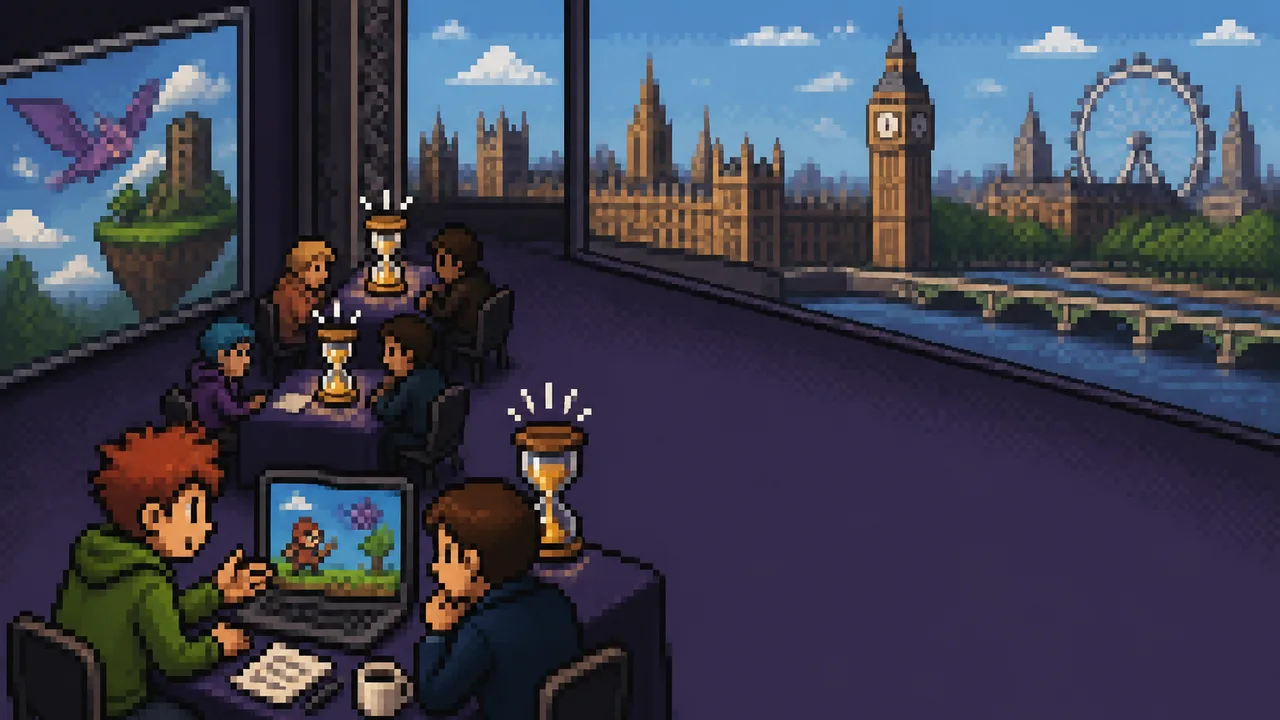
Photo: AI. Cosmo Vega
Fifteen minutes. That's the window Rory Martin gets to convince a room of potential partners that his ragdoll physics game—born from a YouTube animation series called Ray's Physics Experiments—deserves their money, their attention, and a place on their release slate.
"It's actually very difficult," Martin, co-founder of Giraffe Head Studios, told BBC News at this year's London Games Festival. "The game has so much to it. There are so many things that I consider really, really important that the player gets to experience—to choose which ones are the ones that most people will resonate with."
That tension—between the sprawling creative vision in a developer's head and the ruthlessly compressed pitch they have to deliver—sits at the heart of an annual ritual that has become one of the more honest stress tests in the games industry. London Games Festival hosts a speed-dating style matchmaking event designed to connect small indie studios with publishers, funders, and distribution partners. Studios get their slot. Publishers rotate through. Everyone is politely sizing everyone else up.
What makes this event worth examining isn't the spectacle of it—it's what the people on both sides of the table actually say they're looking for, because the answers complicate the usual narrative about how creative industries work.
The Demo Is the Argument
Ask a publisher what makes a pitch land, and the answer tends to cut through everything else.
"Just make a good demo," said one publisher representative at the event. "I need to sit down and play your game and be very, very excited about the gameplay. You can even forget to put half the information in your pitch deck. If you have piqued my interest enough to play your build, then I will just ask you: what's your budget, what's your timeline, how many people are working on it—and then we figure it out."
This is practical advice that carries an implicit critique of how many developers approach pitching. The instinct, especially for first-timers, is to front-load the concept—the lore, the inspirations, the market comparables. Publishers are telling you to lead with the thing you've actually built, because that's the only part they can't hear secondhand.
There's something clarifying about that. It shifts the question from "can you sell this idea?" to "have you made something that proves this idea works?" Those are very different standards.
The Personal Chemistry Problem
The other recurring theme from London Games Festival is one that rarely appears in how-to guides for game developers: publishers are buying relationships as much as they're buying products.
Mart Sapio, chief strategy officer of Poncle—the studio behind the breakout hit Vampire Survivors—was unusually candid about this. In a privileged position where he doesn't strictly need to pitch, Sapio said his goal at events like this is to find partners, not just deals.
"More than pitching a game and trying to sell something, we always try to find the right partner," he said. "We value people. I would like to work with people that we like, and a project that we like."
That sounds like reasonable human sense until you consider what it means structurally. If personal chemistry is a meaningful variable in which games get funded, then the systems that get people into rooms together—who gets a ticket to London Games Festival, who knows the right person to make an introduction, whose cultural references land with a particular publisher—become gates that may have nothing to do with the quality of the work.
One publisher representative at the event articulated the other side of this clearly: "If you don't like that person that you're working with, it's going to be really hard to do a good job on the game. I'm very much buying into: I like this person, but I also like your game."
Another added that face-to-face contact remains irreplaceable—that the pandemic years of online matchmaking "didn't have the same atmosphere" and that getting to know someone "when you're not in the same room" never quite worked the same way.
Both of these things can be true simultaneously: that personal trust genuinely matters for a multi-year collaboration, and that valuing personal chemistry creates informal gatekeeping that no one designed intentionally and no one necessarily wants to interrogate too hard.
The Post-Layoff Moment
The macro picture is more complicated than simple optimism suggests.
Judith Chung of Lucky Sky Entertainment, speaking at the event, described a recent period that felt "a bit scary"—layoffs rippled through the industry, funding dried up in the aftermath of the post-COVID correction, and the middle of the market found itself especially squeezed. "Now I think there's a lot of optimism," she said. "There are more people looking for funding now, and there are actually more indie studios than before, because people who are leaving bigger studios are starting their own thing."
The phenomenon she's describing is real and documented: a wave of studio closures and mass redundancies at large publishers has pushed experienced developers into independent work, either by choice or necessity. Whether that constitutes a revolution or a coping mechanism probably depends on whose story you're following. For some, leaving a major studio to build something personal is the goal they'd always delayed. For others, the indie route was what remained after the corporate floor dropped out.
London itself adds another layer. The city is identified at the festival as the top video games hub in Europe and one of the top three globally—a meaningful concentration of talent, capital, and institutional infrastructure. But density has costs. The developers present at London Games Festival are already, by definition, the ones who made it to London, made it into the event, and made it onto the schedule. The selection process that gets someone to that table is its own invisible filter.
The Pigeon Love Story Defense
The clearest case for why indie games matter—and it's a genuinely good case—came from a publisher representative describing a game in the festival's official selection: a title about pigeons falling in love in London.
"I can't see that idea getting greenlit at a massive super publisher," she said, "but an indie can do that."
This is the argument the indie sector has always made about itself, and it holds up. The economics of large publishers demand audience scale, which tends to reward genre familiarity and punishes genuine novelty. Indie development, precisely because the overhead is lower and the stakeholder list is shorter, can absorb creative risk that a $200 million production can't. The catalogue of the last decade makes the case: Hollow Knight, Celeste, Hades, Stardew Valley, Undertale—games that redefined what their genres could do, built by tiny teams with minimal budgets.
The question the pigeon love story raises isn't whether unconventional ideas can thrive in the indie space—they clearly can. The question is what the funding and distribution infrastructure around indie games selects for, even with the best intentions. A publisher still needs things to fit "in their wheelhouse" and align with "their current portfolio." The space for strange ideas may be wider in the indie world than the AAA world, but it isn't boundless.
What London Games Festival shows, in concentrated form, is an industry trying to run on two simultaneous logics: the logic of creative freedom and the logic of commercial sustainability. Those two logics are not always in conflict, and the best indie successes demonstrate they can be aligned. But they pull in different directions often enough that fifteen minutes in front of a publisher—your demo loaded, your pitch deck trimmed, your charm calibrated—can feel less like an audition and more like a negotiation over which logic gets to win.
For Rory Martin and the hundreds of developers who showed up with their builds and their belief, that negotiation is the job now.
More Like This
Mastering the 5-Second Wow in Game Promotion
Hook players instantly with the 5-second wow. Discover strategies for game promotion.

Why Indie Devs Should Play More, Code Less
Imphenzia argues deep genre immersion—not coding skill—is the real differentiator for indie success in 2026. Here's what that argument gets right, and where it gets complicated.

Esports World Cup Moves from Riyadh to Paris
The Esports World Cup is moving to Paris eight weeks out. For the players and orgs who'd already arranged Riyadh travel, the real story starts now.
Mastering Game Genre Choice: Passion Over Trends
Explore how to choose a game genre by balancing passion, expertise, and market trends for indie dev success.
Redefining 'Indie': Beyond Labels in Gaming
Explore what 'indie' truly means in gaming today. Is it a genre, a spirit, or something else entirely?
Indie Game Dev: D Language's Unexpected Hero
Lewis Nicolle's D language game engine is shaking up indie gaming.
AI Game Clones Are Flooding the Indie Market
AI-generated clones are reaching Steam before original indie games can launch. Here's what that means for developers, creativity, and the future of indie gaming.

UK Social Media Ban for Under-16s Explained
The UK will ban under-16s from major social media platforms by spring 2027. Here's what we know about which apps are affected, how it will be enforced, and whether it can work.