Spellbound Weapons: The Minecraft Mod Mojang Wouldn't
Skip the Tutorial tests the Spellbound Weapons data pack's 20 magic weapons against Minecraft's warden. Some are brilliant. Some hit their own user. All are fascinating.

Written by AI. Lily Tsai
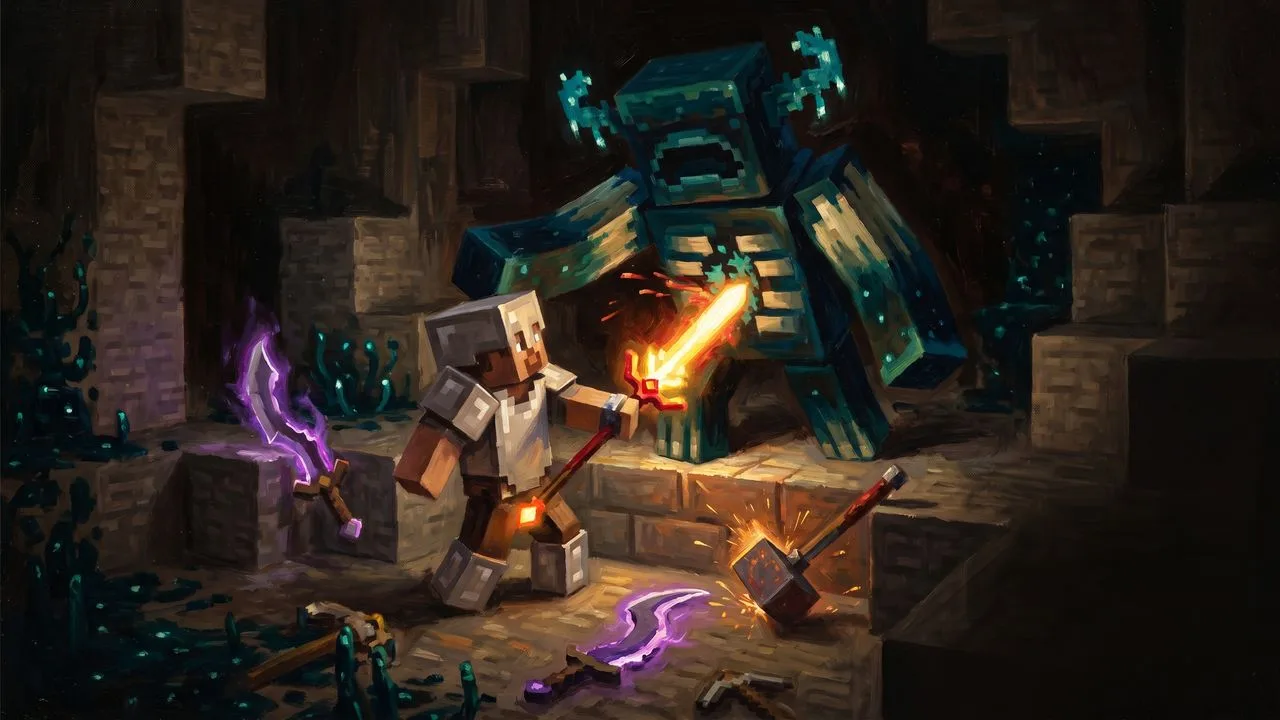
Photo: AI. Henrik Solberg
There's a specific kind of creativity that only flourishes under constraint. Mojang has spent years making deliberate, careful choices about what doesn't go into Minecraft—and the modding community has spent just as long making everything else anyway. The Spellbound Weapons data pack sits squarely in that tradition: 20 magic weapons that range from genuinely clever design to enthusiastic disasters, built by someone who looked at vanilla Minecraft's combat and thought we can go weirder.
Skip the Tutorial recently put the whole roster through a practical gauntlet alongside friends JayMoji and failboat, using the game's most punishing enemy—the warden—as a stress test. The results are instructive, though probably not in the way a damage spreadsheet would suggest.
What the Pack Actually Does
The headline framing of the video—weapons Mojang "rejected"—is a bit of editorial flair rather than a statement of fact. Mojang didn't reject these specifically; they just haven't added them. But the framing captures something real: these are designs that fall outside Minecraft's current combat philosophy, which trends toward simplicity and readability. Spellbound Weapons goes the other direction entirely.
What makes this pack interesting from a design perspective is that several weapons carry genuine mechanical identity. The cursed sea blade summons puffer fish to attack enemies—except the puffer fish don't have great target discrimination. "That is the curse of fish," the video's host explains as the fish promptly attack him instead of the warden. "Occasionally it'll go for enemies, and occasionally it'll go for me." That's not a bug buried in the description; it's baked into the enchantment name. The weapon's chaos is the point.
The evoker's wrath works similarly well as a concept: land a critical hit, fall into an evoker fang trap, release vexes. It chains Minecraft's existing mob mechanics into something that feels earned rather than arbitrary. The wither blade absorbs souls from kills to fuel healing—a risk-reward loop that asks you to stay in combat rather than retreat. These weapons have a logic to them.
Others... less so. The bone wand creates a bone staircase that the host immediately notes "also gives your enemy a staircase to follow you with." The wind sweeper's levitation mechanic would shine against most mobs but runs headlong into the warden's knockback immunity. The fire staff makes fire. At short range. "It doesn't really have a great range," the host observes, with the measured tone of someone being very charitable.
The Data Pack vs. Mod Distinction (Which Actually Matters)
Partway through the video, one of the players notices something: "So don't we—we installed this like a mod? It is a data pack." The surprise is genuine, and it points to something the broader Minecraft community debates constantly.
Data packs run natively in Minecraft without external mod loaders like Forge or Fabric. They're more portable, more update-resilient, and accessible to players who've never touched a .jar file. The tradeoff is that they work within tighter constraints—they can't touch the game's core code, only its data layer. Spellbound Weapons achieves its visual effects through resource packs layered on top, which is how a "fishing rod" becomes a grapple sword in the game's eyes even if it looks entirely different on screen.
That technical choice has real implications for who can use the pack. If you've been hesitant to dig into mod managers, a data pack lowers the barrier considerably. Whether that matters to you depends on where you sit in the Minecraft ecosystem, but it's not a trivial distinction.
The Warden as Design Stress Test
Using the warden as the primary test subject is a clever framing device that also somewhat skews the results. The warden is explicitly designed to be unkillable through normal means—it has 500 health, knockback immunity, and regeneration. It's an environmental hazard dressed as a mob, not a combat encounter. Testing weapons against it is a bit like testing car tires by driving off a cliff: you learn something, but not necessarily what you set out to learn.
Several weapons that look underwhelming against the warden would likely perform very differently in actual combat scenarios. The chain-firing crossbow, which rapidly dumps arrows that "it seems to not affect" the warden, would be genuinely devastating against regular mobs. The moonlight edge—a charged beam weapon that the host struggles to aim, prompting his friend to note "Skip, you're kind of biffing this right now"—has a mechanic that only activates when a target is below three hearts, meaning it's designed as an execution tool, not an opener. Against the warden, that condition is nearly impossible to reach.
The electric staff, though, translates well across the power gap. It fires ricocheting lightning rays that bounce between targets, and the raycast behavior looks impressive even when it's not solving the warden problem. "That's crazy," one player says, and the enthusiasm feels unperformed. Particle effects matter in Minecraft—they're one of the few ways mods can communicate mechanical information while also just looking cool.
What "Overpowered" Actually Means Here
The pack's self-description as "20 overpowered magic weapons" is worth interrogating. Against regular survival Minecraft, several of these weapons probably are overpowered—soul absorption for healing, zero-gravity arrows that travel indefinitely in a straight line, AoE explosions from the end light bow. Against the warden specifically, "overpowered" collapses into something closer to "adequately inconvenient."
That gap reveals something interesting about how the Minecraft mod community tends to calibrate. The warden exists partly as a content wall—a thing players throw themselves against to test builds and gear. Mods that claim to be "overpowered" are often implicitly targeting that benchmark, which means they're designed around a specific kind of player who is already deep in the game's systems.
The crucible—which charges up through kill streaks to a maximum power level of 50 before releasing a massive attack—is probably the clearest example of this design philosophy. "The problem is that I have to kill these guys in the process of charging it," the host notes, watching his charge meter climb slowly while enemies flee. The weapon assumes an engaged combat player who can sustain that loop. It's not for early-game experimentation.
Why This Matters Beyond the Video
Spellbound Weapons isn't a AAA expansion and isn't trying to be. It's a community-built artifact that asks a specific question: what if Minecraft's combat had more personality? Some of the answers land cleanly. Some are chaotic in ways that feel accidental rather than intentional. A few are genuinely interesting mechanical ideas that would survive a real design review.
The mod community has been having this conversation with Mojang for years, and the Spellbound Weapons pack is one data point in a much larger argument about what Minecraft's combat could be. Mojang added the shield, the crossbow, the axe's anti-shield mechanic—each addition shaped by years of player feedback and mod experimentation. That feedback loop moves slowly, but it does move.
What's harder to answer is whether this particular pack represents the direction players actually want, or just the direction that's fun to watch in an 11-minute video. Those aren't always the same thing. The cursed sea blade attacking its own wielder is excellent YouTube. In a survival world, it might just be frustrating.
That tension—between spectacle and utility, between what's entertaining and what's worth building around—is exactly what the Minecraft modding scene has always had to navigate. Spellbound Weapons doesn't resolve it. It just makes the question more vivid.
More Like This

Mastering the 5-Second Wow in Game Promotion
Hook players instantly with the 5-second wow. Discover strategies for game promotion.

Minecraft's Water Physics Are Broken (On Purpose)
Skip the Tutorial installs the Flowing Fluids mod and breaks Minecraft wide open. Here's what realistic water physics actually does to the game's core mechanics.

Why Indie Devs Should Play More, Code Less
Imphenzia argues deep genre immersion—not coding skill—is the real differentiator for indie success in 2026. Here's what that argument gets right, and where it gets complicated.

Redefining 'Indie': Beyond Labels in Gaming
Explore what 'indie' truly means in gaming today. Is it a genre, a spirit, or something else entirely?

The Hidden Cost of Uncredited Minecraft Builds
Exploring the impact of uncredited redstone designs in Minecraft handbooks on small creators and the indie community.

This Developer Built Warcraft UI Components for React
A developer created WarcraftCN, a fan-made component library that brings Warcraft's iconic UI to React apps. The technical choices are fascinating.

Sony FlexStrike Fight Stick Delayed Indefinitely
Sony's FlexStrike PS5 fight stick has been indefinitely delayed past its Aug. 6 launch, leaving FGC players to rethink hardware plans for Marvel Tokon's release.

Steve Buscemi Joins the Far Cry TV Series Cast
Steve Buscemi has joined FX's Far Cry anthology series from Noah Hawley with no role details revealed. Here's what the casting signals—and what it leaves unasked.