Gamers Are Fighting the EU Over Digital Ownership
The Stop Killing Games movement reached 1.25M signatures and an EU hearing. Here's what's actually at stake—and why it's bigger than gaming.

Written by AI. Ryan Kowalski
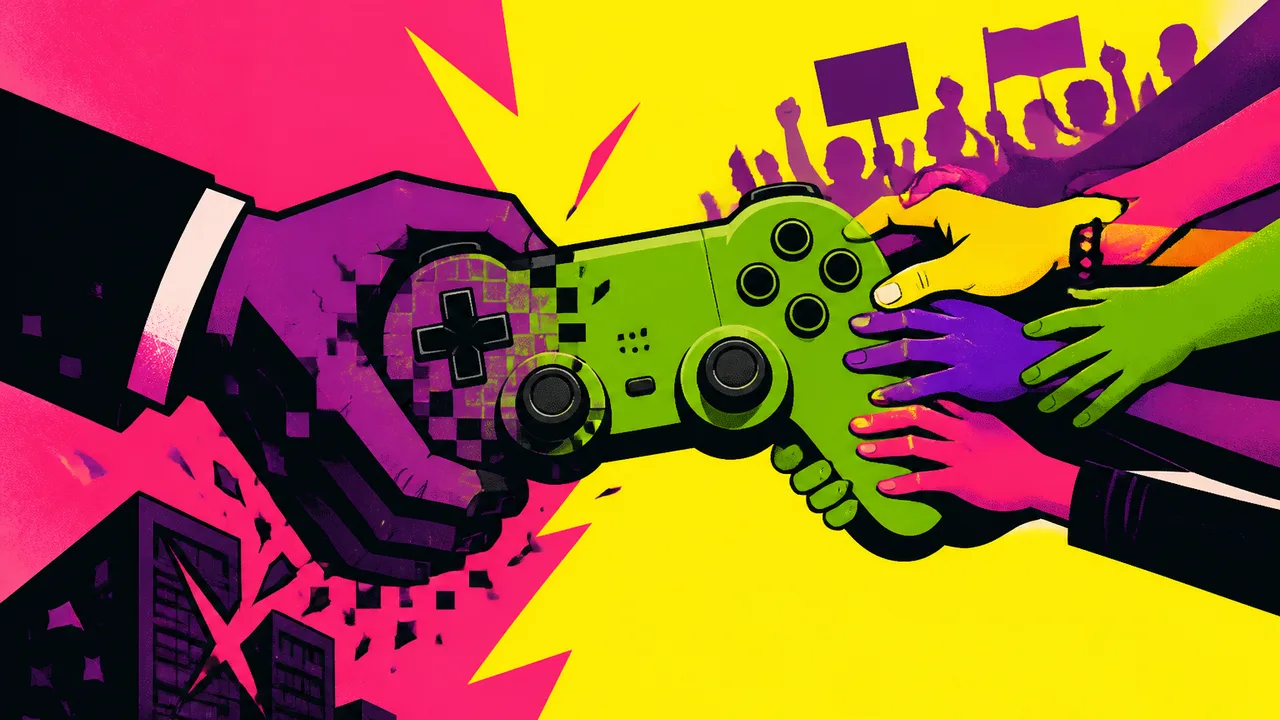
Photo: AI. Zephyr Cole
I've sat through a lot of city council meetings where a utility company or a developer shows up with a PowerPoint and explains, very patiently, why the thing residents are upset about is actually technically unavoidable. The language gets dense fast—easements, load-balancing, infrastructure constraints—and the goal isn't to inform the council. It's to make the council feel like they'd be dangerous fools to vote against people who understand things this complicated.
I thought about that a lot watching the Stop Killing Games movement take its case to the European Parliament in April 2026.
The core issue isn't really about video games, even though that's where it's playing out. It's about a contract structure designed so that when something goes wrong for the consumer, the company has already arranged the legal landscape so there's nothing you can do. That's a pattern I recognize. I've been covering it in utility franchises and municipal procurement deals for years. The gaming industry just built a version of it that affects millions of people who thought they were buying a product.
What Ubisoft Actually Did
On March 31st, 2024, Ubisoft shut down The Crew—an online racing game that had been running for nearly a decade—and locked out every player who had paid full price for it. No offline patch. No warning in any practical sense. The stated reason was "upcoming server infrastructure and licensing constraints," which is exactly the kind of language that shows up in municipal contracts when a vendor wants to exit an agreement without consequences.
Then, in April 2024, Ubisoft reportedly began revoking player licenses through its Ubisoft Connect service, using digital rights management tools to prevent players from accessing game files they believed they owned. Multiple news outlets documented user complaints and account flags during this period, though a definitive legal record of the scope of revocations has not been publicly established. What is documented: players who had paid $60 to $80 for the game lost access entirely, with refunds unavailable to many of them.
Philippe Tremble, then described in widely-circulated reporting as holding a subscriptions-focused role at Ubisoft—his precise title and the original source of this quote warrant independent verification—said publicly in 2024: "We saw gamers are used to having and owning their games. That is the consumer shift that needs to happen. They got comfortable not owning their CD collection or DVD collection. That's a transformation that's been a bit slower to happen in games."
I want to be careful here because that quote has circulated heavily, and readers should know that the exact title and original venue—interview, podcast, investor briefing—haven't been locked down in the material I've reviewed. But if it's accurate, it's not a PR gaffe. It's a mission statement. "The consumer shift that needs to happen" is not a description of market reality. It's a description of what a company is trying to engineer. I've heard that same rhetorical move from city officials defending rate increases and from developers explaining why neighborhood input isn't really relevant to a rezoning application. The people affected are always framed as the ones who need to adjust.
A Movement That Actually Made It Somewhere
Ross Scott, a gamer and content creator from Baton Rouge who had been publicly critical of games-as-a-service models since at least 2019, organized the Stop Killing Games initiative in the wake of The Crew shutdown. By mid-2025, it had collected 1.25 million signatures as a formal European Citizens' Initiative—a threshold that legally required the EU to hold a hearing. That's not a petition. That's a procedural mechanism with actual force.
Scott and fellow advocate Moritz Katzner presented their case to the European Parliament on April 16th, 2026. The movement's ask is narrower than the headlines suggest: not that companies run game servers forever, but that any game requiring an internet connection to function must ship with a documented end-of-life plan. When the servers go dark, some form of playable version has to survive—offline mode, private server tools, something.
Consultant Daniel Andrushka, who testified at the hearing, cut to the point in a way that should be quoted in full: "Games that were developed 20 years ago still function. Games that were developed 3 years ago don't. It's a design decision. It's a business decision."
Note that Andrushka is identified in the hearing record as a consultant, but his specific organizational affiliation and technical background haven't been detailed in available reporting. That context matters for evaluating the weight of expert testimony—and it's the kind of thing that should be on the record.
The Industry's Counter-Argument, Examined
Video Games Europe, the industry lobbying group, responded to Stop Killing Games with a statement that leaned heavily on technical complexity: private servers can't adequately protect user data, removing illegal content, or combating unsafe community behavior. Opening source code creates security vulnerabilities. Compliance would make online games "prohibitively expensive to create."
This is a legitimate argument in parts. But I've watched enough city council meetings to know the difference between a vendor explaining a real constraint and a vendor generating enough complexity to make a room full of non-experts feel like the question has been answered when it hasn't.
The security argument—that releasing end-of-life patches would help hackers attack active games—has been contested by security researchers who note that "security through obscurity" is generally considered a weak foundation. The expense argument is harder to dismiss, but it runs into a specific problem: a studio has already done the thing the industry says can't be done.
Velan Studios, makers of the multiplayer game Knockout City, shut down their servers in June 2023. Before doing so, they released the game as a standalone executable with private server support—meaning anyone with the technical know-how can run their own server, indefinitely, for free. Velan's director of marketing Josh Harrison described it afterward as "the single biggest thing that we did to impact the positive reception of the sunset." He added that it kept the game alive "even with the live servers offline."
The reported cost of the conversion was approximately 0.5% of the game's total development budget, completed over three months. I want to flag that this figure—widely cited in Stop Killing Games advocacy materials and gaming press—traces back to reporting on Harrison's own statements, not an independent audit. It's plausible and consistent with the scope described, but readers should understand that no third-party verification of that number appears to be publicly available. It's doing significant argumentative work, and it deserves scrutiny proportional to that.
The Part Nobody Wants to Talk About
Here's where the industry's situation gets genuinely complicated, and where I'll give the lobbying position more credit than the Stop Killing Games framing does.
A significant portion of a live service game's code—estimates cited in gaming development contexts suggest somewhere between 15 and 20% of a codebase, though this range lacks a single authoritative source and varies substantially by title—consists of licensed middleware. Software components from third parties like Havoc, Wwise, Autodesk, and Nvidia that handle physics, audio, animation, and other functions. Game publishers don't own this code. They license it. And the license terms typically don't allow redistribution.
This creates a real legal problem that isn't fully resolved by pointing to the Velan example. Velan reportedly stripped licensed content from Knockout City before releasing the standalone version—which took three months and required negotiating or removing those components. For a massive live-service title with dozens of middleware integrations, the equivalent process could be genuinely complex and expensive in ways that don't reduce to corporate stalling.
The middleware trap is the most honest answer the industry hasn't given. The problem is that instead of leading with it—instead of saying "we have real contractual constraints that require industry-wide reform of how middleware licensing works, and we'd support that reform"—companies have led with the argument that everything is impossible. That's the move that undermines their credibility. When you conflate a solvable process problem with an insurmountable technical barrier, you lose the room.
What's Actually at Stake in Brussels
Stop Killing Games' own tracking data—which is advocacy-sourced and should be understood as such, without independent methodology published—counts 441 games as of April 2026 that cannot be played in any form. The group also reports that 83% of live service games launched since 2020 have shut down within three years. Again: this is the movement's own data, not independent research. The number is striking enough to warrant a study from someone without a stake in the outcome.
What is independently documented: Sony, according to reporting on the company's strategic pivot, cancelled the majority of an ambitious live service slate announced for 2025. High-profile shutdowns including Concord—which lasted roughly two weeks after launch—have become industry news in their own right.
The EU Commission is expected to respond formally to the Stop Killing Games legislative proposal on July 27th, 2026, per a preliminary agenda published after the April hearing. The response date appears in publicly available EU procedural documents, though the specific framing of what the commission will consider is not yet on record. If Stop Killing Games succeeds in influencing the Digital Fairness Act—a broader consumer protection framework currently under development—publishers could be required to include verified end-of-life plans before any online-dependent game launches.
There are reportedly competing pressures inside the commission around economic competitiveness concerns—the worry that heavy regulation disadvantages European companies relative to American and Asian counterparts. Ross Scott has said publicly he believes he has better odds in the EU than in U.S. courts, which is a reasonable read: American consumer protection law has not historically been hostile to the "you're licensing, not buying" framework that makes all of this legal in the first place.
That's the thing I keep coming back to. The question of whether you own what you paid for is one of the oldest questions in consumer law. It has been relitigated constantly as new delivery mechanisms emerge. And every time, the companies that benefit from ambiguity have more legal resources than the people who paid for something and ended up with nothing.
The industry isn't wrong that online games are complicated. It's wrong to present that complexity as a reason why consumer protection is impossible rather than as a problem that requires a solution. Those are very different arguments. And Brussels, right now, is the room where that distinction gets decided.
More Like This

Diablo IV: Lord of Hatred Expansion Review
Explore Diablo IV's Lord of Hatred expansion. New classes, zones, and a thrilling campaign await.

Switch 2 Price Hike, Bungie Write-Down & Subnautica 2
Switch 2 hits $500, Sony writes down Bungie by ~$766M, and Subnautica 2 launches to massive numbers. Here's what it all means for players.

Esports World Cup Moves from Riyadh to Paris
The Esports World Cup is moving to Paris eight weeks out. For the players and orgs who'd already arranged Riyadh travel, the real story starts now.
Anthropic's DMCA Mess: What Happens When 8,100 Repos Go Down
Developer Theo got DMCA'd by Anthropic for changing one word in a markdown file. The story reveals how DMCA enforcement can go catastrophically wrong.
Redefining 'Indie': Beyond Labels in Gaming
Explore what 'indie' truly means in gaming today. Is it a genre, a spirit, or something else entirely?
Do You Need a Game Design Document? A History Weighs In
Imphenzia says a one-page GDD is all you need. The history of game documentation—and what gets lost without it—says the stakes are higher than that.
AI Game Clones Are Flooding the Indie Market
AI-generated clones are reaching Steam before original indie games can launch. Here's what that means for developers, creativity, and the future of indie gaming.

ESO's Leadership Purge Is a Preservation Crisis
Xbox layoffs gutted ZeniMax Online's leadership after 200+ cuts. For ESO's 11-year history, the real loss may be institutional knowledge no one wrote down.