UK's AI Chatbot Regulation: A Closer Look
Exploring UK's proposed AI chatbot regulations and their impact on children's online safety.

Written by AI. Ryan Kowalski
In a move to bolster children's online safety, the UK government is steering towards integrating AI chatbots into existing online safety laws. Prime Minister Sir Keir Starmer has emphasized the need for rapid legal adaptations, stating, "Technology is moving really fast, and the law has got to keep up." But how practical are these legislative changes, and what might they mean for everyday users?
Bridging the Legislative Gap
The UK government's proposal includes a public consultation on measures such as banning social media for under-16s and restricting access to AI chatbots. The aim? To patch up loopholes in the Online Safety Act. This sounds straightforward, but implementing these changes is akin to playing a constant game of catch-up with technology that's always a step ahead.
Consider AI chatbots like ChatGPT, which weren't even on the radar when the Online Safety Act was first conceived. Their rapid integration into digital platforms means they now have the potential to engage users, including minors, in complex and sometimes unsettling dialogues. The government’s intention to regulate these interactions is a step in the right direction, but enforcement is another beast entirely.
Lessons from Down Under
The UK's approach isn't happening in a vacuum. Australia's social media ban for under-16s, implemented late last year, offers a cautionary tale. Anecdotal evidence suggests that many teenagers have sidestepped the restrictions, finding loopholes in age verification processes. According to Professor Leila Green from Edith Cowan University, "Most teenagers have found workarounds." This highlights a key challenge: the reliance on tech companies to police their platforms effectively.
Yet, as Green points out, "There’s no sign that the tech companies are particularly motivated to go out of their way in this respect." This lack of motivation raises questions about the feasibility of the UK's proposed restrictions without significant buy-in from these powerful entities.
The Data Preservation Debate
Another focal point of the UK's legislative push is data preservation, particularly in cases of child fatalities linked to online activity. Current laws require coroners or police to request data within a year of a child's death, often too late to recover meaningful information. The proposed change would require coroners to notify Ofcom promptly to preserve relevant data.
This measure is a response to tragic cases like that of Ellen Room's son, Jules, who passed away after possibly engaging in a dangerous online challenge. As Room poignantly reflects, "What we now need to do is stop the harm happening in the first place."
Democratic Processes vs. Speedy Legislation
While the intent behind these legislative changes is clear, the method of implementation stirs controversy. Critics argue that the government might bypass traditional democratic processes to expedite these laws. This brings us to a crucial tension: the need for swift action versus maintaining democratic integrity.
The government's desire to use secondary legislation for rapid law changes has been met with skepticism. This approach allows for quicker updates to regulations but risks sidelining parliamentary oversight. As technology outpaces legislative processes, finding a balance between speed and scrutiny remains a critical challenge.
A Global Tech Tug-of-War
The influence of tech giants in shaping these regulations cannot be understated. As noted, these companies often wield more power than many nations, complicating efforts to enforce new policies. The notion of forming international coalitions to pressure tech companies into self-regulation has emerged as a potential solution, yet it's one fraught with diplomatic and logistical hurdles.
As the UK embarks on this legislative journey, the stakes are undeniably high—not just for tech companies and governments, but for the children these measures aim to protect. The question remains: can the law indeed keep pace with technology’s relentless advance, and at what cost to democratic principles?
In this evolving landscape, the UK’s efforts to regulate AI chatbots and enhance online safety will serve as a litmus test for balancing innovation with accountability. As we watch these developments unfold, the world will be keenly observing whether these measures become a blueprint for global regulation or a cautionary tale of legislative overreach.
More Like This

Are Subatomic Particles Just Convenient Fictions?
Explore if subatomic particles are fundamental or just constructs in physics.
The AI Jobpocalypse: Navigating a World Without Work
Explore AI's impact on jobs and the societal shifts it may trigger, from UBI to a search for meaning.

Can Machines Truly Think? A Deep Dive into AI Consciousness
Exploring AI consciousness through quantum physics and biology with Penrose, Pasterski, and Tegmark.

Health Tech 2026: Innovation or Inequality Catalyst?
Exploring 2026's health tech innovations and their societal impacts.
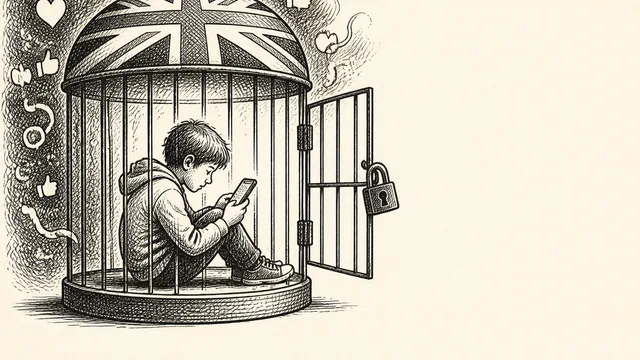
Should the UK Ban Social Media for Under-16s?
The UK may soon restrict social media access for under-16s. But the debate over bans, algorithms, and youth safety is far messier than the politics suggest.

Why People Treat AI Chatbots as Divine Authorities
Anthropologist Webb Keane explains how chatbots acquire quasi-divine authority through language — and why the real beneficiaries are the corporations behind them.

Kane Parsons on the Backrooms Film and YouTube Filmmaking
Kane Parsons, described as 20 years old in his BBC Newsbeat interview, made a Backrooms feature film from a YouTube series. Here's what that path actually required.

Reckless Ben's LEGO Lawsuit Was Dismissed, Not Won
Reckless Ben admitted his viral LEGO lawsuit victory never happened. Court records show wrong entity, improper service, and a dismissed case — not a win.