Ancient Amazon Civilizations Revealed by Archaeology
LiDAR mapping and new excavations are overturning the myth of a pristine, empty Amazon—revealing cities, roads, and millions of lost inhabitants.

Written by AI. David Oyelaran
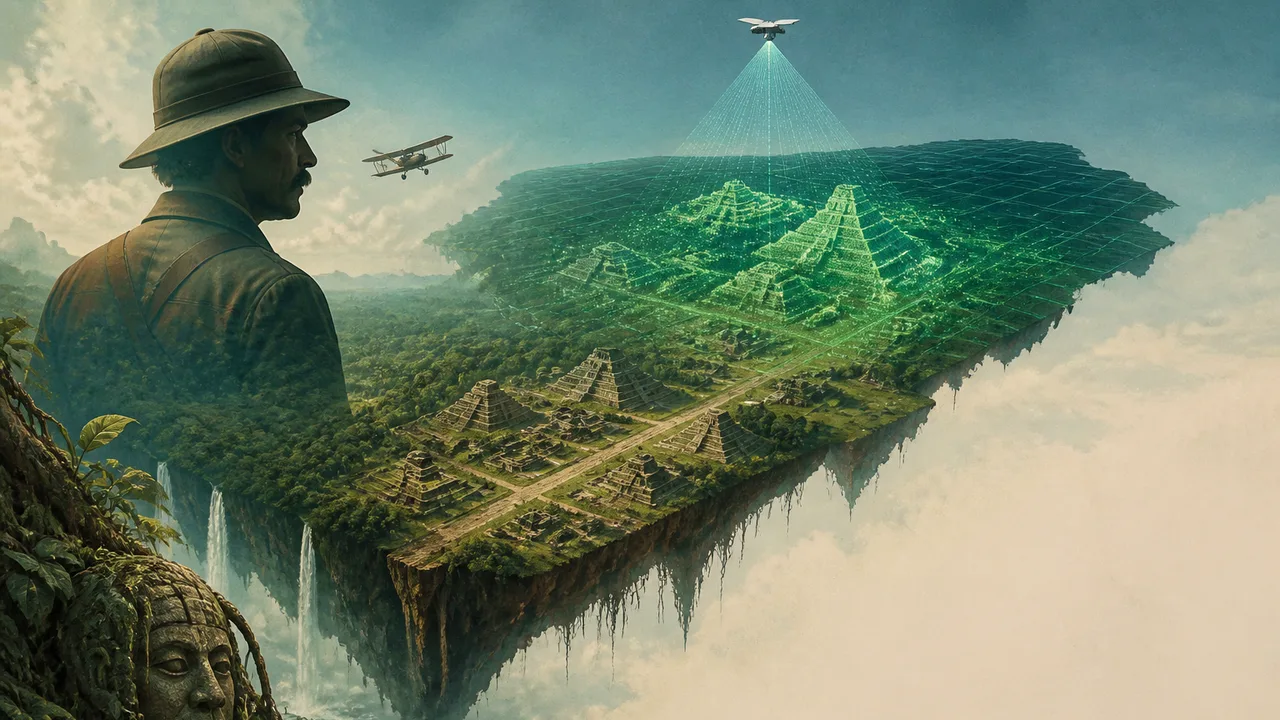
Photo: AI. Iolanthe Fenwick
There is a particular kind of historical injustice in being told you have no history. It is not a neutral claim. It is a political one—and it has consequences. For most of the 20th century, that was precisely the story told about the Amazon: a green desert, a timeless wilderness, home to scattered tribes who had always lived simply and always would. The science felt settled. The soil was too poor. The climate too punishing. No stone cities, no pyramids, no civilization worth recording.
That story is now, piece by piece, being demolished.
Pete Kelly's two-hour-plus documentary for his YouTube channel History Time, The Entire History of the Ancient Amazon, is an ambitious attempt to narrate what's replacing it. Kelly spent years on this project—beginning research in 2020, visiting the Amazon in 2023, and holding off release specifically because the field kept generating new findings. That patience is visible in the final product. This isn't a breathless "lost cities!" special. It's a careful accumulation of what the archaeology actually shows, layered over one of history's more extraordinary disappearance stories: that of British explorer Percy Harrison Fawcett, who walked into the jungle in 1925 with his son and a friend, and never came back.
Fawcett is the frame. But the Amazon is the subject.
The Man Who Was Right for the Wrong Reasons
Fawcett is a complicated figure to rehabilitate. Kelly doesn't shy away from this. He was a colonial officer, a rigid taskmaster, a man shaped by theosophical mysticism and Victorian empire. He was also, by the standards of his time, remarkably observant. Where his contemporaries saw savagery, Fawcett saw stockpiles of food, cultivated floodplains, ingenious fishing methods—and started asking what else might be hidden.
He called his hypothetical civilization "Z." Academics called it fantasy.
"Today, all the evidence suggests that Fawcett was right all along," Kelly says in the documentary. "As many as 25,000 earthworks alone having been found to date, as well as an astonishing array of complex city-building civilizations."
That vindication, though, comes with an asterisk worth examining. Fawcett was looking for stone cities—Inca-style, Maya-style, something legible to a Victorian eye trained on monuments. What archaeology has actually found is something harder to see and, in many ways, more interesting: civilizations that built horizontally rather than vertically, that engineered entire landscapes rather than erecting individual structures, that turned poor tropical soil into something fertile enough to feed millions. Not the lost world Fawcett imagined. A different kind of world entirely.
What the Forest Was Hiding
The transformation of Amazonian archaeology over the past two decades has been driven, more than anything, by LiDAR—laser mapping technology that strips the canopy away digitally and reveals what lies beneath. The results, site after site, have been extraordinary.
In Bolivia's Llanos de Mojos, Bolivian archaeologist Carla Betancourt's LiDAR surveys from 2022 onward revealed a landscape of tens of thousands of levees, irrigation ditches, causeways, reservoirs, and pyramid mounds—some significantly taller than the famous pyramids at Tiwanaku in the Andes. This was the Casarabe culture, flourishing between roughly 500 and 1400 AD, in a region previously considered too inhospitable for complex settlement. The latest population estimates for this single region alone reach as high as a million people.
In Ecuador's Upano River Valley, results published in 2024 pushed the timeline back even further. French archaeologist Stéphan Rostain, who first noted the structures in the 1970s, finally had the LiDAR data to reveal their full extent: five major urban centers, ten smaller ones, thousands of earthen platforms arranged around planned plazas, wide straight roads connecting them across 300 kilometers of landscape. Radiocarbon dates run as early as 500 BC. This is, as Kelly notes, the oldest complex society yet identified in the Amazon—predating Bolivia's Casarabe culture by roughly a thousand years.
Co-author Fernando Mejia of the Catholic University of Ecuador put it plainly: "Without a doubt, if the Maya world and that of Cahokia in what is now the United States are considered urbanism, albeit in a more spread-out form than old world urban centers, then this is too."
And in Brazil's upper Xingu River Valley, anthropologist Michael Heckenberger of the University of Florida spent over three decades living among the Xinguano people, eventually identifying Kuhikugu—a vast networked settlement system complete with walled towns, roads up to fifty feet wide, ceremonial plazas, and an estimated population of 50,000 people across the wider complex. The Xinguano, notably, appear to be direct descendants of the ancient builders. The knowledge didn't disappear entirely. It survived, diminished, in the people who remain.
The Soil That Changed Everything
Underneath all of these revelations is a quieter one, and in some ways the most radical: terra preta, or Amazonian dark earth. This is not natural soil. It is manufactured soil—centuries of deliberately composted organic waste, ash, and ceramic fragments, worked into the ground by generations of people to transform nutrient-poor clay into something capable of sustaining intensive agriculture. An area twice the size of Ireland in the Bolivian lowlands alone was converted this way.
This matters for two reasons. First, it demolished the old argument that Amazon soil simply couldn't support civilization—because the people who lived there had been improving that soil for millennia before Europeans arrived. Second, and perhaps more urgently, researchers are now exploring whether terra preta could be part of the solution to ongoing deforestation—a pre-Columbian technology with potential 21st-century applications for land restoration.
The academic who held the line against all of this longest was Betty Meggers, an American archaeologist who insisted until her death in 2012 that any complex society found in the Amazon must have diffused from the Andes or elsewhere—that the forest itself was simply too hostile for independent urban development. She explained away everything she found. When she encountered the Valdivia pottery culture of Ecuador, she attributed it to Jōmon-era Japan. The field moved on around her while she held her position. Kelly is fair to her—she was working within the paradigm of her time—but he doesn't soften the irony that she spent decades finding exactly what she refused to believe existed.
A Record Interrupted
The other thing worth sitting with is how we know any of this at all—and how much we've already lost.
The first European to navigate the full Amazon River, Francisco de Orellana, did so in 1541–42. His chaplain, Gaspar de Carvajal, kept meticulous records: densely populated settlements lining both banks for hundreds of miles, cities with wide central avenues, war fleets of canoes, trade networks spanning the whole river, at least thirteen named overlords and twenty-six tribal groups. When later Europeans returned, they found none of it. The forest had reclaimed everything. Carvajal was dismissed as a fantasist for four centuries.
What happened between Orellana's passage and the return of Europeans wasn't emptiness. It was catastrophe. The diseases that arrived with the Spanish—smallpox, measles, influenza—moved through interconnected river societies far faster than any army. Populations that had no immunological defense collapsed in waves. What the later explorers found was the aftermath of a civilizational apocalypse, and they mistook it for the original condition.
"As far as westerners were concerned, the Amazon was a land without history, sometimes even without myth," Kelly observes. "But today, we can dig to tell the tale."
The archaeology now corroborates what Carvajal wrote. The cities were real. The roads were real. The population was real. What was missing was the catastrophe itself from the historical record—because the people who lived through it didn't survive to write it down, and the ones who came after weren't looking for evidence of what had been lost.
What We're Still Figuring Out
It's worth being clear about what remains genuinely uncertain. The Upano Valley sites are close enough to the Andes that Andean cultural influence can't be entirely ruled out—though researchers emphasize the distinctly Amazonian character of the society. The question of political organization across these vast networked settlements—whether they were governed by central authority, religious hierarchy, competitive polities, or some combination—remains open. Heckenberger's "galactic urbanism" model, with its clusters of settlements radiating from ceremonial centers, is compelling but still being tested against new LiDAR data published as recently as 2024 and 2025.
And there is the harder question that no LiDAR survey can answer: what did these people believe, how did they organize their social lives, what were their own names for themselves and their cities? The oral histories that survived European contact were rarely recorded with anything like care. What we have is largely the material record—the earthworks, the dark earth, the ceramics. The rest requires the kind of slow, patient, community-rooted work that Heckenberger modeled, living among the Xinguano for decades. There aren't enough researchers doing that kind of work, in part because it doesn't produce quick publications.
Stefan Rostain, the lead researcher on the Upano Valley, said of what's been found so far: "Rather than a singular Amazonia, because of the sheer quantity and differences between the various cultures therein, we should say Amazonas." Plural. Each civilization distinct, each adapting differently to its particular corner of the basin.
That plurality is what the old "green desert" myth could never accommodate. The Amazon was not one empty place. It was many full ones.
More Like This
Middle Platonism's Hidden Role in Western Esotericism
ESOTERICA's new crowdfunded seminar argues Middle Platonism built the foundations of Hermeticism, Gnosticism, and early Christian theology. Here's what that means.
LIDAR Is Rewriting What We Know of Ancient Cities
Anthropologist Luke Caverns is planning the largest LIDAR scan ever done in the Amazon. What the technology finds may force a rewrite of ancient history.

Uncontacted Tribes and the Amazon's Perilous Future
Paul Rosolie discusses Amazon deforestation and its impact on uncontacted tribes and global ecology on Joe Rogan's podcast.
San Francisco 1906: The Disaster That Was Built
The 1906 San Francisco earthquake wasn't just an act of nature—it was the bill coming due on decades of willful ignorance. Here's what actually happened.
Pavlopetri: Inside the World's Oldest Sunken City
A Bronze Age city has sat submerged off southern Greece for 3,500 years. New technology is finally letting archaeologists read what it says about us.
The Gods of Pre-Islamic Arabia, In Their Own Words
Ancient desert inscriptions reveal the polytheistic world before Islam—gods, prayers, sacrifice, and fate, recorded by the nomads who lived it.

DNA Names a Revolutionary War Teen Soldier After 245 Years
Genetic genealogy has identified Private John Pumphrey, a Maryland teen who died at the Battle of Camden in 1780 — one of America's oldest John Doe cases.
Cicero and the Fall of the Roman Republic
Marcus Tullius Cicero defended Rome's Republic with words alone—and paid with his life. A look at history's most consequential orator and his impossible political moment.