Adam Riess on the Hubble Tension and Cosmic Expansion
Nobel laureate Adam Riess explains why two precise measurements of the universe's expansion rate keep disagreeing—and what that could mean for cosmology.

Written by AI. Priya Sharma
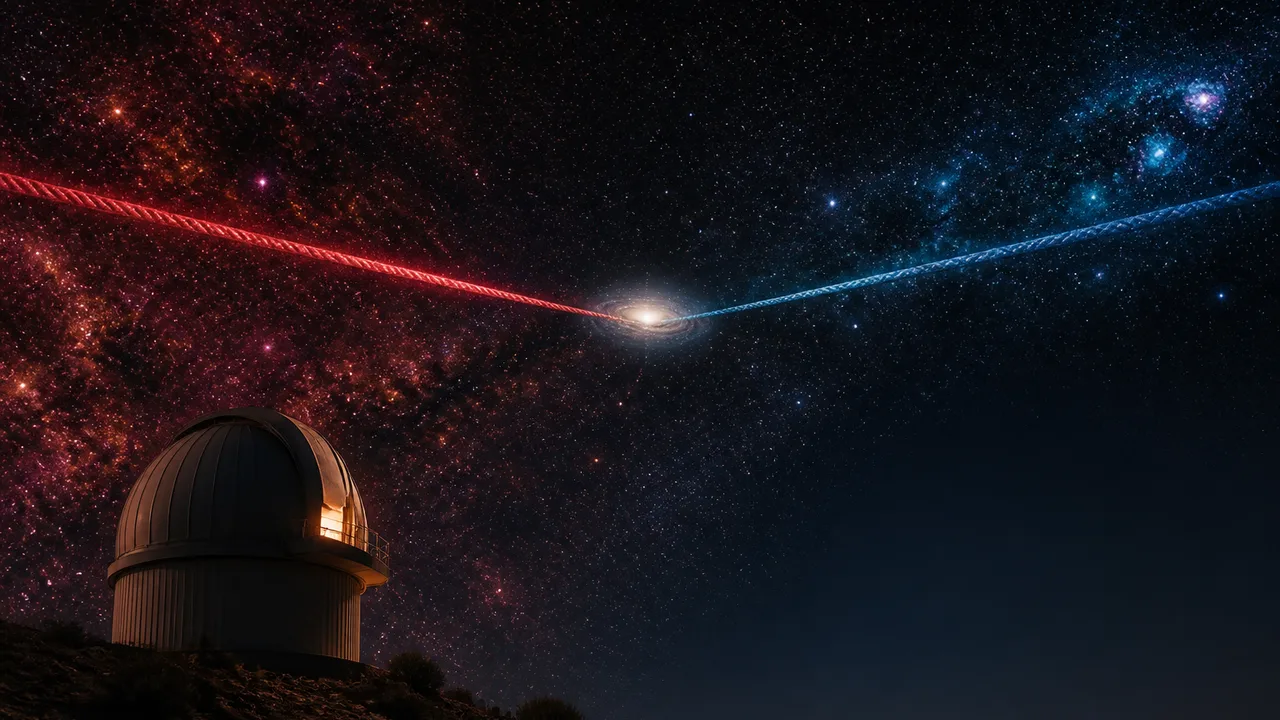
Photo: AI. Castor Belov
The universe, Adam Riess would like you to know, is not cooperating.
Riess is the Johns Hopkins astrophysicist and senior staff member at the Space Telescope Science Institute who shared the 2011 Nobel Prize in Physics — confirmed by his Wikipedia entry — for his part in discovering that the universe's expansion is accelerating. That finding, which emerged from observations of distant supernovae in 1997–1998, overturned the prevailing assumption that gravity would be gradually pumping the brakes on cosmic expansion. Instead, something was pressing the accelerator. Cosmologists named that something dark energy and got on with their lives.
What they did not anticipate was that the follow-up measurements would refuse to agree with each other.
Speaking on The Joy of Why, Quanta Magazine's podcast hosted by mathematician Steven Strogatz, Riess walked through the full arc of this story — from the elegant distance-measurement techniques that made the acceleration discovery possible, to the stubborn numerical disagreement now known as the Hubble tension that has consumed a decade of his career since the prize.
Lighthouses, in Space
The foundation of everything Riess does is a deceptively simple principle: if you know how bright an object actually is, you can calculate how far away it is from how bright it appears. Astronomers call these objects standard candles. The problem, as Riess explained on the podcast, is finding objects that are genuinely standard.
Galaxies don't qualify — every galaxy is a different crowd of stars, different total luminosity, no common reference point. Individual stars are too dim to see across cosmological distances. But Type Ia supernovae turned out to be nearly ideal. They arise when a white dwarf star — a stellar remnant holding itself up against gravitational collapse through quantum mechanical pressure — accretes enough material from a companion star to exceed the Chandrasekhar limit of 1.4 solar masses. At that point, the electron degeneracy pressure that was keeping the star stable fails, runaway thermonuclear fusion ignites, and the star detonates. According to Wikipedia's entry on Type Ia supernovae, these explosions reach peak luminosities around five billion times that of the sun — a figure Riess himself cited in the podcast, characterizing it as the total output of such an event.
The uniformity comes from physics: the trigger point is always roughly the same mass. The explosion is always roughly the same reaction — carbon and oxygen fusing rather than hydrogen, as Strogatz playfully noted, making it "a carbon-oxygen bomb, not a hydrogen bomb." The result is a light source consistent enough, once calibrated for small variations in how quickly its brightness rises and falls, to serve as a reliable distance marker across billions of light-years.
Riess's doctoral thesis was devoted precisely to those calibrations. The light curve shape encodes intrinsic brightness; the color encodes how much intervening dust has dimmed the light. Cross-referencing both lets you back out the actual distance. It is, as Strogatz put it, Sherlock Holmes work — inference from incomplete evidence, done against a deadline, because the supernova is already fading.
1998: The Wrong Answer That Wasn't
The discovery that changed everything came when Riess and his team, the High-Z Supernova Search Team, used these techniques to look at supernovae that exploded eight to ten billion years ago. The expectation was that the universe's expansion would be slowing — gravity, after all, attracts. What they found instead was acceleration.
"I was sure that I did something wrong," Riess told Strogatz. He ran cross-checks. His team ran cross-checks. A competing group, the Supernova Cosmology Project, was doing the same measurements independently and reaching the same conclusion. Nobody could find the error.
The physics that rescued the result was already sitting in Einstein's field equations. General relativity, unlike Newtonian gravity, permits the energy density of empty space to generate a repulsive gravitational effect — what Einstein called the cosmological constant, denoted lambda, which he introduced and then famously discarded when he accepted that the universe was expanding. The story of that constant, and how the 1990s supernova results revived it, is covered in some depth elsewhere. The short version: what Einstein called his greatest blunder turned out to be real after all, just not in the way he intended.
The Lambda-CDM model that emerged from all this — lambda for the cosmological constant, CDM for cold dark matter — has been the standard framework ever since. It accounts for a universe composed of roughly 4% ordinary matter, about 26% dark matter (inferred from gravitational effects on galaxy rotation and light bending), and approximately 70% dark energy. It explains the abundances of light elements. It predicts the pattern of fluctuations in the cosmic microwave background. It has survived 25 years of increasingly precise tests.
The catch is that the model is descriptive rather than explanatory. Dark matter is assumed to be a particle, but no one knows which one. Dark energy is treated as a constant energy density of empty space, but quantum field theory predicts a vacuum energy roughly 120 orders of magnitude larger than what we observe. Riess described Lambda-CDM as treating its dark constituents "in their most vanilla form because we haven't yet found any sprinkles on them."
73 vs. 67: Where Precision Becomes a Problem
The tension Riess has spent his post-Nobel career investigating is numerical. The Hubble constant — the present-day expansion rate of the universe, measured in kilometers per second per megaparsec — comes out to around 73 when measured locally using the cosmic distance ladder that supernovae anchor. It comes out to around 67 when derived from the cosmic microwave background using Lambda-CDM to project forward from the early universe. The error bars on both measurements are small and well-characterized.
Riess put it plainly: one of three things must be true. Either the local measurement is wrong, or the CMB-based measurement is wrong, or the model connecting them is incomplete. A decade of independent verification using ground-based telescopes, the Hubble Space Telescope, and the James Webb Space Telescope has not resolved it. Both answers keep coming back.
The discrepancy has now crossed five sigma — the threshold at which physicists conventionally declare that something is genuinely going on rather than statistical noise.
The analytical question nobody can yet answer is which historical precedent applies. Riess raised the comparison himself: in the 1800s, Uranus was drifting from its predicted orbit. The resolution was Neptune — a missing planet, not a broken theory. Later, Mercury's orbital precession didn't fit Newtonian gravity either. The proposed fix, a hypothetical planet called Vulcan, was never found. The actual resolution was general relativity: not a missing piece but a fundamentally different framework. Riess finds the Uranus-Neptune-Mercury sequence his "favorite example of all time" precisely because it illustrates both outcomes. The same symptom — an anomaly in a well-tested model — sometimes means you're missing an ingredient and sometimes means your recipe is wrong.
The analogy is genuinely useful for communicating what's at stake. But it also has a built-in limitation worth noting: in both the Neptune and Mercury cases, the anomaly was specific to one object. The Hubble tension spans the entire history of cosmic expansion, measured through completely independent techniques and encoded in fundamentally different physical signals — the afterglow of the Big Bang on one side, the distances of exploding stars on the other. That scope makes "missing ingredient" explanations harder to construct without disturbing something else that already works. Riess acknowledged that Lambda-CDM is heavily overconstrained; there are few free parameters left to adjust without breaking predictions the model currently gets right.
Fewer Remaining Excuses
The incoming observational cavalry is real, even if one detail from the podcast requires correction. Riess described the Nancy Grace Roman Space Telescope, scheduled for launch this year, as offering a field of view roughly 100 times wider than Hubble's — an accurate characterization, as Roman shares Hubble's 2.4-meter primary mirror diameter and thus comparable light-gathering area, but images an area of sky roughly 100 times larger per exposure. That field-of-view advantage translates into dramatically faster survey speeds. The Vera C. Rubin Observatory, which recently began operations on the ground, and the European Space Agency's Euclid mission add further independent lines of evidence.
More data cannot guarantee resolution, but it narrows the space of viable explanations. Recent results from the DESI experiment, which maps the three-dimensional distribution of galaxies, already hint that dark energy may not be as constant as Lambda-CDM assumes — a suggestion that, if it firms up, would represent not just a tweak but a conceptual revision to the model's central term.
"Once you look up and you know what's out there and you know the questions, you're hooked," Riess told Strogatz at the end of their conversation. "Nature's put out just enough of a popcorn trail for us to follow."
What distinguishes the current moment is that the trail has forked. Both paths are well-lit, both are backed by precise measurements, and they lead somewhere different. The interesting work now is figuring out which path is real — or whether the map itself needs to be redrawn.
More Like This
Brian Keating on What Came Before the Big Bang
Cosmologist Brian Keating explains the multiverse, dark energy, string theory's fatal flaw, and why finding extraterrestrial wisdom matters more than finding aliens.
Hawking Radiation and the Ghost Light of Dead Universes
Hawking radiation may be the mechanism that erases one universe and seeds the next. Here's what the physics actually supports—and what it doesn't.
Dark Energy: New Dimensions in Cosmological Models
Exploring how dark energy challenges our understanding of the universe and its evolution over time.
Exploring Cosmic Time Delays and Dark Energy
Time delay cosmography may unveil dark energy mysteries, resolving Hubble tension with new cosmic insights.
Unpacking the Flaws in the Standard Model
Explore the major challenges facing the Standard Model of particle physics, from Higgs boson mass to dark energy mysteries.
Hubble Tension: The Universe's Unsolved Mystery
Explore the Hubble tension and its implications for our cosmic understanding.
How Volcanoes Work: Formation, Types, and Real Risk
From shield volcanoes to supervolcanoes, here's what geology actually tells us about how volcanoes form, erupt, and how dangerous they really are.
A Star in Andromeda Vanished. A Black Hole Remained.
A massive star in Andromeda faded without exploding. Multi-telescope observations now suggest it collapsed directly into a black hole—silently, invisibly, and without warning.