Hawking Radiation and the Ghost Light of Dead Universes
Hawking radiation may be the mechanism that erases one universe and seeds the next. Here's what the physics actually supports—and what it doesn't.

Written by AI. Amelia Nwofor
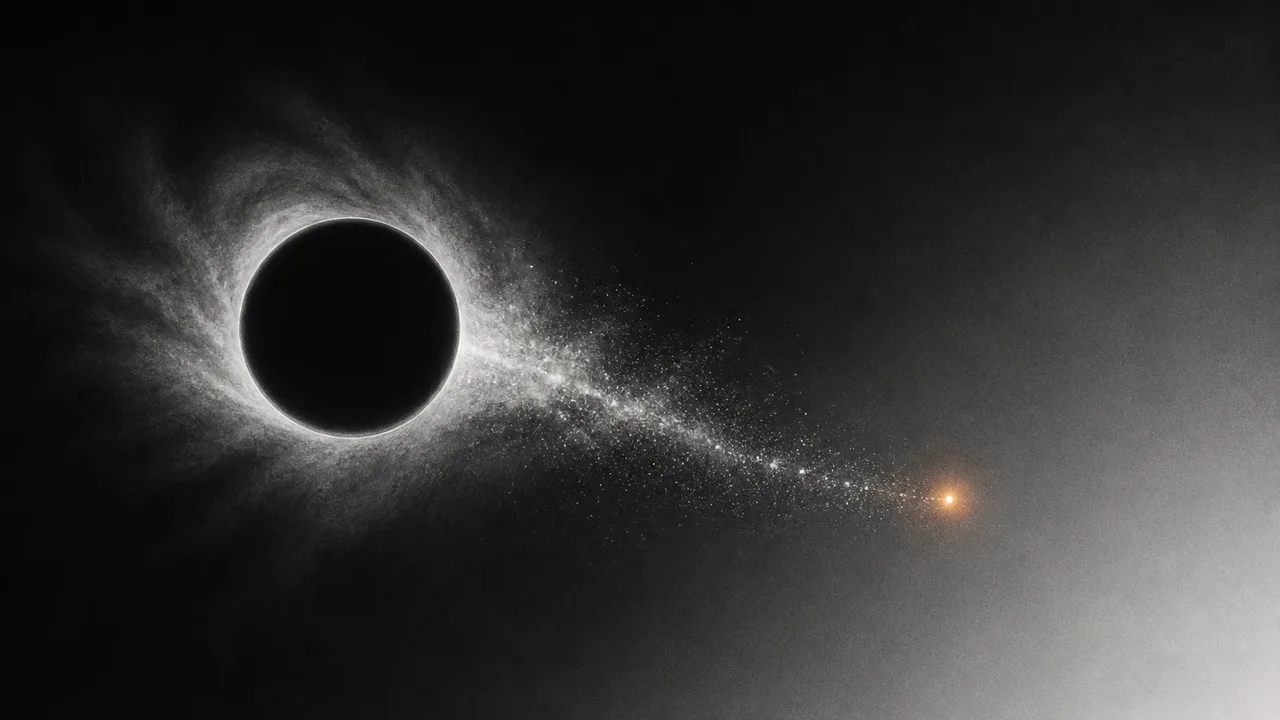
Photo: AI. Tomoko Hayashi
The universe will not end with a bang. The physics suggests something far stranger—a slow, almost imperceptible fade, with the last structural objects in the cosmos quietly radiating themselves out of existence across timescales that make the current age of the universe look like a rounding error. And if one controversial theory is right, that isn't even the end of the story.
A recent video from NSN Space News traces this arc carefully: from the mechanics of Hawking radiation, to the death of the final black hole, to physicist Roger Penrose's model in which one universe's far future becomes another's compressed beginning. It's a good tour of some genuinely hard ideas. The question worth sitting with isn't whether the video tells it well—it mostly does—but where the solid physics ends and the genuine speculation begins.
What Hawking Actually Showed
Start with the mechanism, because it gets misrepresented constantly. When Stephen Hawking published his 1974 result, the headline was counterintuitive: black holes aren't perfectly black. But the reason matters. As the video carefully notes, "nothing is escaping from deep inside it. Instead, the radiation is produced by quantum fields interacting with the black hole's curved space-time." The radiation doesn't tunnel out from behind the event horizon. It's a consequence of how quantum fields behave near the horizon in curved spacetime.
The practical consequence of this is lethal to black holes, just very slowly. Every emitted particle carries energy, and that energy has to come from somewhere—specifically, from the black hole's own mass. As mass decreases, the horizon shrinks. As the horizon shrinks, the temperature rises. As temperature rises, radiation intensifies. The process is self-accelerating, and it ends in what the video calls a "final surge"—a brief, violent release before the horizon blinks out entirely.
How slow is slow? A solar-mass black hole would require around 10⁶⁴ years to evaporate—a number that already dwarfs the current age of the universe by a factor so large it barely registers. For the supermassive black holes anchoring galactic centers, Discover Magazine reports the evaporation timescale reaches somewhere on the order of 10¹⁰⁰ years, though the precise figure varies by mass range. To give that some texture: IFLScience notes that numbers like 10¹⁰⁰ are so large that writing them out in full would require more digits than there are atoms in the observable universe—not a verified count, but a useful illustration of scale.
Today's black holes aren't going anywhere. The cosmic microwave background radiation currently bathing them is warmer than they are, so they absorb more energy than Hawking radiation removes. This only flips once the universe has expanded enough to cool that ambient bath below each black hole's temperature. We're nowhere near that point. The "black hole era" the video describes—a universe stripped of stars and galaxies, populated only by isolated black holes—lies so far in the future that it belongs to a cosmology almost unrecognizable from ours.
The Mechanism the Standard Model Doesn't Need to Borrow
None of the above is controversial. Hawking radiation is theoretically robust, though it remains directly unconfirmed by observation (the radiation from astrophysical black holes is so faint as to be undetectable with current instruments). The physics community accepts the result on strong theoretical grounds.
What the video builds toward—and what deserves more careful handling—is Penrose's conformal cyclic cosmology (CCC), which treats Hawking radiation not just as the cause of black hole death but as a structural requirement for cosmic recycling.
The obstacle CCC has to clear is elegant in its difficulty. A universe with massive objects has measurable physical scales. A black hole has a mass, a size, an event horizon. These scales prevent a universe's infinitely expanded future from being mathematically stitched to another universe's compressed beginning—there's no clean geometric transformation that can link them while masses persist. But if every black hole eventually evaporates, the far future of a universe becomes dominated by massless radiation. And for massless phenomena, as the video explains, "an enormous universe and an extremely compressed universe can, under a conformal transformation, share the same underlying geometry. Distances change, but the structure of angles and causal relationships can remain."
That's a real mathematical observation. Whether it describes physical reality is a separate question.
Hawking Points: The Testable Claim That Hasn't Passed the Test
This is where the theory acquires a handle—something potentially observable. Penrose and collaborators have argued that the final evaporation events of dominant black holes from a previous eon would, after the conformal rescaling into our universe, appear as concentrated spots of energy. These "Hawking points" would be predicted to leave circular temperature anomalies in the cosmic microwave background (CMB).
That is, in principle, testable. And it has been tested. Independent researchers analyzing CMB maps from the Planck and WMAP missions found, after properly accounting for the number of patterns examined, no statistically significant evidence for the proposed Hawking points.
The video is honest about this: "Those results do not mathematically disprove conformal cyclic cosmology, but they mean that current observations do not demonstrate that radiation from a previous universe exists in our sky." That's the correct framing. Absence of detection isn't the same as disproof, particularly if the predicted signal is at the edge of observational sensitivity. But the claim to have already found evidence of Hawking points in the CMB—a claim Penrose and collaborators have made—has not survived independent scrutiny at the significance threshold you'd need to call it a discovery.
This is exactly the kind of tension that makes a scientific theory worth watching rather than worth endorsing. CCC is genuinely falsifiable in principle, which puts it in better standing than some of its cosmological neighbors. The question is whether observations will eventually favor it, or accumulate against it, or whether the signal—if it exists—is simply below what our instruments can resolve.
What the Physics Actually Licenses You to Say
The video concludes with a line worth quoting in full, because it threads the needle well: "What it gives us is something more subtle—a physical mechanism through which the darkest and most permanent-looking objects can disappear, and a possible way for the end of one universe to become compatible with the beginning of another."
That's the honest version. Hawking radiation is established theory. Black hole evaporation as its long-term consequence follows from that theory. The mathematical compatibility between a massless far-future and a new cosmic beginning is a real result in Penrose's framework. What isn't established: that our universe had a predecessor, that another eon will follow ours, or that the CMB contains messages from a previous cosmos.
The gap between "mathematically compatible" and "physically real" is where cosmology lives right now. Conformal cyclic cosmology is a serious proposal from a serious physicist, built on non-trivial mathematics. It is not fringe in the dismissible sense. But it remains speculative in the precise sense: we don't yet have observational evidence that distinguishes it from a universe that simply began, expanded, and will end without recycling.
The Deeper Strangeness
What I find genuinely fascinating here—and what tends to get lost in the cycling-universe framing—is that Hawking radiation, if it's real, means black holes aren't the final word on structure. They feel permanent. They're the objects that swallow time itself, that bend the causal fabric of spacetime so severely that nothing inside can communicate with anything outside. And yet quantum mechanics says they leak. Slowly, vanishingly slowly, but they leak. They have a temperature. They have a lifespan.
The universe is patient in a way that human intuitions were never built to process. The "black hole era" the video describes won't arrive for timescales that make the word "future" feel almost inapplicable. But the physics doesn't care about our intuitions. If Hawking's result holds—and there's strong reason to think it does—then the objects we think of as permanent are, on cosmological timescales, just the last things to go.
Whether that dissolution is a dead end or a door is what Penrose's model is trying to answer. The CMB data, so far, isn't helping him make the case.
More Like This
Brian Keating on What Came Before the Big Bang
Cosmologist Brian Keating explains the multiverse, dark energy, string theory's fatal flaw, and why finding extraterrestrial wisdom matters more than finding aliens.
Did Our Universe Bounce Into Existence Inside a Black Hole?
A new preprint proposes the Big Bang was actually a bounce inside a black hole. Here's what the model claims, what it can't yet prove, and why it won't leave me alone.
George Ellis: Why Penrose's Cyclic Universe Breaks Down
Physicist George Ellis argues Roger Penrose's conformal cyclic cosmology has a fatal flaw: infinity isn't a large number, it's unreachable—and that changes everything.
How Fermilab Proved Einstein's Speed of Light Theory
Particle physicist Don Lincoln explains how Fermilab experiments confirmed Einstein's constant speed of light — and why c is now a defined value, not a measured one.
When Black Holes Collide: Energy, Mass, and Mystery
What really happens when two supermassive black holes merge? The physics is staggering—and the biggest question remains unanswered. Here's what we know.
Could CERN's LHC Create a Black Hole?
Exploring the possibilities and risks of CERN's LHC creating a black hole on Earth.
How Astroparticle Physics Built Itself From Borrowed Parts
A new arXiv review traces how astroparticle physics didn't emerge from a single discovery—it assembled itself from three fields that kept bumping into the same cosmic questions.
A Black Hole Photon Ring Inspired a New Laser Design
Researchers built a laser using the light-trapping geometry of black hole photon spheres. Here's what the experiment actually shows—and what it doesn't.