Webb Detects Methane on Interstellar Comet 3I/ATLAS
Webb's MIRI instrument detected methane on interstellar comet 3I/ATLAS after perihelion—a timing that hints at buried volatile layers from another planetary system.

Written by AI. Amelia Nwofor
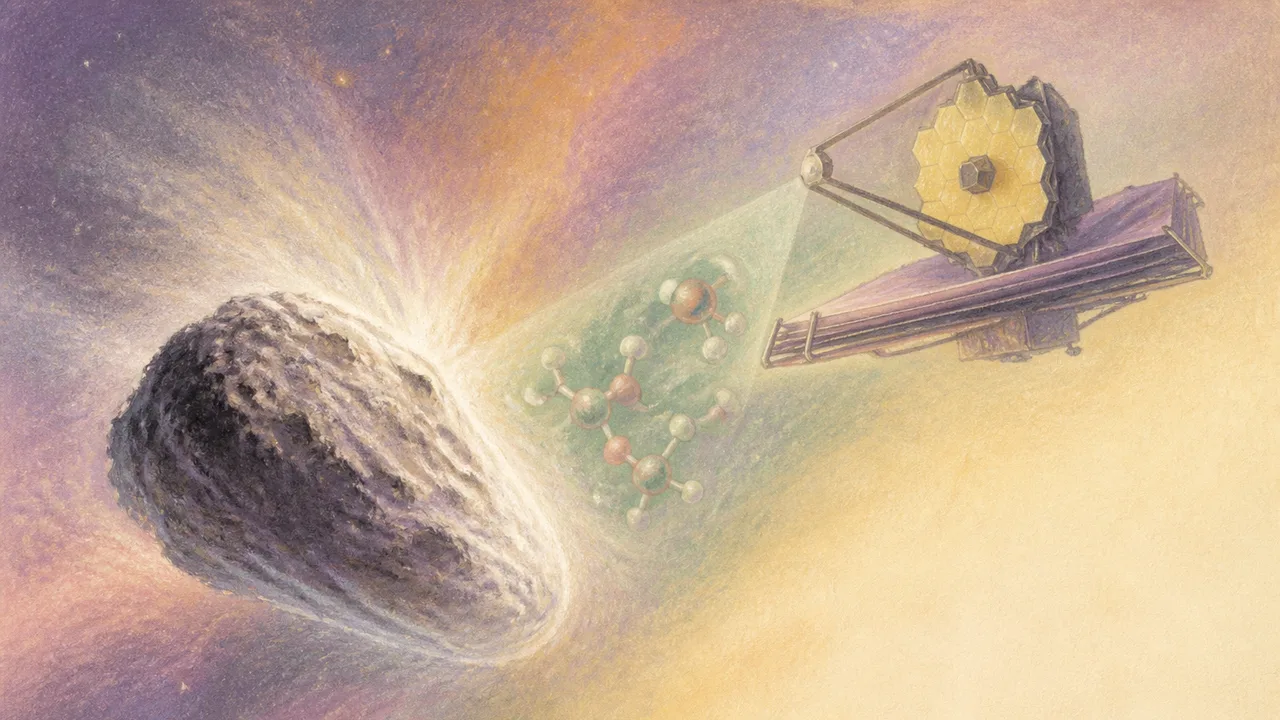
Photo: AI. Aiyana Stone
There's a version of this story that writes itself: mysterious comet from another star system baffles NASA scientists. That version is not wrong, exactly. It's just not where the interesting science lives.
The interesting science is in the timing.
When the James Webb Space Telescope trained its Mid-Infrared Instrument—MIRI—on the interstellar comet 3I/ATLAS, the comet had already passed perihelion. It was on its way back out, retreating from the Sun's peak heating. That's the context that makes the methane detection, reported in a preprint posted to arXiv (2601.22034), worth pausing on. Methane is highly volatile. Under normal circumstances, you'd expect surface methane to flash off during the closest solar approach, not linger as a detectable signal in the aftermath. The fact that it showed up after peak heating is what's driving the scientific conversation—and what keeps this from being a routine "comet has gas" story.
What MIRI Actually Saw
Webb didn't just take a snapshot. It caught 3I/ATLAS in the act of changing. MIRI splits infrared light into specific wavelengths, letting researchers read the chemical fingerprints coming off the nucleus and the surrounding coma rather than just tracking position. What it found was a multi-molecule profile with some notable internal tensions.
Water vapor was present but spread out—diffuse, extending further from the nucleus. Methane and carbon dioxide, by contrast, were concentrated closer in. And as the comet moved farther from the Sun, the gases didn't all behave the same way. Water production dropped most sharply, which fits the expected model: water ice sublimates readily near the Sun but quiets down fast as heating fades. Methane and carbon dioxide are more volatile, so their persistence at greater heliocentric distances is less surprising in isolation. What matters is the relative picture—particularly the carbon dioxide-to-water ratio, which researchers describe as unusually high compared with typical solar system comets.
Then there's the methane signal itself, which marks the first direct detection of methane on any interstellar object. As the source material puts it: "The delayed appearance suggests that the methane may have been protected below the outer layers until heat from the sun reached deeper material."
That's a mechanistically coherent explanation. It's also, right now, a hypothesis. The data are consistent with buried methane reservoirs—but the preprint, as of this writing, is working from a relatively narrow observation window, and the inferences about interior structure extend beyond what direct measurement can yet confirm.
The Chemical Memory Argument
Here's where I find the framing genuinely useful, even if it runs a little ahead of the data.
Comets are often described as "dirty snowballs"—aggregates of ice, rock, and organic material left over from planet formation. In our solar system, they carry chemical records of conditions in the early solar nebula: what temperatures prevailed where, which ices could survive at which distances from the young Sun. The logic applied to interstellar comets is the same, just pointed outward. If 3I/ATLAS formed in another planetary system's protoplanetary disk, its chemistry might preserve something about that disk's temperature structure and volatile inventory.
The volatility ratio on 3I/ATLAS—high CO₂ relative to water, plus the methane signal—points toward one of two broad possibilities. Either the comet formed in a colder region of its home system, where methane and CO₂ ices could survive more easily, or its outer layers were processed and stripped before ejection into interstellar space, leaving a depleted surface above intact volatile reservoirs. The two scenarios aren't mutually exclusive, which is part of what makes this hard to resolve from a single observation set.
"Its chemistry may reflect a different disk, a different formation distance, and a different history before it was thrown into interstellar space," the source notes. That's fair, and it's a genuinely useful frame. What it doesn't—and can't—do yet is tell us which scenario is operative, or in what proportion.
This is where the comparison to 'Oumuamua (the first confirmed interstellar object, detected in 2017) and Borisov (2I/Borisov, the first confirmed interstellar comet, in 2019) becomes relevant. Borisov's chemistry, studied by multiple telescopes, looked broadly similar to solar system comets—slightly elevated CO and CO₂, but nothing that screamed "alien chemistry." 3I/ATLAS appears to be doing something more unusual. Whether that difference reflects genuine chemical diversity across planetary systems, or a selection effect (we're catching objects that happen to be volatile-rich enough to be detectable), is an open question that a sample of three can't settle.
What the Timing Question Is Really Asking
Let me be precise about what's actually puzzling here, because "baffling scientists" is doing a lot of work in the headline ecosystem right now.
Methane appearing post-perihelion isn't physically impossible—it fits a model where subsurface material gets exposed as outer layers erode. That's a well-understood process on solar system comets. What makes 3I/ATLAS interesting isn't that the methane detection violates known physics. It's that the delayed detection provides a potential structural diagnostic: if the surface were methane-rich to begin with, you'd expect more of it earlier. The timing is consistent with a layered interior, which would mean the surface "skin" of this comet tells a different story than the material underneath.
"Webb may have caught more than a gas escaping from a comet," the analysis suggests. "It may have caught a hidden layer of another planetary system becoming active for the first time in front of our telescopes."
That's a compelling way to frame it. It's also the kind of sentence that benefits from a qualifier: if the layered-interior interpretation holds up under further analysis, and if the compositional signal genuinely reflects formation conditions rather than post-formation processing. Those are not small ifs. They're the questions the follow-up work has to address.
The Methodological Takeaway
What's underappreciated in the coverage is the observational lesson here, which applies regardless of how the chemical interpretation shakes out. A single observational window—even a Webb-quality one—can't capture a comet's full chemical evolution. "Scientists need to track these objects before perihelion, during peak heating, and after they begin moving away from the sun," the source notes. "The way gases rise, fade, or appear late can reveal how heat travels through the object and what kinds of ice are stored inside."
This is a real constraint, and it's worth sitting with. 3I/ATLAS was caught post-perihelion. We don't have the pre-perihelion baseline. That gap matters for interpreting whether the methane signal is truly "delayed" in a meaningful structural sense, or whether earlier observations would have told a different story. Future interstellar objects—and given the detection rate is now three in less than a decade, there will be more—need to be flagged and scheduled for observation earlier, ideally with a coordinated multi-telescope campaign across multiple heliocentric distances.
The comparison effort is also ongoing: researchers plan to look at how 3I/ATLAS's full molecular inventory—methane, CO₂, water, carbon monoxide, dust—changed over time, and to stack that against what's known from Borisov and other cometary benchmarks. That comparative work is where the "chemical memory" argument will either gain traction or get complicated.
What 3I/ATLAS appears to be offering, at minimum, is the most chemically detailed portrait of an interstellar object we've yet obtained—and a portrait that doesn't look quite like anything from our own neighborhood. Whether that makes it a window into a genuinely alien chemistry or a snapshot of a known process in an unfamiliar comet is a question still waiting on the data.
For now, the methane is real. The timing is interesting. The interpretations are provisional. And there's another object out there, somewhere, that will either sharpen the picture or scramble it entirely.
More Like This

Betelgeuse's Hidden Star: Solving Celestial Mysteries
Unveiling Betelgeuse's hidden companion star reshapes our understanding of stellar evolution and supernova precursors.
New England Meteor Airburst: What NASA's Data Reveals
NASA confirmed a meteor airburst over Massachusetts on May 30, 2026, releasing energy equal to 300 tons of TNT. Here's what the science actually shows.

JWST's Latest Discoveries Are Breaking Cosmology
JWST is finding galaxies too big, too bright, and too early. From dark stars to interstellar comets, here's what the data is actually telling us.
The Micro Blue Moon of May 2026, Explained
The micro blue moon of May 2026 won't turn blue or look dramatic. Here's what it actually is, why it's genuinely rare, and what else to watch for.

Black Holes, Rubble Piles, and the Cost of Not Knowing
Neil deGrasse Tyson's StarTalk Cosmic Queries tackles black holes, the Roche limit, and asteroid deflection—where astrophysics meets existential stakes.
Harnessing Night: Stirling Engine Powers with Cold Space
Scientists use radiative cooling to power a Stirling engine at night, leveraging Earth’s natural heat loss to space.
The Double Slit Experiment's Real Mystery
Physicist Sabine Hossenfelder dismantles common misconceptions about the double slit experiment—and reveals the one question nobody is actually asking.

Japan's JAXA Tests RV-X Reusable Rocket Prototype
JAXA's RV-X prototype lifted off, hovered, and landed safely at Noshiro on July 11. Here's what the test actually showed—and what it didn't.