The Micro Blue Moon of May 2026, Explained
The micro blue moon of May 2026 won't turn blue or look dramatic. Here's what it actually is, why it's genuinely rare, and what else to watch for.

Written by AI. Amelia Nwofor
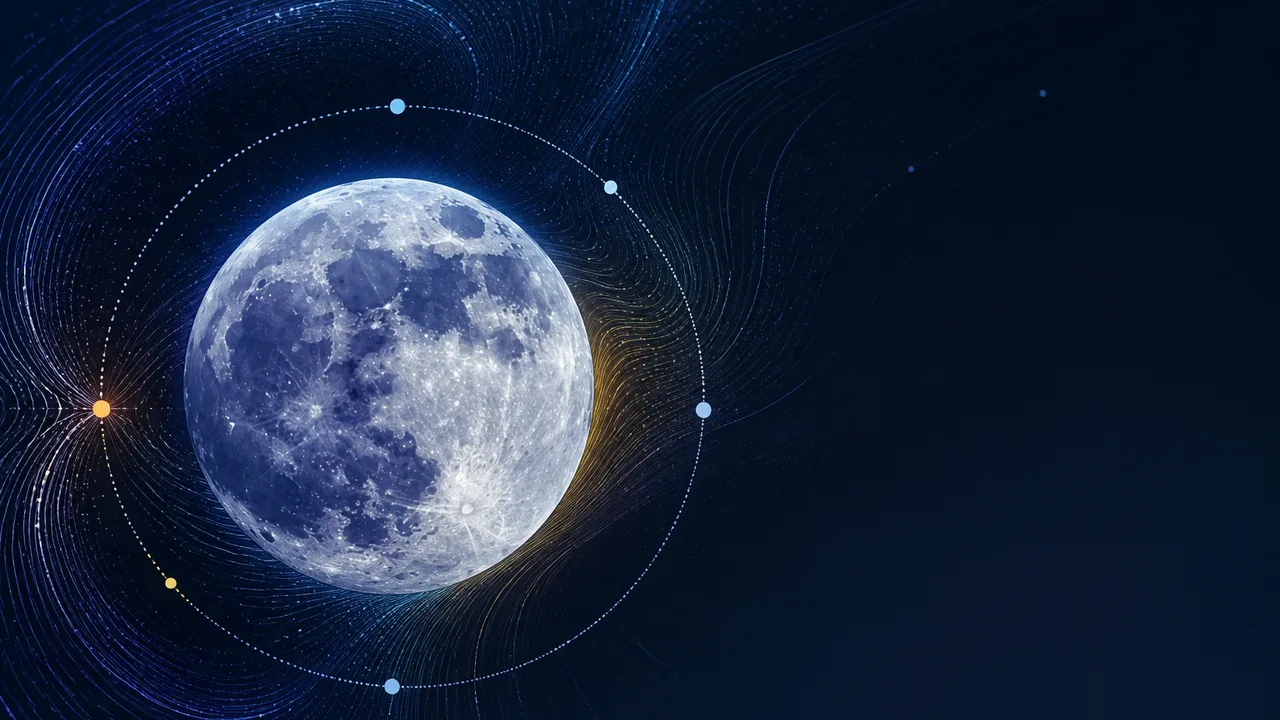
Photo: AI. Dexter Bloomfield
On the last night of May 2026, a full moon will rise above the eastern horizon wearing a name that almost guarantees disappointment: the micro blue moon. It will not be blue. It will not look dramatically smaller. Most people who glance up will see what appears to be a perfectly ordinary, perfectly round, bright moon doing its perfectly ordinary moon thing.
And yet the name is not exactly wrong. There's something genuinely unusual happening — it just requires understanding two separate ideas at once, and the name compresses both of them into a phrase that sounds like a cocktail menu item.
Let's unpack it.
Two coincidences, one name
The "blue moon" half of this is a calendar quirk, nothing more. The moon's phase cycle takes roughly 29.5 days. Our calendar months range from 28 to 31 days, and that mismatch means the lunar and Gregorian calendars slowly drift out of sync. Most months contain exactly one full moon. Occasionally, the math lines up so that a single calendar month fits two — and under the most common modern definition, that second full moon in a month gets called a blue moon. May 2026 has two full moons. The one landing on the final night of the month is the second, which earns it the label.
That part has nothing to do with the moon's appearance. It's a naming convention derived from how humans chose to carve up the year. The moon does not know it's May.
The "micro" half is different in kind. The moon orbits Earth in an ellipse, not a circle. That means its distance from us isn't fixed — it fluctuates between roughly 356,500 km at its closest approach (perigee) and around 406,700 km at its farthest (apogee). When a full moon happens near perigee, we get the supermoon that every outlet covers breathlessly each year. When it happens near apogee, we get the less-celebrated micro moon — technically a bit smaller and a bit dimmer in angular terms, though the difference is subtle enough that it largely escapes naked-eye detection without a side-by-side comparison.
As a NASA Space News video covering the event puts it: "The phrase micro blue moon combines a human-made label with a real astronomical condition. One part comes from how we count months. The other comes from orbital mechanics."
That distinction matters. One component of this event is arbitrary — a function of our calendar. The other is a real physical fact about where the moon sits in space on that particular night. Conflating them is exactly how these events get either over-hyped or under-explained, often both simultaneously.
What you will actually see
Here is the honest version: if you walk outside on the night of May 31, 2026, look east, and expect to see something obviously different from any other full moon, you will probably feel cheated.
The moon will be bright. It will be round. The subtle reduction in apparent size relative to a perigee full moon — roughly 14% smaller in diameter, about 30% less luminous if you're measuring carefully — is not something the human eye reliably notices in isolation. You'd need to compare it directly with a supermoon photograph to see the difference, and even then many people find it less striking than they expected.
What the event does offer is context, and that's where it gets interesting to a certain kind of observer. Near the moon, skywatchers with reasonably dark skies may be able to spot Antares, the red-orange heart of Scorpius. Antares is one of the largest stars visible from Earth, a red supergiant sitting roughly 550 light-years away, and its distinctly warm hue makes for a notable contrast against a pale full moon. Whether Antares is actually visible depends significantly on local light pollution and atmospheric conditions — the full moon floods a lot of sky with reflected light — but the geometry places the two in the same field of view, which gives dedicated observers something specific to locate rather than just admiring a bright disk.
Then the story continues past that single night.
The sequence is the point
The strongest version of the case for paying attention to this event isn't actually about the micro blue moon itself. It's about what happens in the days immediately following it.
After the full moon, Venus and Jupiter — two of the brightest objects in the night sky after the sun and moon — will converge toward a close conjunction in the western evening sky. Planetary conjunctions aren't astronomically significant in any physical sense; the planets aren't actually close to each other, they just happen to share the same line of sight from Earth. But visually, watching two brilliant points of light draw toward each other night after night requires no equipment, no expertise, and no special timing. You look west after sunset and track them.
As the video frames it: "The reason this event matters is not only the moon itself. It is the sequence. First, a rare full moon shaped by calendar timing and orbital distance. Then, a red star nearby. Then, two bright planets closing in after sunset. Together, they create a short sky-watching window that is easy for the public to follow without equipment."
That framing is genuinely useful. Astronomy outreach has a persistent problem: it builds up individual events as visual spectacles and then underwhelms people who were expecting something cinematic. An eclipse delivers. A meteor shower, in a dark sky, delivers. A full moon with an unusual name mostly does not, if the expectation is set incorrectly.
The more honest — and arguably more effective — sell is: here is a several-night window where the sky is doing multiple interesting things in sequence, none of them requiring a telescope, all of them more meaningful if you understand the geometry behind them.
The naming problem
It's worth sitting with the fact that both "blue moon" and "micro moon" are relatively modern constructs, and neither has a single authoritative definition.
The "second full moon in a calendar month" definition of blue moon only became widespread after a 1946 Sky & Telescope article that — in a well-documented piece of astronomical irony — actually misinterpreted an older usage from the Maine Farmers' Almanac, which defined blue moons differently. The misinterpretation spread, got repeated, and eventually became the dominant definition. The moon itself had nothing to say about any of this.
"Micro moon" is similarly informal — there's no universal threshold for how close to apogee a full moon needs to be to earn the prefix. Different sources draw the line in slightly different places. What the term captures is real (the apogee effect on apparent size is measurable), but the label is a popularization tool more than a technical designation.
None of this makes the May 2026 event fake or uninteresting. It does mean that the name is doing more work than the phenomenon — which is the case for most astronomical events that get public attention. As the video observes: "The sky is not only interesting when something explodes, flashes, or disappears. Sometimes the story is in the geometry."
That's the line I'd put on a poster. The geometry here — a moon near apogee, arriving second in a calendar month, near a recognizable star, followed by a planetary conjunction — is genuinely unusual in its combination. The name oversells it. The mechanics, explained honestly, are more interesting than the spectacle.
The question worth sitting with: if we were better at communicating orbital geometry to general audiences, would we even need the dramatic names? Or is a little bit of misleading branding the price of getting people to look up in the first place?
More Like This
Betelgeuse's Hidden Star: Solving Celestial Mysteries
Unveiling Betelgeuse's hidden companion star reshapes our understanding of stellar evolution and supernova precursors.
The Rainbow Is Yours Alone—Here's What That Means
Neil deGrasse Tyson breaks down the optics of rainbows—why yours is private, why you can't reach its end, and why every rainbow is actually a circle.
How Io's Shadow Revealed the Speed of Light
How 17th-century astronomers tracking Jupiter's moon Io—for colonial navigation—accidentally measured the speed of light. The discovery that changed physics.
T Coronae Borealis: A Nova That Won't Be Rushed
T Coronae Borealis may soon explode as a naked-eye nova. Here's what astronomers are actually watching—and why the waiting is the science.
Harnessing Night: Stirling Engine Powers with Cold Space
Scientists use radiative cooling to power a Stirling engine at night, leveraging Earth’s natural heat loss to space.
Are Aliens Whispering Through Cosmic Firefly Signals?
Could extraterrestrial communication be subtle like fireflies, not loud radios? New SETI research explores this intriguing possibility.
Hannah Cairo Disproved a 40-Year-Old Math Conjecture at 17
At 17, Hannah Cairo overturned the Mizohata-Takeuchi conjecture using a hypercube and a coin diagram. Here's what she actually did—and why it matters.
How Language Shapes Thought, According to Lera Boroditsky
Cognitive scientist Lera Boroditsky explains how the language you speak shapes memory, color perception, and thought—and what's lost when languages disappear.