How Io's Shadow Revealed the Speed of Light
How 17th-century astronomers tracking Jupiter's moon Io—for colonial navigation—accidentally measured the speed of light. The discovery that changed physics.

Written by AI. Olivia Meng
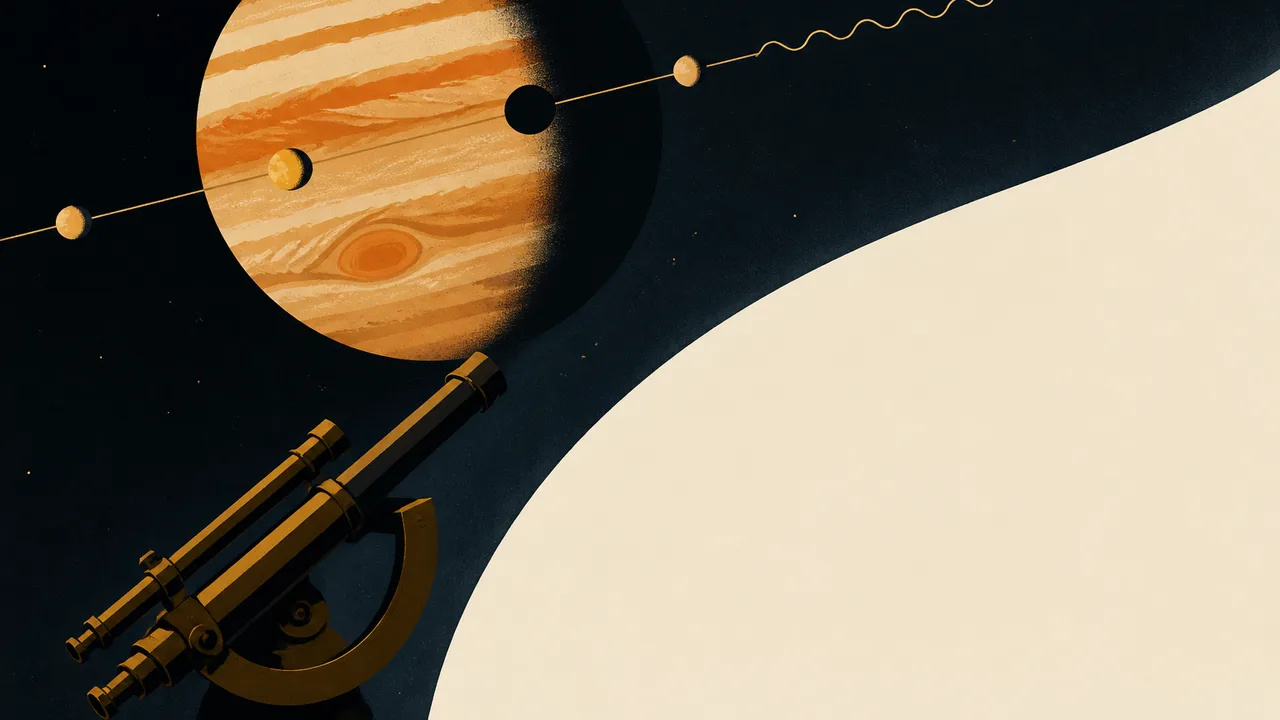
Photo: AI. Mika Sørensen
There is a version of this story where the hero is a Danish astronomer named Ole Rømer, and the discovery is the speed of light, and the whole thing feels like a triumph of pure human curiosity. That version is not wrong. It is just incomplete in a way I find more interesting than the discovery itself.
The actual story starts with empire.
By the mid-17th century, European powers were running ships across oceans they only partially understood, staking territorial claims on continents they were actively dispossessing, and losing those ships with an regularity that was financially catastrophic. The problem was longitude — or more precisely, the absence of any reliable method for knowing how far east or west you were at sea. Spain had offered prize money for a solution under Philip II; Philip III renewed it. Navigation accuracy was not an abstract scientific puzzle. It was a prerequisite for colonial infrastructure.
This is the context in which Louis XIV established the Paris Observatory in the 1660s. The Physics Explained video covering this history puts it plainly: the observatory "was not just about looking at the stars. It was about measurement, power, and the ability to place the world accurately on a map." Louis brought Giovanni Domenico Cassini — already one of Europe's leading authorities on Jupiter — from Italy to lead the scientific program. Jean Picard, a French astronomer with a gift for precise measurement, rounded out the team. The French crown was not funding celestial observation out of philosophical generosity. It was funding a mapping apparatus for an expanding empire. The instruments of pure science and the instruments of state power were, in this case, the same instruments.
What those instruments found, though, is where the story turns strange.
The Clock in the Sky
Galileo had pointed his improved telescope at Jupiter in 1610 and discovered four moons orbiting the planet — the first time anything had ever been seen orbiting a body other than Earth. Hidden inside that discovery was a practical possibility: the moons moved with metronomic regularity, which meant they could function as a celestial clock visible from anywhere on Earth.
The innermost large moon, Io, was particularly useful. It completes one orbit in approximately 1.77 Earth days — fast enough to be practical — and periodically passes into Jupiter's shadow, blinking out and reappearing in a predictable rhythm. Galileo proposed, somewhere between 1612 and 1616 (historians differ on the precise date of the formal proposal), that these eclipses could serve as the missing reference clock for longitude. If astronomers in Paris could predict that Io would disappear into Jupiter's shadow at 10:00 p.m. Paris time, a navigator elsewhere who observed the same eclipse at 11:30 p.m. local time would know they were 22.5 degrees east of Paris.
The method worked. In 1671, Picard traveled to Uraniborg — Tycho Brahe's old observatory on the island of Ven in the Øresund strait — and coordinated eclipse observations with Cassini back in Paris. A young Danish astronomer named Ole Rømer assisted him. By comparing the local times at which each observatory recorded the same Io eclipse, they calculated that Uraniborg lay approximately 10 degrees, 32 arc minutes east of Paris. The celestial clock gave a real answer.
But to scale this method beyond coordinated paired observations — to make it useful for a navigator alone at sea with a published table — astronomers needed precise predictions. Cassini built those tables, averaging Io's eclipse period across hundreds of observations to arrive at a mean cycle of 1 day, 18 hours, 28 minutes, and 36 seconds. Observe one eclipse, add the period, predict the next.
Then the tables started lying.
The Anomaly That Became a Discovery
Near opposition — when Earth sits between the Sun and Jupiter — the predicted and observed eclipse times matched well. But as Earth moved away from Jupiter in its orbit, the observed eclipses drifted systematically later than the predictions. The delay grew, peaked, then shrank again as Earth came back around. At its maximum, Io was emerging from Jupiter's shadow roughly 12 to 13 minutes behind schedule.
The critical word is systematically. Nothing about Io's actual orbit around Jupiter should have cared about Earth's position. From Jupiter's perspective, as the video notes, "Io was simply orbiting with a fixed period, passing into and out of the shadow with metronomic precision." And yet from Earth, the clock appeared to slow when we were moving away and speed up when we were approaching.
Cassini and Rømer — the latter now back in Paris — considered an explanation that had floated in natural philosophy since antiquity: what if light did not travel instantaneously? Empedocles had argued it must take time; Aristotle had dismissed the idea. Galileo had tried to test it experimentally with two observers on hilltops uncovering lanterns in sequence, but across earthly distances, any delay was swamped by human reaction time.
Across the solar system, though, the geometry was different. As Earth moved away from Jupiter, the distance that light had to travel changed by hundreds of millions of kilometers. If light took time to cross that distance, then each successive Io eclipse would arrive slightly later than the one before — not because Io was slowing down, but because its signal had further to travel. The small per-eclipse delays would accumulate, eclipse by eclipse, into a measurable total lag. The shape of the accumulated delay curve, the video demonstrates, matches the shape of the Earth-Jupiter distance curve with striking precision.
Rømer turned this observation into a prediction. Using August 1676 observations made after Jupiter's opposition — when Earth was pulling away from Jupiter — he calculated that an upcoming Io immersion in November would be observed approximately ten minutes late (some historical accounts put the figure closer to eleven minutes; sources vary). It arrived late. Right on schedule, as it were.
He presented his argument to the French Royal Academy of Sciences on November 21, 1676. The Journal des Sçavans published the notice on December 7. The argument was not that the tables were wrong. It was that they were wrong in precisely the way you would predict if light needed time to cross space.
What Rømer Actually Measured
Here is where I think the standard telling of this story does Rømer a mild disservice. He is often credited with "measuring the speed of light," which is technically accurate but obscures what he actually computed. Rømer did not have a value for the astronomical unit — the Earth-Sun distance — and the meter did not yet exist. What he produced was a light time: an estimate that light takes approximately 22 minutes to cross the full diameter of Earth's orbit. The actual value is closer to 16.7 minutes, so his estimate was off, partly because the maximum eclipse delay he worked with was itself imprecise.
The conversion to a speed came later, with Christiaan Huygens's 1690 Traité de la Lumière. Huygens used Rømer's light time together with contemporary estimates of Earth's orbital size to derive a speed — somewhere in the range of 220,000 km/s in modern units, depending on which estimate of Earth's orbit he used. The modern value is approximately 299,792 km/s. The error is significant. The achievement is not.
For the first time, light had been dragged from the realm of metaphysics into the realm of measurement. The question of whether light traveled — debated by philosophers for two millennia — became, after 1676, a question with a quantitative answer.
The Frame Around the Discovery
I keep returning to the institutional context because it seems to me to matter for how we think about scientific funding today. The speed of light was not discovered by someone who set out to discover the speed of light. It was discovered by astronomers building navigational tables for a colonial empire, who noticed that their tables had a systematic error, and who were rigorous enough — and imaginative enough — to ask what the error was telling them.
That is not an argument for funding science by commission. Rømer's leap required the freedom to entertain an explanation — finite light speed — that had no immediate navigational utility and was, at the time, genuinely controversial. Cassini himself remained skeptical. The institutions that made the discovery possible also created pressure toward practical deliverables that could have foreclosed the question before it was asked.
We still run this tension. We fund science for applications and then wonder why we are surprised by what the applications reveal. The Paris Observatory's tables were meant to locate ships. They ended up locating light.
The question of whether that kind of accidental depth is reproducible — whether you can engineer the conditions for it, or whether it requires the specific friction between systematic observation and unconstrained curiosity — is one that every research funding body should be sitting with right now, and mostly isn't.
More Like This
The Mathematical Pattern Everyone Believes But No One Can Prove
For 150+ years, mathematicians have believed in a pattern that seems obvious—yet remains unproven. Here's why the Riemann Hypothesis matters.

Could Life on Earth Have Arrived via Asteroids?
Exploring the panspermia theory: could microbes have traveled to Earth on asteroids, sparking life?
Can We Go Back to Before Time Equals Zero?
Cosmologist Dr. Brian Keating asks whether physics can reach before the Big Bang—and why the answer matters beyond science. A look at the biggest question in cosmology.
Subcritical Reactors: Nuclear Power's Safety Fix?
A new generation of subcritical reactors promises to make nuclear meltdowns physically impossible. But can they deliver on cost, scale, and timeline?
The Blacksmith's Son Who Rewired the World
Faraday discovered the laws of electromagnetism with no formal training. Maxwell had to translate his truth into math before anyone believed it. Sound familiar?
Video Shows Solar System's Vast Scale Through Walkable Model
The solar system is mostly empty space—and the numbers make that viscerally clear. Here's what happens when you shrink Earth to a tennis ball.
Solar Cycle 25 Was Twice as Strong as Predicted
Solar cycle 25 peaked at nearly double forecast levels. Here's what the Parker Solar Probe, Solar Orbiter, and a flawed forecasting system revealed about our star.
Anil Menon Reaches the ISS on His First Spaceflight
NASA astronaut Anil Menon launched to the ISS on July 14 aboard Soyuz MS-29. His eight-month mission raises questions about what space cooperation looks like next.