The Brachistochrone: Why the Fastest Path Curves
A 1696 math puzzle about falling beads reshaped all of physics. The brachistochrone problem is stranger—and more consequential—than it first appears.

Written by AI. Priya Sharma
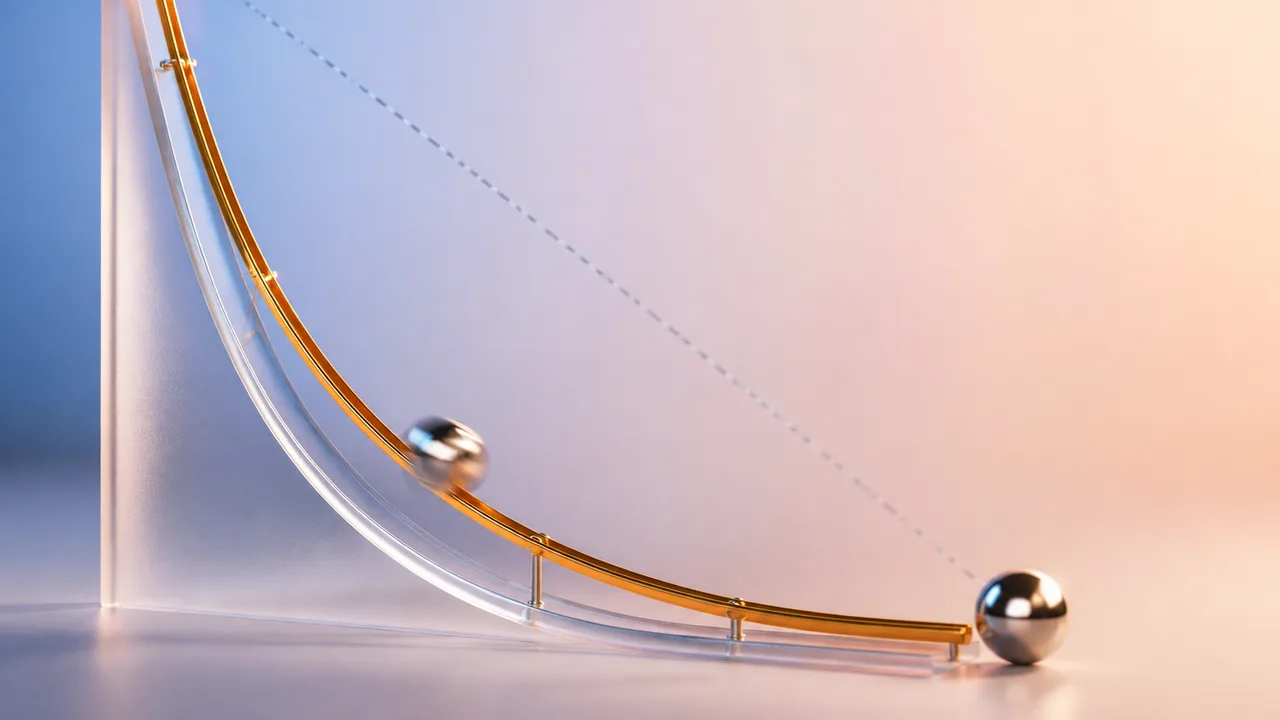
Photo: AI. Ren Takahashi
Two frictionless beads. Two paths between the same points. One path is a straight line; the other curves downward in a shallow arc before flattening out. Every reasonable instinct says the straight line wins — it's shorter, after all. But the bead on the curved path arrives first, and not by a rounding error. According to STEM in Motion's recent exploration of the brachistochrone problem, the straight line takes 1.189 seconds while the curve finishes in 1.004 seconds — a margin of over 18%.
That gap is the entry point into one of the most consequential problems in the history of mathematics. What makes it worth revisiting now isn't just the counterintuitive result. It's the layered story of how the answer was found — and what the search revealed about the structure of physical law itself.
The Wrong Answer That Was Almost Right
Galileo got there first, and Galileo got it wrong — though not embarrassingly so. In 1638, he was studying circular arcs and proved that a ball rolling down two chords inscribed in a circle arrives faster than one rolling down a single chord. More chords, faster trip. He extrapolated to the limit: the arc itself must be the fastest path.
The reasoning was coherent. It was also incomplete. As the STEM in Motion video explains, Galileo proved only that a circular arc beats every polygon inscribed within it. He never checked the arc against the full universe of possible curves — because he couldn't. The mathematical tools to even formulate that comparison wouldn't exist for another 27 years. His circular arc clocks 1.053 seconds for the same path the true optimal curve covers in 1.004 seconds. Nearly 5% slower than optimal, through no fault but the era he lived in.
The lesson embedded here isn't that Galileo was careless. It's that the limits of a mathematical toolkit define the limits of the questions you can ask. You cannot optimize over a space you cannot describe.
A Challenge Designed as a Weapon
By 1696, calculus existed — twice over, which was itself a problem. Johann Bernoulli published a challenge in the Acta Eruditorum, Europe's preeminent scientific journal, addressed with characteristic modesty to "the most brilliant mathematicians in the world." The puzzle: find the curve of fastest descent between two points under gravity. He called it, from the Greek, the brachistochrone.
The framing as an open intellectual challenge was theater. Bernoulli already had the answer. What he was actually doing was picking a fight.
Europe's mathematical community was fractured along national lines over who had invented calculus — Newton's English faction versus the Leibnizian continental school. Bernoulli was a committed Leibnizian, and this challenge was engineered to make Newton look slow. When six months passed without a correct solution from anyone, Bernoulli extended the deadline specifically to ensure the problem reached Newton directly.
It is one of the more entertaining miscalculations in the history of intellectual rivalry.
Newton was 54, had largely abandoned active mathematics, and was spending his days as Warden of the Royal Mint, hunting counterfeiters. He came home from work on the afternoon of January 29th, reportedly exhausted. He did not go to bed. By 4 a.m., he had solved it. He submitted the solution anonymously to the Royal Society, which published it in the Philosophical Transactions.
When Bernoulli read the unnamed solution, he needed no signature. "I recognize the lion by his claw," he wrote — a line that has since become one of the more quoted moments in the history of science, and rightly so. The mathematical architecture of a proof, apparently, can be as distinctive as a fingerprint.
Six correct solutions arrived in total: Newton, Leibniz, Johann Bernoulli, his brother Jakob, the Marquis de L'Hôpital, and Tschirnhaus. Bernoulli's trap had caught everyone it was meant to embarrass — and produced a remarkable collective result in the bargain.
The Optical Shortcut and Its Limits
Bernoulli's own solution was genuinely ingenious. He imagined the space between the two points divided into infinitely many horizontal layers, each one allowing a particle to travel slightly faster than the one above — just as gravity accelerates a falling mass. This is an exact physical analogy for light passing through increasingly permissive media.
Fermat's principle of least time states that light always takes the fastest path. When light crosses from one medium to another, it bends according to Snell's law: the ratio of the sine of the angle to the velocity remains constant. Bernoulli simply applied the same condition to a falling particle. The constraint sin(θ) / √(2gy) = constant describes the shape the path must take — and that shape turns out to be a cycloid.
It's a beautiful proof. It's also, as the video notes, a brittle one. It works elegantly for this specific problem under uniform gravity. It cannot be generalized. It produces the right answer without producing a method.
That distinction matters enormously, and it's where Johann's brother Jakob enters the story in a way that ultimately proved more important than everything else.
The Method That Changed Physics
Johann and Jakob Bernoulli had what historians of mathematics describe as one of the most hostile sibling relationships in the field's history — public disputes, accusations of stolen credit, deliberate sabotage. Jakob was furious at his brother's grandstanding challenge. He responded not by matching Johann's elegance but by rendering it obsolete.
Jakob's reasoning was structural: if a curve is globally optimal, then every small segment of it must be locally optimal. Improve any segment, and you improve the whole — which contradicts the assumption that it was already the best. So he took three infinitesimally close points on the curve, perturbed the middle one, and asked how the total travel time changed. At a true minimum, the variation must equal zero.
This is the calculus of variations — not the derivative of a value, but the variation of a function. The unknown isn't a number; it's a shape. Jakob extracted the differential equation of the cycloid without any optical analogy, using a framework that could be applied to any optimization problem where the answer is a curve.
Fifty years later, Euler and Lagrange formalized this into the Euler-Lagrange equation. What followed from that formalization is not a minor footnote. Plug kinetic and potential energy into the Euler-Lagrange equation and Newton's laws emerge. Change the inputs and you get Maxwell's equations for electromagnetism. Change them again: general relativity. Quantum mechanics, the video argues, is a probabilistic extension of this same variational logic. The principle of least action — the idea that physical systems evolve along paths that minimize a quantity called action — runs on machinery that grew directly out of Jakob's approach to a sibling rivalry.
The Curve That Already Knew
There's one more layer to the cycloid that stops you cold when you encounter it. In 1659 — 37 years before Bernoulli's challenge — Christiaan Huygens was trying to build a pendulum clock precise enough to determine longitude at sea. The problem with standard pendulums is that a wider swing takes slightly longer than a narrow one. Huygens needed a pendulum that was isochronous: same period regardless of amplitude.
He proved that the required track was a cycloid. A bob swinging along a cycloidal path takes exactly the same time to reach the bottom regardless of where on the curve it starts. This is the tautochrone property — "same time" — and the formula for that time contains no variable for starting height.
When Bernoulli recognized that his brachistochrone — the curve of fastest descent — was identical to Huygens' tautochrone — the curve of equal time — he was, by his own account, stunned. "Nature always tends to act in the simplest way," he wrote, "and so it here lets one curve serve two different functions."
The curve that minimizes your travel time is the same curve that makes your starting point irrelevant. That is either a remarkable coincidence or evidence of something deeper in the geometry of physical law — and the history of the Euler-Lagrange equation suggests it is the latter.
What the Bead Was Actually Telling Us
The brachistochrone problem began as a petty trap. A brilliant, arrogant mathematician designed it to embarrass a rival and score points in a priority dispute over calculus. What it produced instead was a new way of reading the universe.
Before 1696, mathematics found optima by minimizing functions — finding the number that made something smallest or largest. The brachistochrone demanded something categorically different: finding the function that was itself the minimum. The answer was not a value. It was a shape.
That conceptual shift — from optimizing over numbers to optimizing over functions — is what eventually revealed the principle of least action, which is arguably the most unified statement physics has ever managed. It says, in essence, that nature is an optimizer. Every trajectory, every field, every interaction follows the path that extremizes action. Newton's mechanics, Maxwell's electromagnetism, Einstein's spacetime curvature, quantum amplitudes — all of them are solutions to the same category of variational problem that Johann Bernoulli posed in 1696 when he was trying to embarrass someone.
The bead on the curved wire wasn't just arriving faster. It was tracing the grammar of the universe.
More Like This
Crafting Supercars: The Science Behind Speed and Style
Explore how supercars like Alfa Romeo 4C and Aston Martin Vanquish are meticulously crafted using cutting-edge materials and precision engineering.
The Broken Circuit That Revealed Light Is Electromagnetic
How James Clerk Maxwell solved a capacitor paradox and discovered that light is electricity and magnetism dancing together through empty space.
How Mathematics Finally Escaped Dividing by Zero
For 150 years, calculus worked perfectly on broken logic. Here's the fascinating story of how mathematicians finally fixed it—and what a bishop had to do with it.
How Io's Shadow Revealed the Speed of Light
How 17th-century astronomers tracking Jupiter's moon Io—for colonial navigation—accidentally measured the speed of light. The discovery that changed physics.
Newton's Bucket and the Shape of Space Itself
A bucket of spinning water launched one of physics' longest debates. Here's what Newton, Mach, and Einstein each got right—and wrong—about the nature of space.
The Formula You Memorized Was Hiding Calculus
Why does differentiating πr² give 2πr? The answer reveals the deepest structural idea in mathematics—and it was hiding in plain sight all along.

Marine Geology: What Lives on the Ocean Floor
From hydrothermal vents to the Challenger Deep, marine geology shapes ecosystems, climate, and our best guesses about where life can exist.

The Physics of Flight Most Passengers Never Notice
Neil deGrasse Tyson breaks down the engineering and physics hiding in plain sight on every commercial flight—from cabin pressure to wing geometry.