Could Our Galaxy Reside in a Cosmic Void?
Exploring the possibility of the Milky Way's location in a cosmic void and its impact on cosmic expansion measurements.

Written by AI. Amelia Nwofor
If you ever feel like the universe is a vast, empty place, you might be more right than you know. Recent research suggests that the Milky Way could be nestled inside a giant cosmic void—a region of the universe with fewer galaxies than average. This intriguing possibility emerges from a study analyzing ancient sound patterns from the early universe, aiming to shed light on one of cosmology's persistent puzzles: the Hubble tension.
The Void Hypothesis
The Hubble tension refers to the vexing discrepancy between two sets of measurements of the universe's expansion rate. Measurements rooted in the early universe, particularly the cosmic microwave background, predict a slower present-day expansion rate than observations based on nearby galaxies and supernovae. This tension has sparked a flurry of theoretical gymnastics, suggesting everything from new particles to altered gravitational laws.
Enter the void hypothesis. Instead of rewriting the universe's rulebook, this idea proposes that our cosmic neighborhood's underdensity could be skewing local measurements. As the video from NASA Space News explains, "If our region of the universe contains less matter than average, gravitational forces would cause matter to flow outward towards surrounding denser regions." This flow could make nearby galaxies appear to recede faster than expected, potentially accounting for the observed Hubble tension.
A New Perspective on Cosmic Expansion
The research at the heart of this hypothesis relies on baryon acoustic oscillations (BAOs)—subtle yet measurable patterns in the distribution of galaxies. These oscillations serve as standard rulers, allowing astronomers to trace cosmic expansion. By analyzing BAO measurements across different cosmic epochs and regions, researchers observed that the BAO ruler appears larger than predicted, particularly at closer distances. "The statistical preference for the void scenario was strong," the video notes, indicating a potential local effect rather than a universal anomaly.
This perspective suggests that the universe's expansion might not be as inconsistent as previously thought. Instead, the differences could stem from where we happen to be observing the cosmos. The void hypothesis posits that while the universe follows a consistent global expansion history, local measurements can be biased by large-scale matter flows and gravitational effects.
Testing the Hypothesis
The beauty of the void hypothesis lies in its testability. Future galaxy surveys, with their increased precision and coverage, could directly test the hypothesis' predictions. "The BAO standard ruler should continue to show characteristic distortions at low redshift," the researchers assert. Independent observational probes, such as gravitational lensing and galaxy velocity fields, will also be crucial in corroborating or refuting this idea.
However, the hypothesis is not without its skeptics. Some researchers point to potential observational systematics or survey selection effects that could influence the BAO signal. Others question whether current structure formation models can naturally produce voids of the necessary scale and depth. These debates are part of an active, ongoing discussion within the cosmological community.
Implications for Cosmology
Should the void hypothesis withstand scrutiny, its implications would be profound. It would recast the Hubble tension as a local observational effect, easing the pressure to invoke new physics. It would also underscore the importance of cosmic environment in shaping our observations, reminding us that measurements from within a specific region might not always reflect global properties.
Moreover, the hypothesis could streamline our search for cosmic truths. By narrowing the range of viable explanations for the Hubble tension, researchers can focus on fewer, more precise avenues of investigation. And crucially, this approach maintains the age of the universe as determined by early universe data, distinguishing it from other proposed solutions that might alter cosmic age estimates.
In the grand tapestry of cosmology, the void hypothesis offers a compelling thread to pull. Whether it unravels into a new understanding or is woven back into the existing fabric, its exploration is a testament to the scientific process—a journey of curiosity, rigor, and the relentless quest to understand our place in the cosmos.
More Like This
The Enigma of Simultaneity in Relativity
Explore how the relativity of simultaneity reshapes our understanding of time and challenges the concept of a universal 'now.'
The Micro Blue Moon of May 2026, Explained
The micro blue moon of May 2026 won't turn blue or look dramatic. Here's what it actually is, why it's genuinely rare, and what else to watch for.
Could CERN's LHC Create a Black Hole?
Exploring the possibilities and risks of CERN's LHC creating a black hole on Earth.
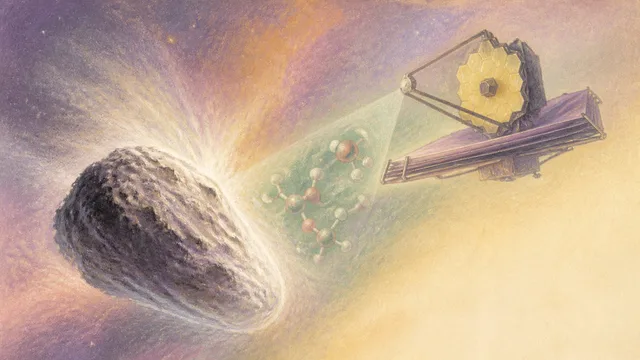
Webb Detects Methane on Interstellar Comet 3I/ATLAS
Webb's MIRI instrument detected methane on interstellar comet 3I/ATLAS after perihelion—a timing that hints at buried volatile layers from another planetary system.
Harnessing Night: Stirling Engine Powers with Cold Space
Scientists use radiative cooling to power a Stirling engine at night, leveraging Earth’s natural heat loss to space.
Are Aliens Whispering Through Cosmic Firefly Signals?
Could extraterrestrial communication be subtle like fireflies, not loud radios? New SETI research explores this intriguing possibility.
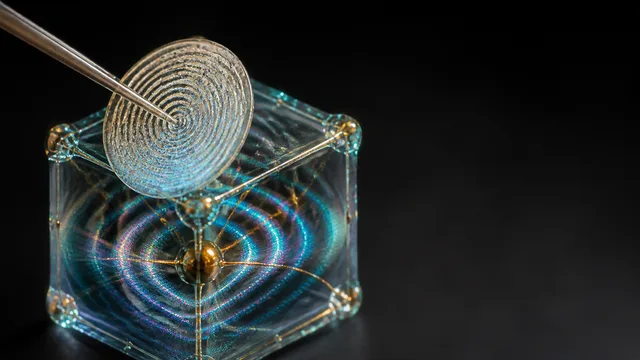
Hannah Cairo Disproved a 40-Year-Old Math Conjecture at 17
At 17, Hannah Cairo overturned the Mizohata-Takeuchi conjecture using a hypercube and a coin diagram. Here's what she actually did—and why it matters.

How Language Shapes Thought, According to Lera Boroditsky
Cognitive scientist Lera Boroditsky explains how the language you speak shapes memory, color perception, and thought—and what's lost when languages disappear.