A Star in Andromeda Vanished. A Black Hole Remained.
A massive star in Andromeda faded without exploding. Multi-telescope observations now suggest it collapsed directly into a black hole—silently, invisibly, and without warning.

Written by AI. Priya Sharma
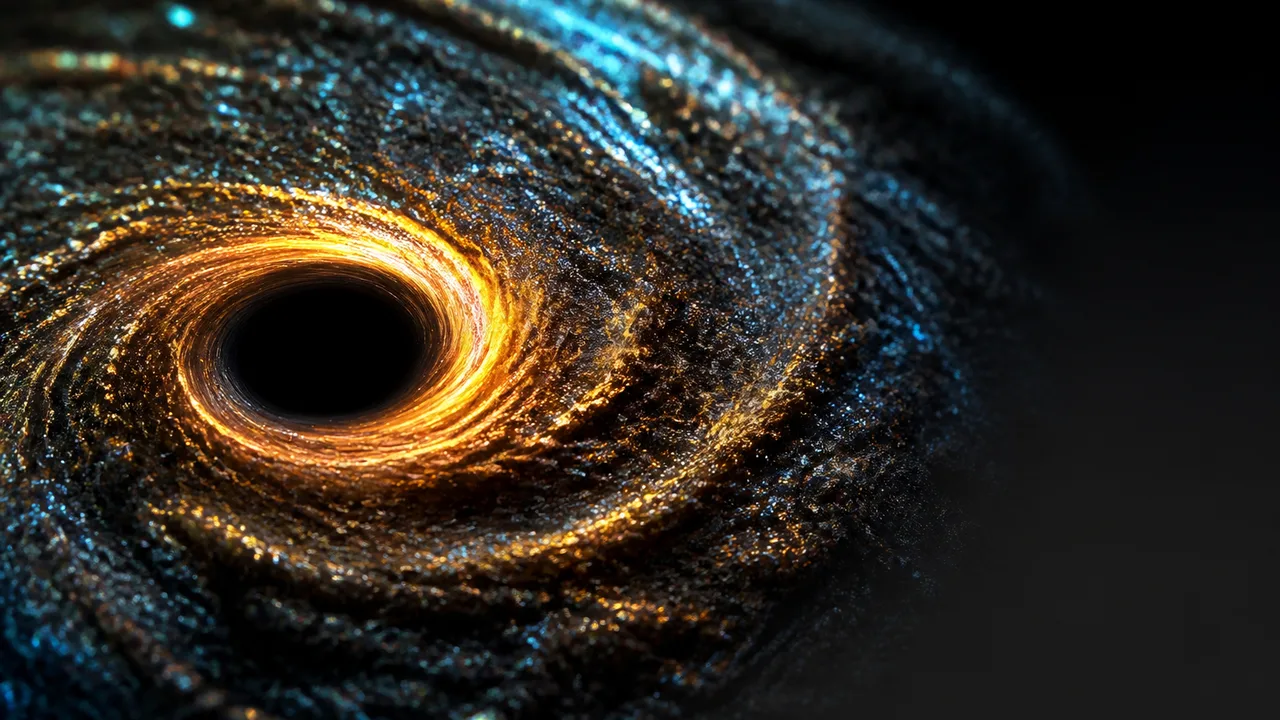
Photo: AI. Pippa Whitfield
The textbook version of a massive star's death is difficult to miss. A core collapses, a shock wave tears outward, and for weeks the explosion outshines entire galaxies. Astronomers have catalogued thousands of these events. They know what to look for. The problem, a new body of multi-telescope observations now suggests, is that they may have been looking for the wrong thing.
A star catalogued as M31-2014-DS1, located roughly 2.5 million light-years away in the Andromeda galaxy, appears to have ended its life without any of the fireworks. It brightened in infrared light sometime before 2016, then faded — steadily, persistently, without recovery — until it was nearly undetectable. No supernova. No flash. Just absence where there had been one of Andromeda's more luminous stellar residents. A recent NSN Space News analysis, drawing on published observational data from four separate NASA instruments, reconstructs what the evidence now points toward: the star collapsed directly into a black hole, an event researchers call a failed supernova.
It is worth sitting with how strange that phrase is. Not a failed detection of a supernova. A supernova that the physics tried to produce and couldn't.
The Evidence Accumulated Slowly
The story of M31-2014-DS1 is, in some ways, a story about the patience observational astronomy requires. The disappearance wasn't a single dramatic moment that triggered alarm. It was a slow erosion, noticed only because astronomers kept returning to compare archival images with newer ones. Each visit: a weaker signal. The star had, as the NSN analysis puts it, "begun glowing more strongly in infrared light" before its decline — an early anomaly that registered but didn't, at the time, read as a death rattle.
By the time the infrared brightening had given way to near-total fading, the first instinct was a relatively mundane explanation. Massive stars can shed enormous quantities of material; a cocoon of dust can block visible light entirely while still allowing thermal infrared radiation to escape. The star might simply be hidden — obscured, not gone.
That explanation held until the energy accounting didn't add up. As the NSN analysis notes: "The source was not just obscured. It had lost most of its total brightness. If the original star were still shining behind the dust, its enormous energy should still be escaping somehow." A dust screen changes what wavelengths you can observe. It doesn't make a star's total luminosity disappear. Whatever was happening at M31-2014-DS1's location, the dust was incidental — a symptom, not the diagnosis.
Four Instruments, One Converging Picture
What makes this particular case compelling — and what distinguishes it from the speculative category — is the convergence of instruments. NEOWISE provided the infrared baseline. Hubble offered archival optical imaging. The James Webb Space Telescope examined the location with its unprecedented infrared sensitivity. Chandra looked for X-ray emission, the signature of energetic processes, from the hidden center.
Webb's contribution was particularly telling. When it examined the precise location of the vanished star, it found something: "a faint, extremely red source remained buried inside a shell of gas and dust." That is not nothing. But it was not the massive star that had preceded it, either. Webb also detected material moving outward from the center — slowly. The key qualifier there is slowly. The debris was, as the analysis describes it, "moving far more gently than material thrown out by a normal stellar explosion." A conventional supernova evacuates stellar material at velocities measured in thousands of kilometers per second. This was not that.
Chandra, for its part, found nothing definitive at all — no powerful X-ray source. In the context of this investigation, a null result is itself a data point. An accreting compact object often blazes in X-rays. The silence at M31-2014-DS1's location is consistent with a black hole that formed through direct collapse rather than through the turbulent accretion environment a neutron star or actively feeding black hole would produce.
The researchers behind this work have not entirely closed the door on alternative interpretations. The NSN analysis is careful to note that "researchers are still testing whether a deeply hidden surviving star or a stellar merger could explain every clue." A star-star merger, for instance, could produce dust and some outflowing material. But neither merger nor hidden-survivor models easily account for the almost total loss of energy from the site. The leading model — direct collapse to a black hole of roughly five solar masses — fits the data most parsimoniously.
What a Failed Supernova Actually Means Physically
The mechanics of a failed supernova are worth unpacking, because they reveal just how narrow the margin between spectacular death and silent disappearance can be.
When a massive star exhausts its nuclear fuel, electron degeneracy pressure can no longer support the core against gravitational collapse. The core implodes in under a second. Under normal circumstances, that implosion generates a bounce — a shock wave that propagates outward through the stellar envelope with enough energy to unbind and eject the star's outer layers. The supernova we observe is essentially the light from that ejection.
But the shock can stall. As it moves outward through the infalling material, it loses energy — partly to neutrino losses, partly to the dissociation of heavy nuclei it encounters along the way. If the star is massive enough, and the core collapse deep enough, the shock never gains the energy it needs to escape. It weakens, stalls, and the outer layers that briefly began moving outward turn around and fall back in. The core accretes more mass. It crosses the threshold for black hole formation. The star, as the NSN analysis puts it plainly, "created the black hole from within."
What escapes is only the small fraction of outer material that had already been launched before the shock fully failed — hence the faint, slow-moving ejecta Webb detected. Most of the star simply... informs the black hole of its existence and then becomes it.
The Search Strategy Problem
The deeper implication of M31-2014-DS1 concerns not just this star, but the entire methodology astronomers have used to census black hole formation.
Supernova surveys are designed to detect new lights appearing in the sky. Telescopes systematically image swaths of nearby galaxies, flag any new point source that exceeds a brightness threshold, and queue follow-up observations. It is an efficient system for finding things that explode. It is, by construction, blind to things that disappear.
"A normal supernova suddenly adds a bright object to the sky," the NSN analysis observes. "A failed supernova removes one."
If failed supernovae occur at any significant fraction of the overall core-collapse rate, then some portion of the black holes in the universe formed without ever triggering a survey alert. They sit in archival imaging, invisible — traceable only if someone thinks to look at a star that used to be there and isn't anymore. The field has been staring at the sky, waiting for it to light up. The signal, at least sometimes, runs in the opposite direction.
Theoretical models had actually anticipated failed supernovae before M31-2014-DS1, and some observational hints had accumulated from other candidate events in nearby galaxies. What this case adds is depth: years of multi-wavelength coverage, across instruments that probe different physical processes, all pointing toward the same conclusion. It is close to the most complete evidentiary record assembled for a putative failed supernova.
That doesn't make it settled. Science rarely settles on a single event. What it does is sharpen the questions worth asking next. How often does this happen? Is there a mass threshold above which stars preferentially fail to explode? What would a systematic archival survey of stellar disappearances in nearby galaxies actually find?
"Astronomers had been waiting for the sky to light up," the NSN analysis notes. "But the real signal was a star going dark."
There is something quietly unsettling about that reorientation — not because it undermines confidence in what we know about stellar death, but because it raises the possibility that the universe has been assembling black holes in the dark, and we've simply been pointing our instruments the other way.
More Like This
Betelgeuse's Hidden Star: Solving Celestial Mysteries
Unveiling Betelgeuse's hidden companion star reshapes our understanding of stellar evolution and supernova precursors.
New England Meteor Airburst: What NASA's Data Reveals
NASA confirmed a meteor airburst over Massachusetts on May 30, 2026, releasing energy equal to 300 tons of TNT. Here's what the science actually shows.

NASA's Nuclear Mars Spacecraft: What SR-1 Freedom Means
NASA approved SR-1 Freedom, a nuclear electric spacecraft targeting a 2028 launch. Here's what the mission actually tests—and what it doesn't solve.
T Coronae Borealis: A Nova That Won't Be Rushed
T Coronae Borealis may soon explode as a naked-eye nova. Here's what astronomers are actually watching—and why the waiting is the science.
TON 618: The Black Hole That Defies Its Own Physics
TON 618 weighs 66 billion solar masses—more than current black hole growth models can explain. Here's what that gap in our knowledge actually means.
Cosmic Rays: What Particles From Deep Space Reveal
Cosmic rays bombard Earth constantly, yet their origins remain partly unknown. Here's what a century of detective work has—and hasn't—resolved.
Primordial Black Holes as Dark Matter Candidates
After decades of failed WIMP searches, physicists are turning to primordial black holes as a serious dark matter candidate. Here's what the evidence actually shows.

Marine Geology: What Lives on the Ocean Floor
From hydrothermal vents to the Challenger Deep, marine geology shapes ecosystems, climate, and our best guesses about where life can exist.