Cosmic Rays: What Particles From Deep Space Reveal
Cosmic rays bombard Earth constantly, yet their origins remain partly unknown. Here's what a century of detective work has—and hasn't—resolved.

Written by AI. Olivia Meng
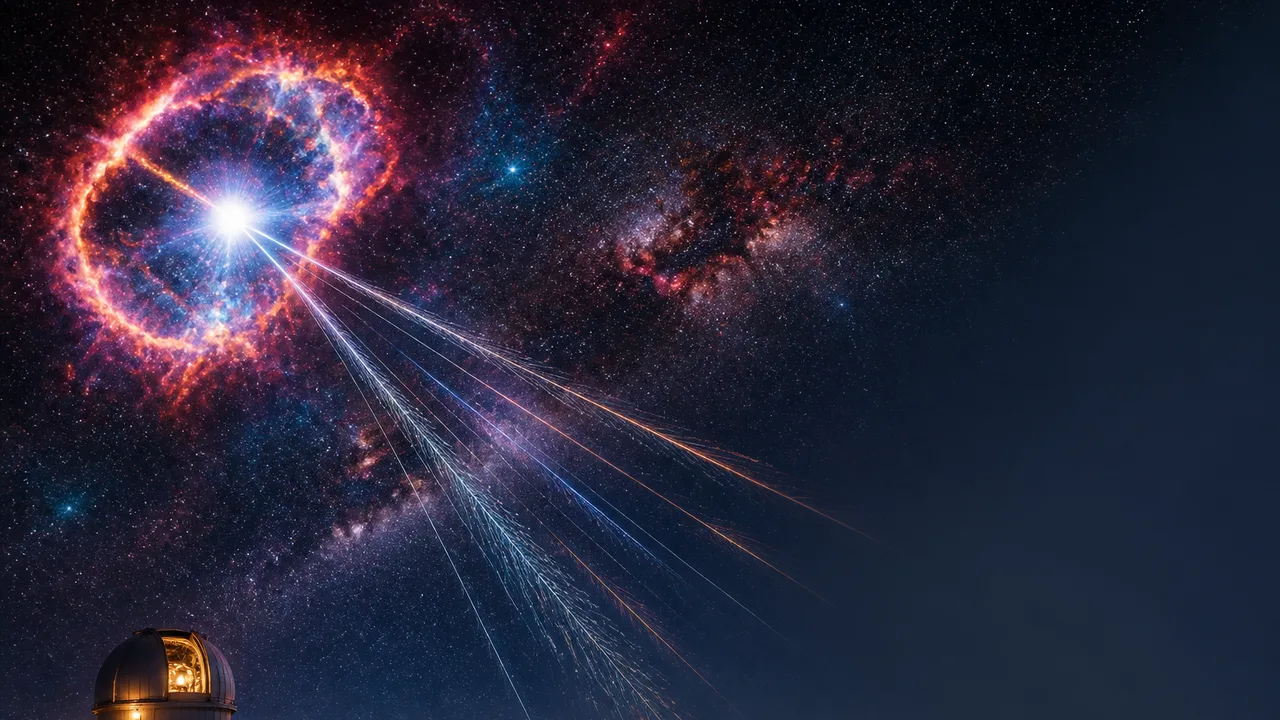
Photo: AI. Castor Belov
Right now, roughly 10,000 subatomic particles are passing through every square meter of Earth's surface every second — a figure cited in modern physics coursework at Purdue University's nanohub platform. They arrive from every direction. For most of the last century, no one knew where they were coming from, and the reason for that ignorance is not a gap in ambition. It's a gap in tools. The story of cosmic rays is, at its core, a story about what evidence-based science can and cannot do when the evidence itself has been systematically erased in transit.
I spend most of my time writing about detection problems. How do you attribute a flood to a warming climate when the signal is buried in natural variability? How do you measure ice-sheet loss when the instruments are limited by orbital geometry? The cosmic ray problem turns out to be the same problem, scaled to the galaxy. The particles arrive carrying information about the most violent events in the universe — but the interstellar magnetic fields they traverse scramble their trajectories so thoroughly that by the time they reach us, they appear to come from everywhere and nowhere at once. "The magnetic fields completely scramble the directions of cosmic rays moving through the galaxy," the Doc of the Day documentary puts it, "so that from Earth's point of view, they appear to be coming from all over the sky, leaving no hint about where they originally came from."
That is not a small problem. That is the central problem. And solving it has required building a new instrument almost every time the question advanced to the next stage.
The Address Was There All Along — The Envelope Was Shredded
The discovery that cosmic rays existed at all came from a man willing to trust anomalous data over prevailing assumption. In 1911, Austrian physicist Victor Hess took his instruments aloft in a balloon to a height of over five kilometers, expecting radiation levels to fall as he climbed away from the radioactive minerals at Earth's surface. They did fall — briefly. Then, starting around 1,500 meters, the readings reversed and kept climbing. Hess landed knowing that whatever was producing this radiation, it was coming from above, not below. A new field of science announced itself through a number that refused to behave.
By the 1930s, Geiger counters had quantified the bombardment, and French physicist Pierre Auger had discovered that a single, intensely energetic incoming particle could detonate a cascade of millions of secondary particles raining across kilometers of atmosphere — what physicists call a cosmic ray shower. The implication was vertiginous: some of these incoming particles carried energies far beyond anything produced on Earth. Nature, somewhere out there, had built particle accelerators that dwarf the Large Hadron Collider's 27-kilometer ring by orders of magnitude. The highest-energy cosmic rays are millions of times more energetic than the protons the LHC accelerates.
The composition turned out to be simpler than the energies implied. About 90 percent of cosmic rays are single protons — bare hydrogen nuclei, the most abundant building block in the universe. Most of the remaining 10 percent are heavier atomic nuclei, stripped of their electrons, including iron. Whatever is launching these particles has no shortage of raw material.
Why the Answer Required Building the Telescope First
Here is where the systems logic gets interesting. Scientists suspected by mid-century that supernova explosions — the catastrophic deaths of massive stars — were the likely factories. In 1949, physicist Enrico Fermi proposed the mechanism: charged particles bouncing back and forth across a supernova's expanding shock wave would gain energy with each pass, like a ball accelerating between two approaching walls, until they reached cosmic-ray velocities and broke free into the galaxy. It was an elegant theory. It was also, for decades, unverifiable.
The problem was the signature. Fermi acceleration should produce gamma rays when the accelerated protons collide with surrounding gas — but gamma rays from space are absorbed by Earth's atmosphere before they reach the ground. You cannot test the theory without an orbital gamma-ray observatory. You cannot build an orbital gamma-ray observatory until the space program, the materials science, and the electronics are all ready simultaneously. Every link in that chain was a prerequisite for the next.
NASA's Fermi Space Telescope — named, fittingly, after Enrico Fermi — launched in 2008 and eventually trained its detectors on two supernova remnants that were considered ideal test cases. W44, a dramatic shell of expanding gas in the constellation Aquila, sits some 10,000 light-years away according to NASA's Jet Propulsion Laboratory. IC 443, nicknamed the Jellyfish Nebula and located in the constellation Gemini, is estimated at roughly 5,000 light-years distant according to data compiled by Wikipedia's astronomy editors drawing on published literature. Both are supernova explosions expanding into unusually dense clouds of interstellar gas — precisely the conditions Fermi acceleration requires.
After more than four years of data collection, the Fermi telescope team confirmed what the theory had predicted: a gamma-ray signal consistent with high-energy protons being accelerated at the shock fronts of these remnants. A century after Hess's balloon flights, scientists had their first direct glimpse of cosmic rays being made. The documentary describes it as a confirmation that "supernova explosions are significant sources of cosmic rays, as they create shock waves that can accelerate particles to high energies."
The Part We Still Cannot Explain — and How Big That Part Is
Here is where urgency is warranted. Because the Fermi result, for all its elegance, only closes half the case.
The most energetic cosmic rays — the ultra-high-energy particles that carry energies millions of times greater than the LHC's beams — are too powerful for supernova shock waves to produce. Something else is making them. And that something else almost certainly lies outside our galaxy.
The leading candidate is M87, a giant elliptical galaxy roughly 60 million light-years away. At its center sits a supermassive black hole whose mass the Event Horizon Telescope collaboration, in their landmark 2019 imaging result, measured at approximately 6.5 billion times the mass of our sun. The black hole's spin drives gas into an energetic jet wrapped in magnetic fields potentially strong enough to accelerate particles to ultra-high energies — producing what physicists call ultra-high-energy cosmic rays.
If that theory is correct, we are periodically struck by matter that originated in another galaxy. Not light from another galaxy. Not a radio signal. Matter. Actual particles that were once in the vicinity of M87's black hole and are now passing through your body.
Catching those particles requires detectors of almost absurd scale. Because ultra-high-energy cosmic rays are so rare, observatories must cover thousands of square kilometers to intercept a statistically meaningful sample. We are deploying infrastructure the size of small countries to catch a handful of the most energetic particles in nature — and we still cannot be certain we've correctly identified their source, because the directional scrambling problem persists even at these extreme energies.
This is, to borrow a frame I use constantly on my regular beat: a monitoring problem that precedes a solutions problem. In climate science, we could not act on sea-level rise until we had satellite altimetry. We could not quantify methane emissions until we had orbital spectrometers. The tool enables the question to become answerable, and not before. Cosmic ray physics is running the same race — the Pierre Auger Observatory in Argentina, spanning 3,000 square kilometers of pampas, is the current state of the art in ultra-high-energy detection. Its data are accumulating.
The experiment that would settle — or decisively reopen — the extragalactic question is the next-generation upgrade of the Auger Observatory, AugerPrime, which is in the process of enhancing surface detectors to better distinguish between proton-initiated and heavier-nucleus-initiated showers. The composition of ultra-high-energy cosmic rays matters: if they are mostly protons at the highest energies, directional tracking becomes more feasible, and the case for or against sources like M87 sharpens considerably. Results are expected over the coming years.
A particle that has traveled 60 million light-years, survived the intergalactic void, and threaded its way through Earth's atmosphere is not asking for our attention. It doesn't need to. The question is whether we've finally built instruments sensitive enough to hear what it's been trying to say.
More Like This
Neutrinos, Oscillation, and the Matter-Antimatter Mystery
Particle physicist Kirsty Duffy explains neutrino oscillation, what it broke in the Standard Model, and why DUNE may finally answer why matter exists at all.
Ten Discoveries That Rewired How We See Everything
From CRISPR to dark energy, ten scientific breakthroughs that didn't just change their fields — they changed what questions we're allowed to ask.

How the Asteroid Impact Ended the Dinosaur Era
Explore the catastrophic asteroid impact that ended the dinosaurs, its immediate aftermath, and the long-term environmental changes.

James Webb Challenges Dark Matter Beliefs
James Webb Telescope data questions the Bullet Cluster's role as dark matter proof, suggesting complex galaxy interactions.
The BOSS Great Wall: Anatomy of a Billion-Light-Year Structure
The BOSS Great Wall spans one billion light-years and shouldn't exist—at least not according to gravity alone. Here's what astronomers think is holding it together.
Unraveling Cosmic Mysteries: Platypus Galaxies & Dark Matter
Explore JWST's discovery of 'platypus galaxies' and a starless gas cloud, unveiling new cosmic secrets and dark matter evidence.
How Astroparticle Physics Built Itself From Borrowed Parts
A new arXiv review traces how astroparticle physics didn't emerge from a single discovery—it assembled itself from three fields that kept bumping into the same cosmic questions.
Arctic Sediment Flows Are Rewriting Climate Science
NASA imagery of Russia's Severny Island reveals how Arctic sediment flows are becoming one of science's most precise—and alarming—climate change indicators.