How Astroparticle Physics Built Itself From Borrowed Parts
A new arXiv review traces how astroparticle physics didn't emerge from a single discovery—it assembled itself from three fields that kept bumping into the same cosmic questions.

Written by AI. Amelia Nwofor
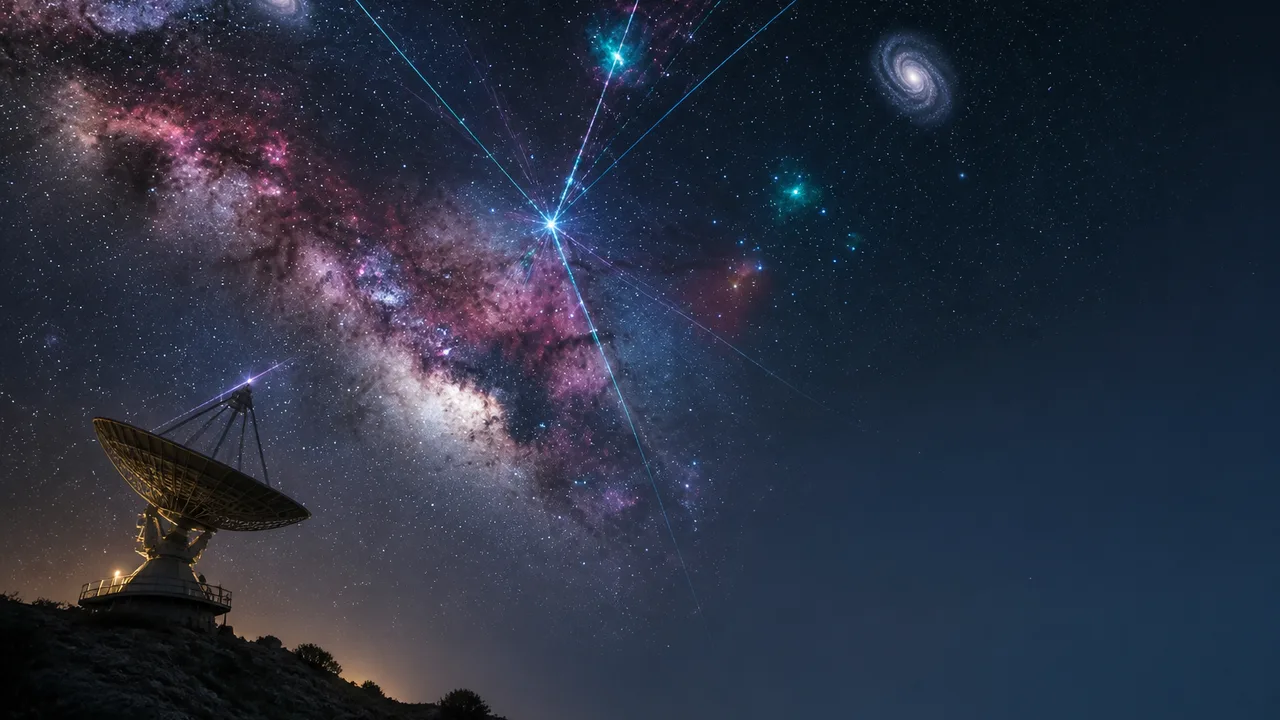
In 1987, a star exploded in the Large Magellanic Cloud some 168,000 light-years away. Three separate detector arrays—built by physicists who didn't particularly think of themselves as being in the same field—simultaneously caught the neutrino burst from Supernova 1987A within seconds of each other. Physicists studying underground particle detectors, astrophysicists watching the sky, and cosmologists thinking about the universe's large-scale structure suddenly found themselves staring at the same data point. Nobody had planned for that moment. There was no committee, no merger announcement, no rebranding. There was just a dead star, an ocean of neutrinos, and three communities realizing they'd been circling the same questions from different angles.
That collision—uncoordinated, urgent, electric—is closer to how astroparticle physics actually got born than any official origin story you'll find.
A new review posted to arXiv traces the intellectual history of the field and makes a specific argument worth sitting with: astroparticle physics didn't emerge because disciplines merged. It emerged because scientific problems outgrew the disciplines that first encountered them. The reorganization followed the questions, not the other way around.
That distinction sounds subtle until you consider what it means for how we think about scientific progress. If fields form around answers, the boundaries between them make sense — particle physicists have accelerators, astrophysicists have telescopes, cosmologists have mathematics and observation. But if fields form around questions, then the borders were always provisional, always waiting to dissolve the moment a question got big enough.
Dark matter is big enough. Cosmic rays are big enough. The origin of the universe's matter-antimatter asymmetry is definitely big enough.
Before Accelerators, There Was Just the Sky
Here's the thing about cosmic rays that still gets me every time I think about it: before particle accelerators existed, Earth's atmosphere was the accelerator. Protons and atomic nuclei streaming in from deep space at energies we still can't fully replicate in a lab were slamming into our air and cascading into showers of secondary particles. And the only way to catch them was to go up — to mountain tops, to balloons, to early cloud chambers.
The physicists doing that work in the early-to-mid 20th century were, by any reasonable description, doing particle physics. They discovered the positron, the muon, the pion, all via cosmic ray experiments. But the particles were coming from space, so astrophysicists cared too. And the energies involved had implications for the young universe, so cosmologists had opinions.
According to the Living Reviews in Relativity piece from Springer Nature, the post-WWII era is typically described as the "downfall" of cosmic ray studies — the moment when man-made accelerators took over and physicists who'd been using the sky as a lab moved indoors, chasing cleaner, controllable particle beams. Cosmic ray research went from glamorous to niche almost overnight. New subfields emerged or gained importance in those years, pulling attention and funding toward accelerator-based experiments.
But "downfall" is only true if you measure cosmic ray work by the standards of accelerator physics. The questions didn't go away. They went underground — literally. Physicists started building huge detectors deep in mines and under mountains to watch for rare events: proton decay, solar neutrinos, relic particles from the big bang. The tools changed. The address changed. The obsession stayed exactly the same.
Three Fields Walk Into a Supernova
The neutrino burst from SN1987A is the clearest proof of what was already happening. Three formerly separate programs — underground detectors watching for proton decay, solar neutrino experiments, and astrophysical sky surveys — all registered the same signal within a window of seconds. Researchers who'd never formally collaborated suddenly had joint data. The boundary between "particle physics" and "astrophysics" didn't just blur in that moment; it briefly became embarrassing to even invoke.
That's the collision the arXiv review is pointing at. Its central argument is that astroparticle physics didn't get created so much as recognized — that what emerged was a gradual reorganization of high-energy research around problems that had always transcended traditional disciplinary boundaries. The label "astroparticle physics" was finally catching up to the science.
This is actually a strange and underappreciated fact about how scientific fields work. We tend to narrate them as: researchers identify a new domain, build institutions and journals and degree programs, and a field is born. The arXiv review is suggesting the sequence often runs backward — the researchers are already doing the work, the shared vocabulary is already developing informally, and the official recognition is almost administrative, a stamp on something that's been true for years.
What Gets Laundered Into Someone Else's Legacy
There's a credit problem embedded in this history that I find genuinely uncomfortable. A lot of the work that built astroparticle physics — particularly the cosmic ray era, particularly the underground detector programs — got retroactively absorbed into either particle physics or astrophysics depending on who was writing the history. Cosmic ray discoveries get credited to the "founding of particle physics." Neutrino astronomy milestones get folded into astrophysics's greatest hits. The middle ground where the actual synthesis happened gets cited less, funded less, remembered less.
The arXiv review is, among other things, a corrective to that. By tracing the specific intellectual lineage — how the problems themselves migrated, how instrumentation developed at the intersections, how researchers built careers that didn't fit cleanly into any existing department — it argues for astroparticle physics having its own coherent identity rather than being the leftovers after the "real" fields took what they wanted.
That argument has contemporary stakes. The way we categorize science shapes how it gets funded, how students get trained, and which questions get treated as legitimately important versus perpetually interdisciplinary and therefore nobody's specific budget line. The Living Reviews in Relativity history captures some of this in its coverage of how the post-WWII reorganization shuffled resources and prestige — and who ended up on the losing side of that shuffle.
The Fields That Are Still Borrowing
Watch where today's researchers keep having to go outside their departments for tools. That's where the next label is assembling itself.
Astroparticle physics right now is chasing dark matter detection, ultra-high-energy cosmic ray origins, gravitational wave sources, and the neutrino mass — questions that require, simultaneously, the sensitivity of particle physics instrumentation, the sky coverage of astrophysics, and the theoretical scaffolding of cosmology. According to the arXiv review, the field's ongoing coherence comes from exactly this: not shared techniques, but shared targets. Problems big enough that no single discipline's toolkit is sufficient.
The pattern has a kind of predictive power. Right now, quantum information science keeps borrowing from condensed matter physics. Climate science imports techniques from oceanography, chemistry, and ecology simultaneously. Synthetic biology is basically a standing negotiation between molecular biology, engineering, and computer science. Each of those fields is in some version of the state astroparticle physics was in circa 1987 — the work is happening, the community is forming, the journal is probably in planning.
The official recognition will catch up. It always does. The question is whether the history of how the field formed gets told accurately, or whether it gets flattened into a cleaner story that fits someone else's founding myth.
Astroparticle physics took decades to get its own honest accounting. The arXiv review is doing some of that work now. The fields assembling themselves in the background today probably shouldn't have to wait as long.
More Like This
Sterile Neutrinos: A Particle Physics Puzzle
Recent experiments challenge the existence of sterile neutrinos, reshaping our understanding of the universe.
Ten Discoveries That Rewired How We See Everything
From CRISPR to dark energy, ten scientific breakthroughs that didn't just change their fields — they changed what questions we're allowed to ask.
Could We Have Detected Dark Matter at Last?
Scientists may have detected dark matter's signal in the Milky Way, hinting at potential breakthroughs in understanding the universe.
Physicists Just Caught Virtual Particles Becoming Real
New experiment at Brookhaven Lab allegedly proves virtual particles exist—challenging how we understand empty space and quantum reality itself.

Why a Theory of Everything Is Centuries Away
Fermilab physicist Don Lincoln says a theory of everything is at least 100 years away—and his reasoning is harder to dismiss than it sounds.
When Basic Physics Secretly Rewrites the World
Don Lincoln explains how Maxwell's equations revealed the speed of light — and why what we ignore in physics today may determine our climate future.
A Black Hole Photon Ring Inspired a New Laser Design
Researchers built a laser using the light-trapping geometry of black hole photon spheres. Here's what the experiment actually shows—and what it doesn't.
Cold Spark Machines Are Hot — Just Not How You Think
Cold spark machines are marketed as safe firework alternatives, but the science tells a more complicated story. Here's what's actually happening inside those sparks.