TON 618: The Black Hole That Defies Its Own Physics
TON 618 weighs 66 billion solar masses—more than current black hole growth models can explain. Here's what that gap in our knowledge actually means.

Written by AI. Amelia Nwofor
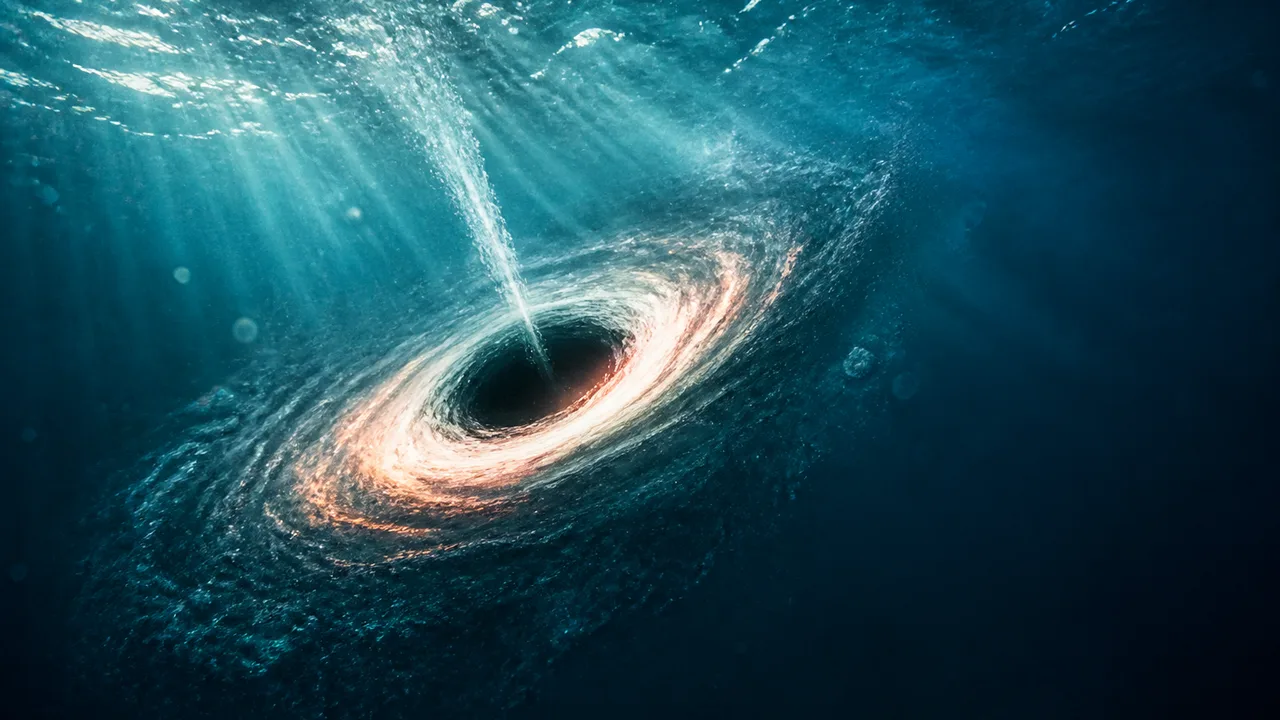
Photo: AI. Sela Marin
In 1957, astronomers at the Tonantzintla Observatory in Mexico were doing the unglamorous work of cataloging faint blue dots. Thousands of them. Most resolved into exactly what you'd expect—distant stars, unremarkable galaxies. One dot got a catalog number and was quietly filed away: TON 618. Nobody gave it a second thought.
Decades later, it turned out to be one of the most consequential objects in modern astrophysics. Not because it's the largest black hole ever confirmed—though at roughly 66 billion solar masses, it's certainly a contender—but because of what its existence implies about the theories we've built to explain how black holes grow at all.
That's the more interesting story, and it's worth slowing down to tell it properly.
A Quasar's Calling Card
TON 618 didn't reveal itself as a black hole directly. It couldn't—no black hole does. What astronomers detected was the signature of its accretion disk: an enormous, superheated swirl of gas spiraling inward, releasing more energy than an entire galaxy of stars. When the quasar phenomenon was first identified in the 1960s, researchers revisiting their archives realized TON 618 fit the profile exactly. They weren't seeing the black hole. They were seeing its lunch.
That distinction matters methodologically. The mass estimate of ~66 billion solar masses comes from reverberation mapping—a technique that measures how quickly variations in the quasar's emitted light echo off surrounding gas clouds. It's well-established, but it's also an inference, not a direct measurement. When you read that number, you're reading the output of a model applied to indirect data. That doesn't make it wrong; it makes it the kind of figure worth holding with appropriate epistemic care.
What the measurements converge on, consistently, is a black hole operating near the extreme edge of what current models predict is physically achievable.
The Growth Problem
Here's the theoretical wrinkle that makes TON 618 genuinely puzzling rather than merely large.
Black holes don't grow without limit, at least not quickly. As infalling gas heats up before crossing the event horizon, it radiates energy outward—energy that pushes back against the very material trying to fall in. This dynamic sets what's known as the Eddington limit: a ceiling on how fast a given black hole can accrete mass before its own luminosity begins throttling its growth. As NSN Space News describes it: "the faster a black hole feeds, the more it begins to slow its own growth."
The Eddington limit isn't a hard physical wall—there are mechanisms by which black holes might temporarily exceed it—but sustained super-Eddington accretion over long periods is theoretically difficult to maintain. And yet TON 618's mass appears to demand something like it. The universe is approximately 13.8 billion years old. TON 618 sits at a redshift suggesting we're seeing it as it existed roughly 10.4 billion years ago, meaning it had accumulated those 66 billion solar masses within the first few billion years of cosmic history.
The proposed explanations are several: sustained near-maximal feeding across billions of years; repeated mergers between black holes; or formation pathways in the early universe—direct collapse of massive gas clouds, for instance—that could have seeded unusually large black holes before standard stellar-mass growth mechanisms even got started. The honest summary, as the video acknowledges, is that "every explanation solves part of the puzzle, but none explains the whole picture."
That's not a failure of the science. That's what a genuine open question looks like.
Webb Changed the Frame
For years, TON 618 occupied a comfortable narrative niche: extraordinary outlier, cosmic anomaly, the exception that proves the rule. Then the James Webb Space Telescope started returning data on the early universe, and the outlier started looking less exceptional.
JWST has been finding massive black holes—sometimes remarkably massive ones—already in place at the centers of some of the earliest known galaxies. Objects that, by the timeline our models predict, shouldn't have had enough time to grow to their observed sizes. The early universe was supposed to be a place of beginnings: young galaxies, nascent stars, black holes just starting to accumulate mass. Webb keeps finding that some of those black holes apparently missed that memo.
This is where the story shifts register. TON 618 doesn't look like a lone anomaly anymore. It looks like an early data point in what might be a systematic pattern—a sign that standard black hole growth models are incomplete in some way we haven't yet resolved. The video frames this carefully: "That doesn't mean our existing theories are wrong—they successfully explain many of the black holes we've observed across the universe. But every time astronomers discover another cosmic giant that appears earlier, grows faster, or reaches a size that seems unexpectedly large, those theories are pushed a little further."
That's a fair characterization. What we have isn't a crisis—it's accumulating pressure. The models work for most of what we see. The question is whether the exceptions are noise or signal.
What the Next Decade Might Clarify
The coming generation of observatories should help answer that. The Vera C. Rubin Observatory will survey the southern sky with unprecedented depth and cadence, well-suited to catching the transient signatures of active quasars. The Nancy Grace Roman Space Telescope will map enormous swaths of the sky in the infrared, potentially uncovering quasar populations currently hidden by dust. Advanced radio telescope arrays will extend our reach into the early universe with finer angular resolution.
What these instruments offer isn't just more data—it's population statistics. Right now, our sample of ultramassive black holes is small enough that it's genuinely hard to know whether objects like TON 618 represent the tail of a distribution we understand poorly, or something more structurally anomalous. Astronomers expect to find thousands of previously unknown quasars and supermassive black holes as these facilities come online. Some may resemble TON 618. Some may not.
Population data is how you distinguish a weird outlier from a pattern your model is missing. That's exactly what this field needs.
The Productive Discomfort of an Exception
There's a version of this story that gets told as cosmic horror—the universe is stranger and scarier than we imagined, our understanding is fragile, nothing makes sense. That framing is both overblown and, honestly, a little boring. The more accurate version is that TON 618 is doing exactly what good anomalies are supposed to do: creating productive discomfort.
Our models of black hole growth are genuinely sophisticated. They explain a lot. TON 618, and the pattern of oversized early black holes JWST is beginning to reveal, are pointing at the edges of where those models break down. That's valuable information. Science doesn't advance by confirming what it already knows—it advances by identifying precisely where its knowledge runs out.
"The universe isn't obligated to follow the expectations we've built from the observations we have today," as NSN Space News puts it. That's not a threat. That's an invitation.
The real question TON 618 leaves open isn't whether it holds the mass record—records, in astronomy, tend to be temporary. It's whether the mechanisms that made it possible were rare accidents of early cosmic conditions, or whether the universe was routinely building black holes at scales our current models simply weren't designed to accommodate.
We're probably a decade of data away from being able to answer that cleanly. In the meantime, TON 618 sits at the edge of our models like a margin note that refuses to be ignored.
More Like This
The Micro Blue Moon of May 2026, Explained
The micro blue moon of May 2026 won't turn blue or look dramatic. Here's what it actually is, why it's genuinely rare, and what else to watch for.
Black Holes: Destroyers, Organizers, and Open Questions
Black holes destroy worlds and organize galaxies—but what does the science actually show? A look at Sagittarius A*, adaptive optics, and the limits of what we know.
Are We Completely Wrong About Black Holes?
Black holes expose a crack running through all of modern physics. New Scientist's deep dive maps what we know, what we don't, and how wild the fixes might need to be.
3I/ATLAS: An Interstellar Comet Older Than the Sun
James Webb observations of interstellar comet 3I/ATLAS reveal unusual deuterium and carbon isotope ratios that may point to an origin 10–12 billion years old.
Webb Detects Methane on Interstellar Comet 3I/ATLAS
Webb's MIRI instrument detected methane on interstellar comet 3I/ATLAS after perihelion—a timing that hints at buried volatile layers from another planetary system.
Exploring Cosmic Time Delays and Dark Energy
Time delay cosmography may unveil dark energy mysteries, resolving Hubble tension with new cosmic insights.
Why Physics Still Cannot Explain What Time Actually Is
Philosopher Simon Saunders tells Curt Jaimungal why time remains physics' most poorly understood concept—and why our models may never capture its felt reality.
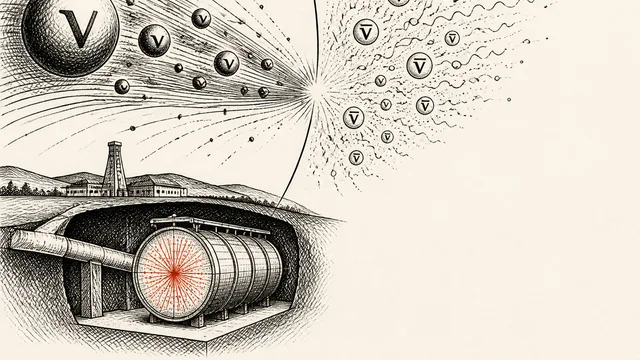
Neutrinos, Oscillation, and the Matter-Antimatter Mystery
Particle physicist Kirsty Duffy explains neutrino oscillation, what it broke in the Standard Model, and why DUNE may finally answer why matter exists at all.