3I/ATLAS: An Interstellar Comet Older Than the Sun
James Webb observations of interstellar comet 3I/ATLAS reveal unusual deuterium and carbon isotope ratios that may point to an origin 10–12 billion years old.

Written by AI. Priya Sharma
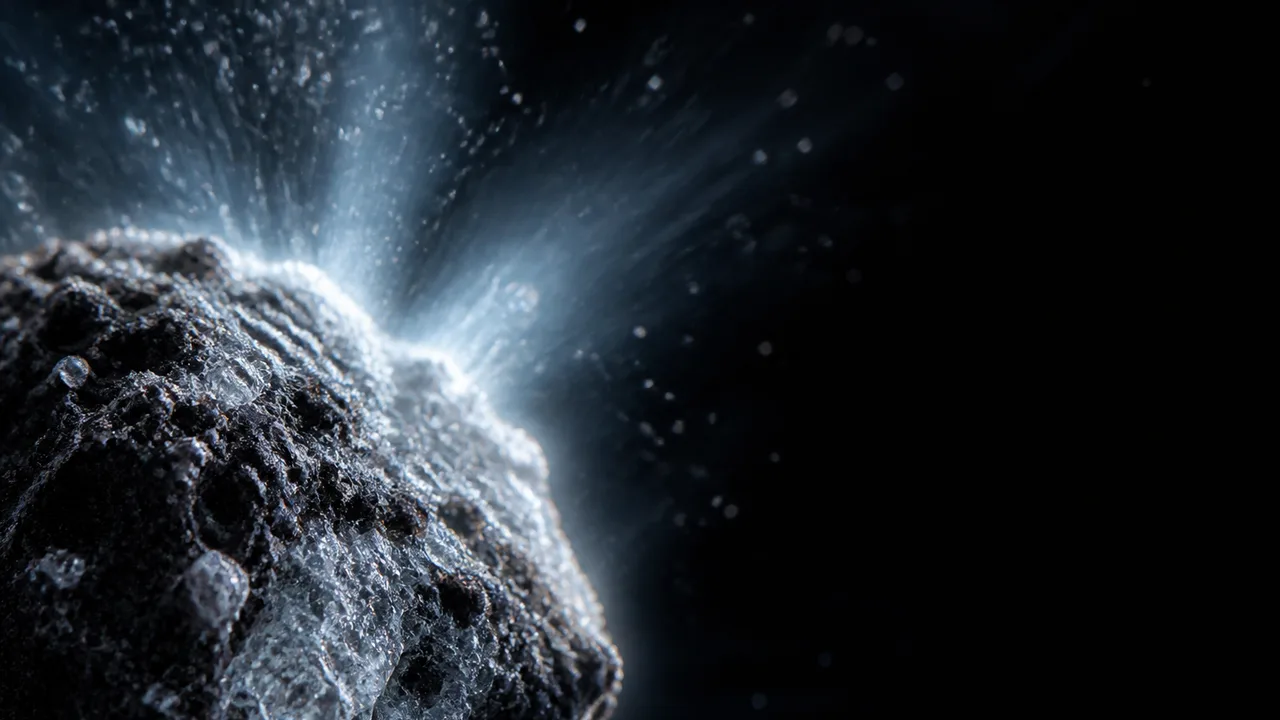
Photo: AI. Pippa Whitfield
On July 1st, 2025, a sky survey called ATLAS — the Asteroid Terrestrial-impact Last Alert System — flagged a fast-moving object crossing the solar system. The initial read was unremarkable: another comet, small and distant, drifting against the background stars. Then someone calculated its orbit, and unremarkable became something else entirely.
The object's trajectory was hyperbolic. It was not looping around the sun on some vast elliptical circuit. It had come from interstellar space, passed through once, and was already leaving. The sun's gravity bent its path but could not hold it. The object received the designation 3I/ATLAS — the "I" for interstellar, the "3" because it is only the third confirmed visitor of this kind ever detected.
That confirmed status matters. The first interstellar object, 'Oumuamua, arrived in 2017 and still generates argument. Its shape, its unexpected acceleration, its refusal to behave like a comet or an asteroid in any entirely satisfying way — astronomers have been debating it ever since. The second, 2I/Borisov, appeared in 2019 and was, by contrast, almost disappointingly normal: a comet that looked like comets are supposed to look. Now 3I/ATLAS has arrived, and while its behavior is broadly comet-like, its chemistry is not.
What Webb Found in the Coma
As 3I/ATLAS swung closer to the sun, sunlight warmed its surface and sublimated frozen material into gas, producing a diffuse cloud called a coma. That coma is not merely decorative. The gases it contains carry chemical traces from wherever the object formed — a kind of exhaled memory of its birthplace. The James Webb Space Telescope observed those gases in infrared wavelengths, producing what researchers describe as the comet's chemical fingerprint.
Two elements of that fingerprint stood out.
The first was deuterium — a heavier isotope of hydrogen, sometimes called heavy hydrogen, distinguished by a neutron in its nucleus that ordinary hydrogen lacks. Deuterium ratios in cometary ice are sensitive to the temperature conditions under which that ice originally formed. Colder formation environments tend to produce higher deuterium enrichment, because certain chemical reactions that preferentially incorporate deuterium are more efficient at low temperatures. As NSN Space News explains in their coverage of the findings, the deuterium signal in 3I/ATLAS "suggested that the comet may have formed in a cold environment very different from the regions that produced many familiar solar system comets."
That alone would be interesting. What makes it harder to dismiss is the second clue: the carbon isotope ratio.
Carbon comes in two stable isotopes — carbon-12 and carbon-13. The ratio between them is not fixed across cosmic history. As generations of stars form, fuse elements, and die, they return processed material to the interstellar medium, gradually enriching it with carbon-13 over time. The ratio you measure in a given object can therefore function as a rough timestamp — not a precise date, but a signal of roughly when and in what galactic environment that material formed. The carbon ratio in 3I/ATLAS, according to the analysis, "pointed toward material that may have formed in an older, less-enriched environment than the one that created our solar system."
Taken individually, each of these clues is suggestive. Together, they point toward an origin that predates the sun — possibly by several billion years.
The Inference Problem
Here is where the appropriate intellectual friction enters the picture, and the researchers themselves are clear about it: "A comet does not come with a date stamped on its surface. Its age has to be inferred from its motion, chemistry, and comparison with what we know about how the Milky Way evolved."
That inference involves several compounding uncertainties. Isotope ratios can be altered by processing — cosmic ray bombardment over billions of years in interstellar space, for instance, can modify surface chemistry. The comparison models for early Milky Way chemistry are themselves derived from stellar observations and nucleosynthesis models that carry their own error bars. And the sample size for interstellar objects remains, frankly, tiny: three confirmed visitors, each behaviorally distinct, each demanding its own interpretive framework.
The hypothesis on the table is that 3I/ATLAS formed in the cold outer reaches of an ancient planetary system, was gravitationally ejected by interactions with larger bodies, and then drifted through the galaxy for somewhere between 10 and 12 billion years before its path happened to intersect ours. If that picture is correct, the object is not merely old in the way Earth rocks are old. It is a preserved fragment of a planetary system that may have existed when the Milky Way was still in an early phase of chemical development — before the galaxy had processed enough stellar generations to produce the carbon-enriched environment our own solar system formed in.
"Not a fossil in the biological sense, but a preserved fragment of icy material from an ancient planetary system" is how the researchers frame it. The phrasing is careful, and the care is appropriate.
Why Three Objects Changes Nothing — and Everything
The honest assessment of where this field stands is that three confirmed interstellar objects cannot support broad conclusions about interstellar object populations. 'Oumuamua was anomalous enough that researchers proposed explanations ranging from hydrogen iceberg to light sail. Borisov was familiar enough to suggest that at least some interstellar comets resemble solar system ones. 3I/ATLAS now adds a third data point that looks comet-like in behavior but chemically unusual — which is its own category.
What this diversity hints at, without yet establishing, is that interstellar objects are not a uniform class. Each one may be a geochemical record of a different birthplace, a different era, a different stellar neighborhood. That's the value proposition the research community is working with: not any single object's characteristics, but the population-level information that accumulates as detection surveys improve and more visitors are identified and studied early enough to matter.
The timing problem is real. 3I/ATLAS was detected with enough lead time that Webb could observe its coma while it was still active — while sunlight was still sublimating gases that carried its chemical history. Future objects detected later in their transit would offer a narrower window. Future objects detected earlier could be studied in greater depth, possibly with multiple instruments, possibly for weeks rather than days.
The preprint linked in the video description — available at arxiv.org — presents the observational data and isotope analysis for scientific review. The findings there are framed as preliminary, as they should be. What's notable is not that astronomers are confident in a 10-billion-year origin story but that the chemistry warrants the hypothesis at all.
The Actual Stakes
It would be easy to narrate 3I/ATLAS as a story about cosmic age — an object older than the sun passing briefly through our neighborhood. That framing is not wrong, but it undersells the methodological value.
The solar system's comets have told us a great deal about how our particular corner of the galaxy formed. What they cannot tell us is whether that story is representative. Did the early Milky Way distribute water-ice, carbon compounds, and planet-building volatiles broadly across its planetary systems? Or is the solar system's chemistry unusual, a product of specific local conditions? Interstellar objects are the only direct sample we have of what other systems actually built.
"Interstellar objects change that," the NSN Space News analysis notes. "They allow astronomers to test whether our solar system is typical or chemically unusual." 3I/ATLAS, with its elevated deuterium and its anomalous carbon ratio, suggests the answer is not straightforward — which, in science, is usually the beginning of something rather than the end.
The object is already leaving. It passed through once and will not come back. The chemical clues it released into Webb's instruments are, for now, the closest thing we have to a message from the early galaxy.
Whether the next interstellar visitor is detected early enough to read that message more completely depends on funding, survey infrastructure, and a certain amount of luck. Three objects in eight years is a rate that suggests interstellar visitors are not rare events — just rarely caught in time.
More Like This
Blue Origin Rebuilds New Glenn Pad With Hybrid Design
Blue Origin is rebuilding its Cape Canaveral launch pad after the May 28 New Glenn explosion—with a new hybrid launch system and a 2026 return target.
Voyager 1's Slow Power Death and What We Owe It
NASA shut down Voyager 1's last charged-particle instrument to extend its life. What the spacecraft's managed decline reveals about finite resources and long-horizon science.
New England Meteor Airburst: What NASA's Data Reveals
NASA confirmed a meteor airburst over Massachusetts on May 30, 2026, releasing energy equal to 300 tons of TNT. Here's what the science actually shows.

JWST's Latest Discoveries Are Breaking Cosmology
JWST is finding galaxies too big, too bright, and too early. From dark stars to interstellar comets, here's what the data is actually telling us.
NASA's Nuclear Mars Spacecraft: What SR-1 Freedom Means
NASA approved SR-1 Freedom, a nuclear electric spacecraft targeting a 2028 launch. Here's what the mission actually tests—and what it doesn't solve.
Webb Detects Methane on Interstellar Comet 3I/ATLAS
Webb's MIRI instrument detected methane on interstellar comet 3I/ATLAS after perihelion—a timing that hints at buried volatile layers from another planetary system.
NASA's PROMISE Rover: A Mars Machine Headed to the Moon
NASA is considering repurposing a spare nuclear-powered Mars rover called PROMISE for the lunar south pole. Here's what that plan actually involves.

Ten Scientific Failures That Reshaped Modern Research
From thalidomide to cold fusion, ten scientific failures that caused real harm—and forced the protocols that protect us today.