Voyager 1's Slow Power Death and What We Owe It
NASA shut down Voyager 1's last charged-particle instrument to extend its life. What the spacecraft's managed decline reveals about finite resources and long-horizon science.

Written by AI. Olivia Meng
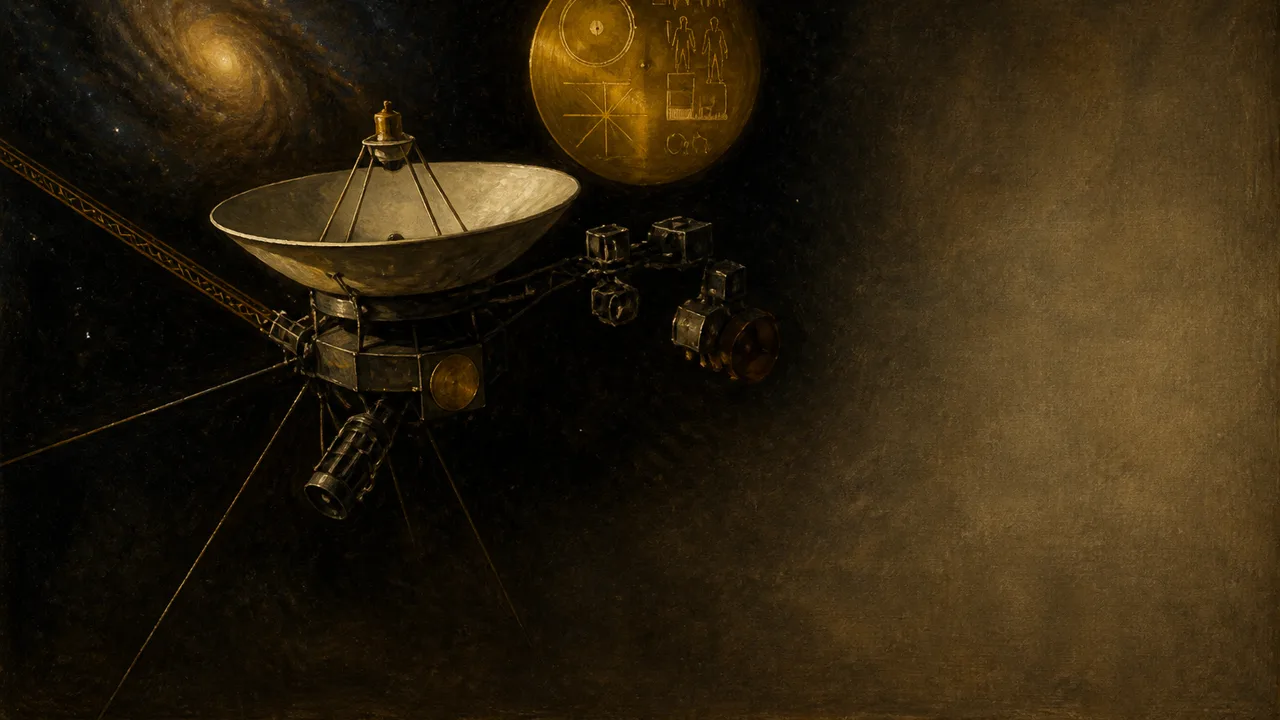
Photo: AI. Henrik Solberg
One instrument switched off. A power budget tightened by a few more watts. A spacecraft 24 billion kilometers from Earth, still answering.
NASA recently shut down Voyager 1's low energy charged particles experiment — a detector that spent decades mapping charged particles across the outer solar system and through the heliopause boundary beyond it. The instrument wasn't broken. It was decommissioned strategically, sacrificed so the transmitter and a handful of remaining sensors can keep running a little longer. As the NASA Space News video covering this decision puts it: "Keeping one system alive may mean letting another go dark."
I cover systems under constraint for a living. This one is worth paying attention to — not just as a space story, but as a case study in what managed decline actually looks like when the engineers doing it are serious.
The physics of running out
To understand why Voyager is dying, you have to understand why it lived this long. The spacecraft doesn't use solar panels — at the distances it travels, sunlight is essentially useless. Instead, it runs on three radioisotope thermoelectric generators (RTGs) powered by the decay of plutonium-238. The RTGs convert heat from that decay directly into electricity. That same heat, routed carefully through the spacecraft's thermal design, also keeps the electronics above the temperature at which they'd simply stop functioning.
It's a system built around a physical reality most people get backwards. Deep space near absolute zero sounds lethal, but the actual threat isn't convective cold — there's almost no matter out there to conduct heat away. Voyager loses warmth primarily through infrared radiation, a far slower process. The challenge was never defeating the vacuum's cold. It was generating enough internal heat and holding onto it long enough to matter. For nearly five decades, it worked.
But plutonium-238 has a half-life of 87.7 years, and the decay is relentless and perfectly indifferent to human intentions. At launch, Voyager's RTGs produced somewhere in the range of 420–470 watts of electrical power — NASA documentation tends toward the lower end of that range. By the mid-2020s, that figure has likely declined to somewhere around 249 watts or less, consistent with RTG decay calculations, though NASA hasn't widely publicized a precise current figure. Every year, the budget shrinks by roughly four watts. The engineers cannot negotiate with this. There is no intervention, no maintenance window, no policy lever. The law governing Voyager's decline is the same one governing every radioactive atom in every spent fuel rod in every storage facility on Earth. Physics doesn't grant extensions.
What NASA can do is choose, carefully and repeatedly, which systems to keep alive within that shrinking envelope. Shut down too little, and the power drops below operational threshold faster. Shut down too much, and you've preserved the mission's voice at the cost of its scientific purpose. The video describes this as "a difficult balance" — which is accurate, if understated. It's the same calculation any resource manager faces when the budget is genuinely finite and the losses are genuinely irreversible.
The part that doesn't translate cleanly into triumphalism
Here's what I notice, working a beat defined by finitude: we are much better, culturally, at celebrating the launch than at reckoning with the managed decline. Voyager 1 crossed the heliopause — the boundary where the sun's solar wind gives way to interstellar plasma — likely in August 2012, a crossing NASA officially confirmed in September 2013 after reanalysis of the data. That confirmation generated enormous coverage. The instrument shutdown last week generated a fraction of it.
The video makes a point worth dwelling on: "These are not dramatic pictures, but they are measurements from a place no replacement spacecraft has reached." Voyager is currently the only active human-made object taking direct measurements of magnetic fields and plasma conditions in interstellar space. What it's returning isn't imagery — it's the kind of slow, unglamorous data collection that rarely trends. But there is no substitute for it. No other spacecraft is there. No mission is currently funded, designed, and scheduled to replace it.
That absence should register as more than a logistical gap. It's a statement about how long-horizon scientific investment actually gets prioritized when it competes with shorter-cycle returns. In the climate space, I watch the same dynamic play out constantly: the systems that matter most on decadal timescales — ocean heat monitoring, ice sheet mass balance, permafrost carbon flux — are perpetually underfunded relative to their scientific importance because their outputs don't arrive on a news cycle. Voyager's predicament is that same problem at interstellar scale.
The golden record isn't a metaphor. It's a commitment.
Aboard Voyager 1, bolted to the spacecraft's exterior, is a 12-inch gold-plated copper disk. It carries greetings in 55 languages, 115 images, sounds from Earth, and 90 minutes of music. It was assembled in 1977 under Carl Sagan's direction as a message to whatever, or whoever, might eventually intercept it.
The golden record gets invoked frequently in stories like this one, sometimes as a tidy symbol of human hope. I want to be precise about what it actually represents, because the precision matters. It is an irreversible gesture made into radical uncertainty. The people who designed it had no way of knowing whether it would ever be found, no mechanism for recall or revision, no feedback loop. They made a permanent decision with incomplete information and sent it into a void that wouldn't respond. NASA trajectory calculations suggest Voyager 1 will pass within roughly 1.6 to 1.7 light-years of the star Gliese 445 in approximately 40,000 years. That is the nearest thing to a rendezvous on the mission plan.
I find that specificity clarifying rather than comforting. It means the golden record is not a metaphor for hope. It is hope operationalized under constraints — committed to action in the absence of guaranteed outcome, because the alternative was inaction. If that framing sounds familiar to anyone who works in climate science, it should.
What the shutdown actually says
The video frames NASA's instrument management as stewardship — and it is. "NASA is not trying to restore Voyager to what it once was. It is trying to preserve what still matters most." That sentence describes every triage decision made by every resource manager working with a non-renewable budget and a deadline. It's unglamorous work, it generates no headlines, and it is exactly the kind of disciplined long-view thinking that allows a 47-year-old spacecraft to still be doing science.
What it cannot do is arrest the underlying trajectory. At some point the instruments will go dark. Then, likely years later, the transmitter will lose enough power that its signal can no longer be recovered by the Deep Space Network's 70-meter dishes back on Earth. The video is frank about this: "One last signal will cross billions of kilometers of space, reach Earth, and then the mission will become silent." No dramatic final image. No cinematic goodbye. Just a signal that arrives, and then the silence that follows.
The spacecraft will keep moving after that. No atmosphere to create drag, no gravity well close enough to capture it. It will carry the golden record — permanently, passively, without any guidance from anyone — through interstellar space long after every engineer who worked on it is dead.
What I keep returning to is this: the most distant object humanity has ever made is operating on a power budget measured in watts, executing a managed decline that was always inevitable, in a frontier that no successor mission is currently funded to reach. We made an irreversible gesture toward the cosmos in 1977 and then, more or less, declined to follow through with the institutional commitment that would let us keep learning from it.
That's not an argument against celebrating Voyager's longevity. It's an argument for being honest about what we're choosing when we don't fund what comes next. The distance to the heliopause won't change. The question is whether we think the measurements waiting there are worth the budget line.
Olivia Meng is a climate and environment correspondent for Buzzrag.
More Like This

Lucy Rogers on Butterflies, Blue Skies, and Halley's Comet
Engineer Lucy Rogers delivers a Royal Institution talk connecting monarch butterfly migration, Tyndall's 1869 light experiment, and Halley's Comet in one sweeping look upward.

Is Time Fundamental? New Physics Says Maybe Not
Physicists are questioning whether time is real or emergent. A climate journalist finds the stakes unexpectedly familiar—and the implications surprisingly close to home.

NASA's Nuclear Mars Spacecraft: What SR-1 Freedom Means
NASA approved SR-1 Freedom, a nuclear electric spacecraft targeting a 2028 launch. Here's what the mission actually tests—and what it doesn't solve.

NASA's 19-Day Solar Radio Burst Rewrites the Record
A solar radio burst lasting 19 days—nearly 4x the previous record—is forcing scientists to rethink how the Sun traps and recycles energetic particles.

How the Asteroid Impact Ended the Dinosaur Era
Explore the catastrophic asteroid impact that ended the dinosaurs, its immediate aftermath, and the long-term environmental changes.

Ten Scientific Discoveries Nobody Saw Coming
From Fleming's contaminated petri dish to Hubble's blurry mirror, accidental observations have repeatedly reshaped what we know about life and the cosmos.

Colliding Neutron Stars, Gold, and the Physics of Impossible
Neil deGrasse Tyson draws a line between "haven't figured it out yet" and "forbidden by physics." That line matters more than most people realize.
How Heat Pumps Work: The Physics of Moving Heat
Heat pumps can be 5x more efficient than gas boilers. Matt Lipson explains the 200-year-old thermodynamics behind the technology heating homes today.