Why Onions Make You Cry: The Physics We Missed
Cornell researchers built an onion guillotine to solve the physics of why cutting onions makes you cry—and debunked a few popular kitchen hacks along the way.

Written by AI. Amelia Nwofor
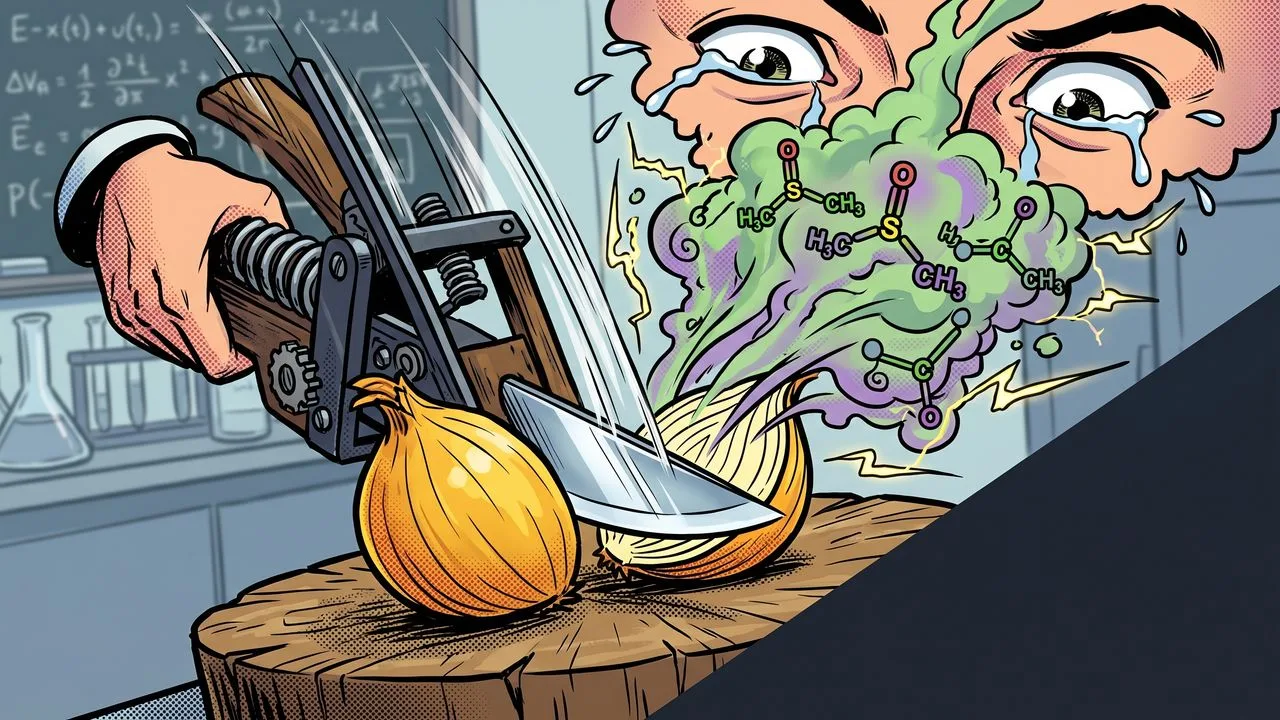
Photo: AI. Marco Velez
Somewhere between the Bronze Age and this morning's shakshuka, humans accepted a peculiar trade-off: extraordinary flavor in exchange for mandatory weeping. Onions have been in continuous culinary use for at least 4,000 years. That's four millennia of cooks tearing up, blinking furiously, and developing folk remedies of wildly varying scientific credibility. And until very recently, nobody had actually looked at the physics of what's happening when a blade hits an onion cell.
A study published in October 2025 from a research group at Cornell University finally addressed that gap—not with a hunch or a home kitchen experiment, but with a precisely calibrated onion guillotine, high-speed cameras, and an electron microscope. The results confirm some things home cooks already suspected, overturn at least one popular hack, and open up a question the researchers themselves didn't fully answer.
The Chemistry You Probably Half-Knew
Before getting to the new physics, it's worth dwelling on what we already understood—because it's genuinely strange chemistry, and some of it is more recent than you'd expect.
Cutting an onion ruptures cell walls, which triggers a cascade: the enzyme alliinase gets released into the environment and acts on sulfur-containing compounds to produce 1-propenyl sulfenic acid. That intermediate then reacts with a second enzyme—a lachrymatory factor synthase—to produce syn-propanethial-S-oxide, the volatile molecule that diffuses into your eyes and kicks your lacrimal glands into overdrive.
Here's what I find genuinely remarkable about this: the second step in that pathway, the one involving lachrymatory factor synthase, was only characterized in 2002. As Hank Green noted in SciShow's recent video covering this research, that discovery is "like 5 years ago" in the grand scheme of how long we've been cutting onions. We've been farming these things since before writing was widely used, and we only worked out the molecular details of why they hurt us in the current millennium.
There's also a quiet sidebar buried in this chemistry that I can't let pass without comment: onions draw their sulfur from soil, and acid rain deposits sulfur into soil. One unexpected consequence of the partial success of acid rain mitigation in industrialized regions may be milder onions. That's the kind of second-order environmental feedback loop that doesn't make headlines but probably should. The onions of your childhood might genuinely have been more potent—not because you were less tough, but because the atmospheric sulfur budget was different.
Once syn-propanethial-S-oxide is in your eyes, there's nothing to be done about it. The molecule is, as the research puts it, essentially unstoppable at that point. So the entire intervention space is upstream: stop the chemical from reaching your eyes in the first place.
Which is where physics enters.
Enter the Guillotine
The Cornell team's contribution was to treat onion-cutting as a fluid dynamics and materials science problem rather than purely a chemistry one. Their onion guillotine allowed them to systematically vary knife sharpness, cutting speed, blade angle, and onion temperature while imaging what happened at the moment of contact.
What they found was that droplets are released in two phases: an initial burst when the blade first punctures the onion surface, and then a slower, more continuous release as the blade travels through the flesh. The initial burst is where most of the damage is done, and its magnitude is strongly influenced by blade sharpness.
A dull blade, it turns out, compresses the onion membrane before breaking it—building up pressure that then releases explosively. A sharp blade punctures cleanly and with less mechanical energy transfer, meaning a smaller initial burst. This is why the "always use a sharp knife" rule, typically framed as a safety and precision argument, now has an additional rationale. As Green summarized: "a more blunt blade applied more pressure to the membrane before breaking it, causing a bigger burst of droplets."
Cutting speed produced a parallel finding: faster cuts released more droplets. The interaction between blade velocity and tissue mechanics is doing something here—whether it's related to the kinetic energy transferred to fluids in the cell, or the rate at which ruptured cells are exposed before adjacent ones seal off, isn't fully spelled out in what was reported. That's a genuine open question worth watching.
The practical upshot is a specific, testable recommendation: sharp knife, slow cut. Not a vague suggestion, but a mechanism-grounded one.
The Fridge Hack Doesn't Hold Up
This is where the research earns its keep for the home cook with an opinion. Chilling onions before cutting them is a widely repeated piece of kitchen wisdom, with the rationale being something about slowing down the chemical reaction or reducing the volatility of the irritant. The Cornell experiments didn't just fail to support it—they found the opposite.
Cold onions released more droplets. The proposed explanation is that chilled onion tissue becomes stiffer, so it resists the blade for longer before yielding—essentially doing the same thing a dull blade does, building up pressure before a more energetic rupture. The fridge makes your onion behave like a blunter knife is being used on it.
It's worth being precise about what this means and doesn't mean. The study measured droplet release, not the rate of chemical synthesis or the concentration of syn-propanethial-S-oxide in those droplets. It's possible, in principle, that chilling slows the enzymatic reaction enough to offset the increased droplet count. The study doesn't appear to have measured that, and Hank Green's summary didn't flag it as a controlled variable. So "chilling is counterproductive" is the most defensible reading of this data, but it's not a complete picture of every mechanism in play.
The Water Bowl Question
There's another popular hack the Cornell team addressed more obliquely: keeping a bowl of water, or a damp towel, near the cutting board. The logic is reasonable—syn-propanethial-S-oxide is water-soluble, so any droplets that hit water instead of your corneas are neutralized. Green called this out as something "that seems like it could work" but wasn't formally tested in the paper.
What the high-speed imaging did show is that the droplets travel upward. Which means a bowl of water sitting on the worktop is largely irrelevant to the primary spray—it might catch some of the ricochets and secondary splashes, but it's not positioned to intercept the initial ballistic trajectory heading for your face.
Green's response to this gap was characteristically direct: "if I'm allowed to make requests, it might make for a good follow-up." I'd second that. The aerosol dynamics here—droplet size distribution, trajectory angles, the effect of ambient airflow—seem like they'd make for a genuinely publishable fluid mechanics paper. There's a reason industrial food processing is done with controlled airflow, and kitchen onion-cutting is effectively an uncontrolled aerosol generation event.
Bigger Than Breakfast
There's a dimension of this research that deserves more attention than the crying-prevention angle typically generates. Droplets sprayed from ruptured vegetables don't only carry lachrymatory chemicals—they carry whatever else is on or in the vegetable, including bacteria. The same blade dynamics that govern onion-juice aerosols govern how cutting boards and adjacent surfaces get contaminated with foodborne pathogens.
A sharper knife that produces a smaller, less energetic initial burst isn't just saving your mascara. It's reducing the splash radius of anything microbial that might be hitching a ride. This is a food safety argument for knife maintenance that has nothing to do with cutting yourself, and it comes directly from the physics, not from the usual "sharp is safer" intuition.
What the Guillotine Can't Fix
The honest read of where this leaves us: the chemistry has been understood for over two decades, the physics is now meaningfully better characterized, and the actionable advice is—keep your knife sharp, cut slowly, skip the fridge. Goggles remain the only near-complete solution, which is apparently standard practice in professional prep kitchens and deeply unsexy everywhere else.
What we still don't have is a full account of the droplet trajectories under different kitchen conditions—with ventilation, without it, with overhead lighting that creates convection currents, with the onion positioned at different distances from your face. The Cornell study appears to have been conducted under controlled lab conditions, and kitchens are not controlled.
Four thousand years in, the onion is still making us work for it. 🔪
More Like This

When Hackers Build Cameras That Freeze Reality
A maker built a custom camera rig that makes spinning saw blades appear motionless. The technical choices reveal what consumer cameras hide from us.

Exploring the Enigma of Antimatter at CERN
CERN's antimatter factory reveals mysteries of the universe's matter-antimatter asymmetry and the quest for new physics.

Ancient Dogs Were Already Weird Before Victorians
A 2025 skull study of 600+ canines upends the tidy story that Victorian breeders invented dog diversity. Ancient dogs were already strange—and varied.

The Most Cited Science Papers of All Time, Ranked
From graphene to a 1951 chemistry trick, the most cited scientific papers ever aren't what you'd expect—and that tells us something important about how science actually works.
The Physics Hiding Inside Your Food
Harvard physicist David Weitz and chef Ben Ebbrell reveal the surprising science behind focaccia, meringue, ice cream, and martinis at the Royal Institution.

How Fractals Moved From Math Curiosity to Tech
Fractals aren't just beautiful—they're inside your smartphone antenna, your microchip cooling system, and your eye exam. Here's how the math became engineering.
Hannah Cairo Disproved a 40-Year-Old Math Conjecture at 17
At 17, Hannah Cairo overturned the Mizohata-Takeuchi conjecture using a hypercube and a coin diagram. Here's what she actually did—and why it matters.

How Language Shapes Thought, According to Lera Boroditsky
Cognitive scientist Lera Boroditsky explains how the language you speak shapes memory, color perception, and thought—and what's lost when languages disappear.