The Most Cited Science Papers of All Time, Ranked
From graphene to a 1951 chemistry trick, the most cited scientific papers ever aren't what you'd expect—and that tells us something important about how science actually works.

Written by AI. Amelia Nwofor
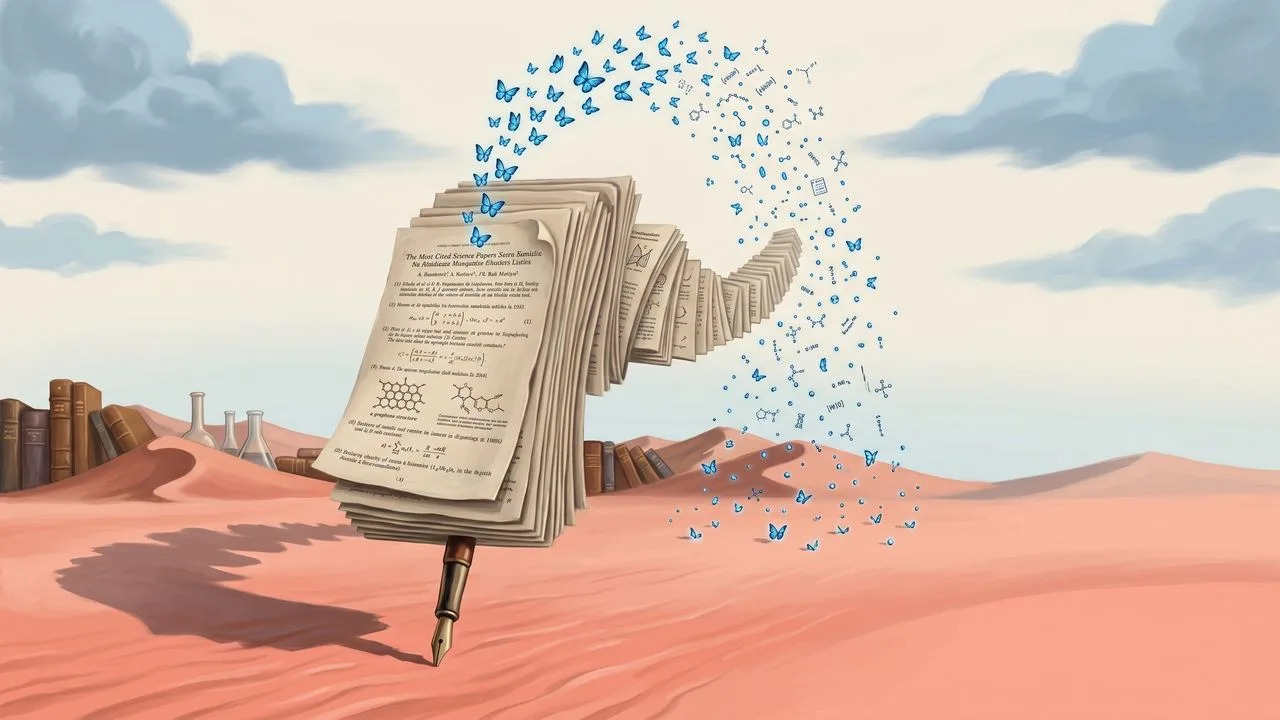
Photo: AI. Iolanthe Fenwick
Ask someone to name the most important scientific paper ever published and you'll probably get Darwin, Einstein, Watson and Crick. The origin of species. General relativity. The double helix. The papers that cracked the universe open and rearranged how humans understand their place in it.
That instinct isn't wrong, exactly. But it's measuring the wrong thing.
In April 2025, Nature published a ranking of academic papers by raw citation count—how many times other researchers have formally referenced a given work in their own publications. The resulting list, which SciShow's Madelyn Leembruggen recently walked through for five major fields, is quietly revelatory. Not because it surfaces dramatic discoveries, but because it surfaces something more interesting: the papers that built the floor that everyone else stands on.
None of the five are household names. That's the whole point.
The Infrastructure of Science
Citation counts measure a specific, narrow thing: how often other researchers found a paper useful enough to formally acknowledge. That's not the same as importance in a grand historical sense, and it's worth holding that distinction clearly. A paper that elegantly reframes how we understand consciousness might reshape philosophy and generate a decade of debate without accumulating citations the way a practical laboratory method does. Citations are a proxy for utility at scale, not for intellectual magnitude.
Which is why the list looks the way it does.
Start at number five: the graphene paper, sitting at roughly 52,000 citations. Graphene is a two-dimensional sheet of carbon atoms arranged in hexagons—one atom thick, theorized in the 1940s, dismissed as physically impossible for decades, then actually synthesized in 2004. The dismissal is worth pausing on. Scientists genuinely believed a material that thin couldn't exist stably. When it turned out it could, and that its honeycomb structure made electrons "skate across the surface without interference from other atoms," making it an extraordinary conductor despite being made entirely of carbon—the materials science community had a lot of catching up to do. The citations reflect that scramble.
At number four, something structurally different happens. The 2015 paper Deep Residual Learning for Image Recognition has over 116,000 citations—more than double graphene's count—despite being a decade younger. The SciShow breakdown explains why: it solved a specific, maddening problem with deep neural networks. When you stack enough layers in a network, information degrades as it passes through each transformation. Like a game of telephone, Leembruggen notes, with 100 layers. The paper's solution—grouping layers into chunks with shortcut connections so information can bypass degraded pathways—turned out to be applicable to essentially everything image-recognition AI does, from tumor detection to autonomous vehicles. The field was moving so fast, and the fix was so generalizable, that it accumulated citations faster than papers that had decades of head start.
This is the interesting tension in citation metrics: time matters, but momentum matters more. A paper that lands in the right field at the right moment can outpace everything that came before it.
The Ones You've Never Heard Of
Number three is where the list gets genuinely counterintuitive. The most cited physics paper of all time is titled Generalized Gradient Approximation Made Simple. That title is, as Leembruggen puts it with appropriate dryness, "spoiler alert—not made simple." It has over 174,000 citations.
What it actually did was streamline the density functional theory calculations that physicists use to model electron behavior in atoms. Before this paper, accurately modeling electron density required accounting for each molecule's specific atomic arrangement—an enormous computational burden. The paper proposed an approximation equation built from physical constants, values that don't change between situations. The same calculation, applied anywhere. The outputs have fed into semiconductor physics, pharmaceutical design, and—in a grounding example of how abstract physics touches daily life—the engineering of breathable fabric in athletic shoes.
Nobody outside computational physics knows this paper exists. It has more citations than almost anything in the history of human knowledge.
The biology entry makes the same point differently. The most cited biology paper carries the title Cleavage of Structural Proteins During the Assembly of the Head of Bacteriophage T4—which tells you almost nothing about why it has 250,000 citations. What it actually introduced was SDS-PAGE, a method for separating proteins by mass. Proteins are frustratingly variable in charge and shape, which makes sizing them difficult. SDS-PAGE standardizes that process. Today it's a routine diagnostic tool in HIV testing, among dozens of other applications. The paper's title is a window into how science actually gets published: you describe what you did, not what you enabled.
The Most Cited Paper of All Time
Which brings us to chemistry, "the central science," and a 1951 paper that has accumulated more than 350,000 citations.
The method it describes is the Lowry assay—a technique for measuring protein concentration in a sample. Any sample. Soil, blood, the protein powder in your kitchen. The assay works through a satisfying bit of chemistry: a reagent called Folin phenol, normally clear, turns bright blue when it oxidizes. Adding copper to a protein sample creates oxidizing conditions, and the more protein present, the more intensely blue the solution becomes. Concentration measured by color intensity. It's elegant in the way the best methods are: the answer is visible.
What's striking is that the Lowry assay is based on old technology. Newer assays exist. But the Lowry is sensitive, consistent, and fills gaps where newer methods fail—so researchers keep reaching for it. Over 70 years later. This is not a paper that unlocked a new field or overturned a paradigm. It described a reliable tool, and reliability, it turns out, is something the scientific enterprise needs in enormous quantities.
"The science that stands the test of time," Leembruggen observes, "is the stuff that's incredibly useful."
That's almost trivially true when you say it out loud. But the citation data makes it concrete in a way that's easy to miss. We tend to narrate scientific progress as a sequence of breakthroughs—the dramatic moments where everything changes. Citations tell a different story: most of what science runs on is careful, repeatable, widely applicable method. Instruments, not discoveries. Infrastructure, not revolution.
What Citations Miss
It's worth being honest about what this framing leaves out. Citation counts are shaped by field size—chemistry and biology simply have more active researchers publishing more papers, which inflates citation potential compared to, say, mathematics or ecology. They're also shaped by what gets indexed, which historically has favored English-language journals and researchers at well-resourced institutions. A foundational paper published in a regional journal in a non-English language may have shaped an entire field while accumulating modest citation counts by these metrics.
There's also a feedback dynamic worth naming: highly cited papers attract more citations partly because they're already highly cited. Researchers learn to cite the canonical reference, not necessarily the original or the most precise one. The Lowry assay paper is a canonical citation in biochemistry the way you cite Newton when discussing classical mechanics—reflexively, correctly, but sometimes without engaging directly with the source.
None of this undermines the value of looking at this list. But it does suggest that "most cited" is better read as a map of scientific infrastructure than as a verdict on importance.
The five papers SciShow surfaces—graphene, deep residual learning, generalized gradient approximation, SDS-PAGE, and the Lowry assay—represent genuine, durable utility. Researchers keep citing them because researchers keep using them. That's not a small thing.
It just raises a question worth sitting with: what currently-obscure paper, published this decade, will have 300,000 citations by 2075—and what will it tell future scientists about what we were actually doing in our labs, as opposed to what we said we were doing?
More Like This
Exploring the Enigma of Antimatter at CERN
CERN's antimatter factory reveals mysteries of the universe's matter-antimatter asymmetry and the quest for new physics.
When AI Gets Cheaper Before It Gets Better
The AI race has split into two strategies: better performance at constant prices, or constant performance at collapsing costs. Both paths lead somewhere new.
When Celebrities Actually Do Real Science
From Hedy Lamarr's frequency-hopping patent to Brian May's astronomy thesis, these celebrity scientists made contributions that still hold up under scrutiny.
Ancient Dogs Were Already Weird Before Victorians
A 2025 skull study of 600+ canines upends the tidy story that Victorian breeders invented dog diversity. Ancient dogs were already strange—and varied.
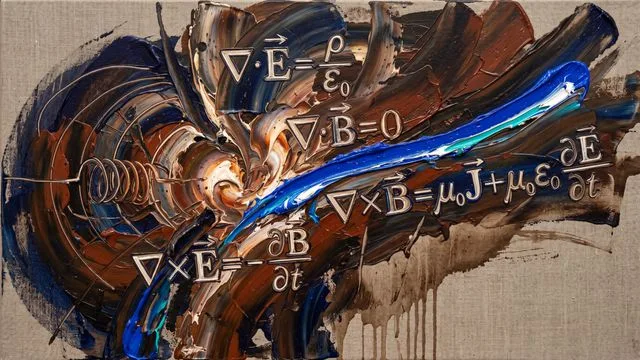
The Blacksmith's Son Who Rewired the World
Faraday discovered the laws of electromagnetism with no formal training. Maxwell had to translate his truth into math before anyone believed it. Sound familiar?
How Fractals Moved From Math Curiosity to Tech
Fractals aren't just beautiful—they're inside your smartphone antenna, your microchip cooling system, and your eye exam. Here's how the math became engineering.
Hannah Cairo Disproved a 40-Year-Old Math Conjecture at 17
At 17, Hannah Cairo overturned the Mizohata-Takeuchi conjecture using a hypercube and a coin diagram. Here's what she actually did—and why it matters.

How Language Shapes Thought, According to Lera Boroditsky
Cognitive scientist Lera Boroditsky explains how the language you speak shapes memory, color perception, and thought—and what's lost when languages disappear.