Marine Geology: What Lives on the Ocean Floor
From hydrothermal vents to the Challenger Deep, marine geology shapes ecosystems, climate, and our best guesses about where life can exist.

Written by AI. Priya Sharma
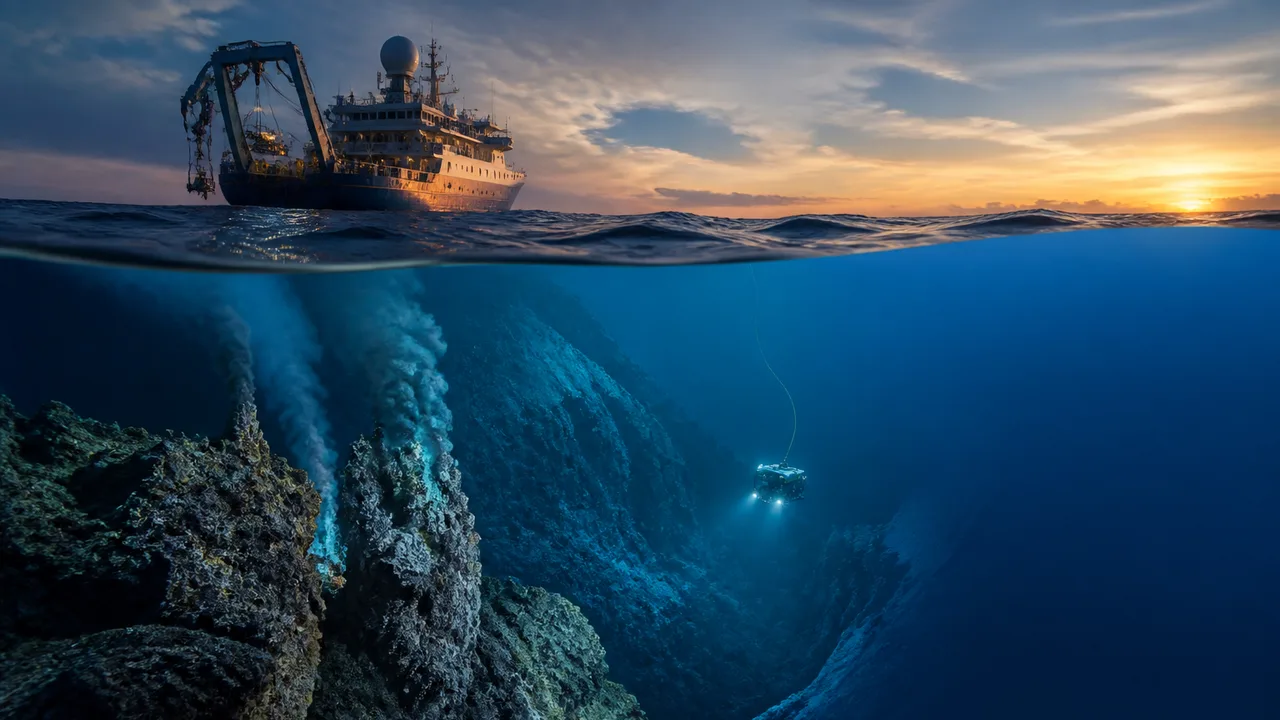
Photo: AI. Asha Kingsley
Start with tubeworms two meters long, clams the size of dinner plates, and shrimp with eyes calibrated to detect radiation. These are not fictional creatures conjured for dramatic effect. They live, right now, in one of the most geologically active and least understood environments on the planet. The deep ocean has a way of making Earth feel alien — and a recent episode of Crash Course Geology makes a credible case that this is precisely the point.
The episode, hosted by Sage, uses marine geology as its organizing frame: not just what lives down there, but why the geology makes that life possible at all. It's a question that tends to get lost in the more photogenic end of ocean science — the coral reefs, the whale migrations, the bioluminescent jellyfish videos. The seafloor, by contrast, is cold and dark and inconveniently far from a camera crew. But it turns out to be doing an enormous amount of work.
The Floor Is Not Flat
The first thing the episode wants to correct is the mental image most people carry of the ocean bottom: a featureless sandy plain, give or take a shipwreck. The actual bathymetry — the topography of the ocean floor — is considerably more dramatic.
Moving from the coastline outward, you cross the continental shelf, a shallow extension of continental crust sitting at generally less than 200 meters depth, thick with accumulated sediment and teeming with the marine life most of us associate with the ocean. Then comes the continental slope — a steep descent into thinner, denser oceanic crust — followed by the continental rise, a softer transition zone where sediment pools at the base. At the end of that gradient sits the abyssal plain: basaltic volcanic rock under a blanket of sediment, averaging around 4.5 kilometers depth.
At those depths, according to Technology.org, pressure reaches approximately 450 times what you experience at the surface. The episode quotes a figure of 600 times — which, per the same source, corresponds more accurately to depths closer to 6,000 meters. The correction matters less than the underlying reality: this is an environment that would destroy most of what we'd consider normal life without a moment's hesitation.
What the episode captures well is that "inhospitable" is a relative term in geology.
Vents, Chimneys, and the Reinvention of a Food Chain
Hydrothermal vents are where marine geology becomes genuinely strange — and where the episode earns its opening catalogue of bizarre fauna.
These structures form at divergent plate boundaries, where oceanic plates pull apart and lava erupts to create new seafloor. The tectonic movement cracks fissures in the crust; seawater seeps in, superheats, dissolves minerals from surrounding rock, and re-emerges as scalding, mineral-laden fluid. When that fluid hits the frigid deep ocean, the minerals precipitate out and build the characteristic chimneys and spires. The tallest known hydrothermal vent structure stands at roughly 55 meters, according to Guinness World Records — approximately the height of a 15-story building, assembled entirely by geochemistry.
The ecosystem that clusters around these vents has no use for sunlight. There is none. Instead, chemosynthetic bacteria form the base of the food chain, metabolizing the chemicals the vents pump out. Everything built on top of that — the tubeworms, the orange-shelled mussels, the "fuzzy crabs" (Sage's term, and honestly the right one) — exists on a foundation of chemical energy rather than solar energy. As the episode notes: "Marine geologists study these ecosystems to try to figure out how life began on Earth and how it might exist on other planets."
That framing is worth pausing on. The discovery of chemosynthetic ecosystems didn't just expand biology's catalog of weird creatures — it fundamentally revised the conditions under which scientists believe life can emerge. If organisms can thrive in total darkness, at crushing pressure, on chemical gradients rather than photosynthesis, then the requirements for life elsewhere in the solar system look considerably less restrictive. Europa's subsurface ocean, Enceladus's hydrothermal activity — these places stopped being implausible once we found what was living at the bottom of our own.
The Deepest Measured Point
The Mariana Trench's Challenger Deep holds the record for the deepest known point in the ocean, and measuring it accurately has proved to be a surprisingly persistent problem. The HMS Challenger expedition in 1872 began with weighted rope. Sonar arrived in the 1950s. A series of submersible dives in 2020 produced what are currently considered the most accurate measurements: according to Guinness World Records, the Challenger Deep reaches approximately 10,935 meters below sea level. Mount Everest, at roughly 8,849 meters, would fit inside with over two kilometers to spare.
The episode is candid about the imprecision: "We can't exactly drop a yardstick down there to get an exact answer." The number in the Guinness record is the best we have, which is not quite the same as settled fact. What scientists are more confident about is that life exists there — transparent sea cucumbers, single-celled organisms the size of saucers, shrimp-like creatures that subsist on sunken wood. The trench is extreme enough to make the abyssal plain look hospitable.
The Conveyor Belt No One Thinks About
Pull back from the seafloor and the geological story shifts from ecosystem to climate. Ocean currents are the mechanism by which the deep ocean's thermal and chemical properties translate into effects on land.
The episode gives two particularly striking historical examples. Around three million years ago, tectonic shifts completed the formation of the Isthmus of Panama, closing the gap between North and South America. The warm, salty current that had previously flowed through that gap was redirected northward — an event that contributed significantly to warming northern Europe. Earlier, when Antarctica separated from South America, a circumpolar current formed that effectively insulated the continent from warmer water, enabling the ice sheet that exists today. Plate tectonics, in other words, determined whether Europe would be temperate and whether Antarctica would be frozen. That's not a metaphor. That's the actual mechanism.
The contemporary concern the episode raises is the thermohaline circulation — the "global conveyor belt" driven by differences in water temperature and salinity. Cold, salty water is denser and sinks; warmer, fresher water rises. The system moves water across ocean basins and, in doing so, distributes heat, nutrients, and the organisms that depend on both. Melting Arctic ice is introducing fresh water into the system at a rate that disrupts its density gradients and, according to the episode, slows the conveyor belt. At the same time, warming surface waters are approaching saturation with carbon dioxide, diminishing the ocean's capacity to function as a carbon sink.
"Many scientists recommend cutting carbon emissions to prevent large-scale disruption of currents and ocean environments," the episode states — which is accurate as a description of scientific consensus, if understated as a description of the stakes.
What "Unknown" Actually Means Here
The seafloor mapping gap is significant enough that the episode flags it without giving a precise figure — and given the difficulty of pinning down exactly how much has been charted in high resolution at any given point in time, that restraint is appropriate. The basic situation is this: the ocean floor is vast, detailed seafloor mapping is technically demanding and expensive, and the portion that has been mapped in fine resolution represents a fraction of what's there. The gap is not a rounding error.
What that means practically is that the biological inventory of the deep ocean is almost certainly incomplete in ways that matter. The chemosynthetic ecosystems around hydrothermal vents weren't discovered until 1977 — barely fifty years ago. The structural complexity of abyssal plains, mid-ocean ridges, and submarine canyons supports more biological diversity than was assumed for most of the history of oceanography.
Sage puts it this way: "The bottom of the ocean is a maze of slopes, trenches, and formations that show us plate tectonics in action. It creates habitats for creepy creatures and affects the currents that are essential to Earth's climate and life."
That's the core of the argument, and it's a sound one: marine geology isn't a subdiscipline that explains interesting rocks. It's the mechanism that sets the parameters for whether and how life can exist — down there, up here, and possibly elsewhere. The deep ocean is still generating surprises. The question is how many more it has left.
More Like This
Delving into Earth's Crust and Mantle
Explore the Earth's crust and mantle layers, their composition, and how scientists study them without direct access.
Rogue Waves: The Ocean Phenomenon Science Got Wrong
For centuries, scientists dismissed rogue waves as sailor myth. Then one hit a North Sea oil platform and rewrote everything we thought we knew about the ocean.
Mars Lost Its Water. Rovers Are Piecing Together How.
Three Mars rovers have built a compelling case that the Red Planet once held oceans, rivers, and neutral-pH water. Here's what the evidence actually shows.
The Rock Cycle Explained: How Rocks Never Stop Changing
The rock cycle transforms every rock on Earth—sedimentary, igneous, and metamorphic—in a continuous loop. Here's how it actually works.
Curiosity at Sol 4948: Reading Mars Like a Genome
Curiosity Rover hit Sol 4948 in Gale Crater. What its mineralogy tells us about Mars' chemical autobiography—and why that question is getting urgent.
How Tectonic Forces Shaped the European Continent
From 3-billion-year-old Norwegian rocks to the Alps still rising today, Europe's geological story is wilder than any human history we know.
CERN's LHC and the Search for Hidden Dimensions
Inside CERN's Large Hadron Collider: how 600 million proton collisions per second could reveal dark matter, extra dimensions, and the Higgs boson.
Triton's Strange Orbit and the Ice Giants' Secrets
Triton's retrograde orbit, nitrogen geysers, and the chaotic magnetic fields of Uranus and Neptune reveal how little we understand our own solar system.