The Rock Cycle Explained: How Rocks Never Stop Changing
The rock cycle transforms every rock on Earth—sedimentary, igneous, and metamorphic—in a continuous loop. Here's how it actually works.

Written by AI. Priya Sharma
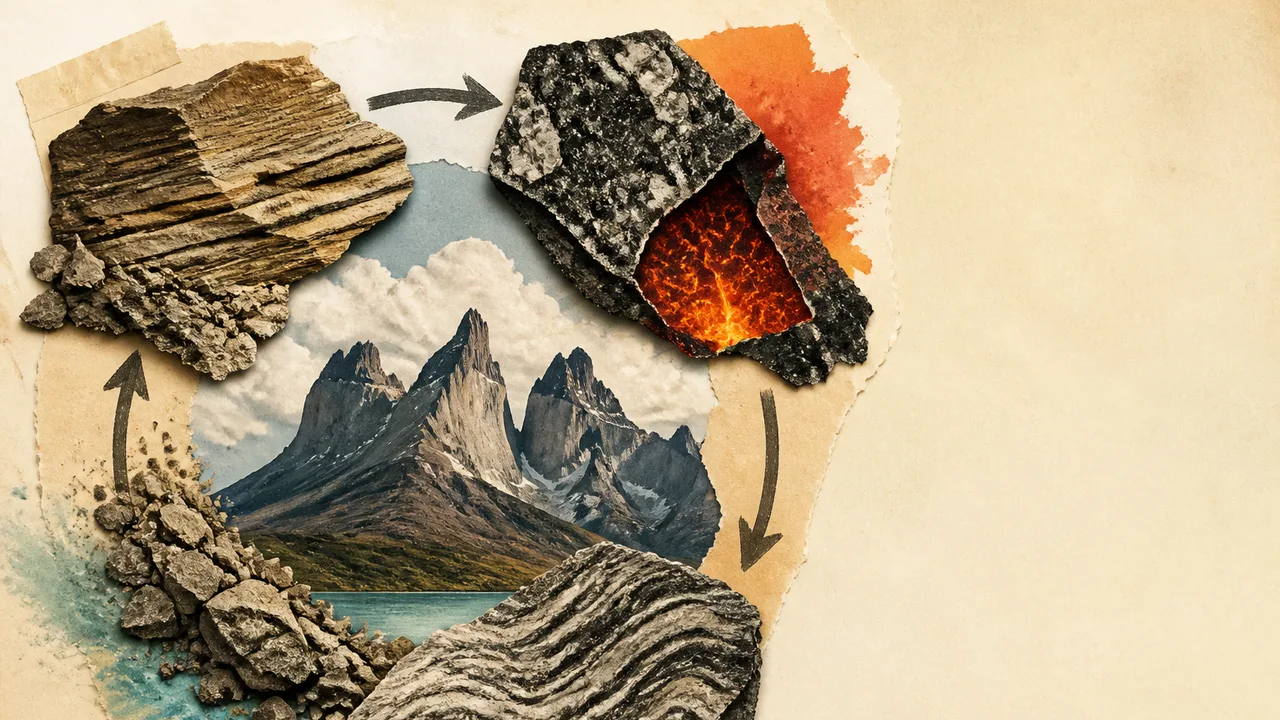
Photo: AI. Wren Sugimoto
There are mountains in Chilean Patagonia that look, improbably, like Oreo cookies. Los Cuernos del Paine—"the Horns of Paine"—rise from the landscape with a pale stripe sandwiched between two dark masses, a geological accident so visually precise it stops hikers in their tracks. They are also, as the latest episode of Crash Course Geology points out, a near-perfect diagram of the rock cycle rendered at mountain scale.
That's a useful thing to know, because the rock cycle is one of those concepts that sounds simple until you sit with it. Every rock you have ever touched—every cobblestone, every cliff face, every gravel driveway—is a temporary arrangement of materials that have been something else before and will be something else again. The ground beneath your feet is not a fixed archive. It is an ongoing process.
What a Rock Actually Is
Before the cycle makes sense, the definition needs to be precise. In geology, a rock is not just any solid lump of earth. It is a solid cluster of one or more minerals, where minerals themselves are solid crystals with a specific chemical composition, formed by geological processes. Host Sage, in the Crash Course episode, reaches for a dog analogy: purebreds like quartzite are almost entirely one mineral (quartz), while mutts like granite blend quartz, feldspar, mica, and potentially several others. The analogy is light, but the underlying point holds—compositional complexity doesn't change the classification framework.
That framework has three categories, and they are defined not by what a rock contains but by how it formed. This is the detail that tends to get glossed over in basic science education, and it matters more than it might seem. Two rocks can be made of identical minerals and look nearly the same, yet belong to entirely different categories because they arrived at their current state through different processes. Formation pathway is identity.
Three Rock Types, One Mountain
Los Cuernos del Paine serves as a convenient, if geologically unusual, case study because all three rock types contributed to its current form—and their formation happened in a legible sequence.
The base of the story is sedimentary. Roughly 90 million years ago, what is now the southern Andes was seafloor. Mud and sand accumulated at the bottom of an ancient ocean, buried under their own weight, and compressed over millions of years into solid rock. The episode describes this process as being "squeezed like a geological panini," which is reductive but not wrong. Lithification—the technical term for sediment consolidating into rock—requires both burial pressure and, in many cases, the cementation of mineral-rich fluids binding grains together. The rocks this produced at Los Cuernos are clastic sedimentary rocks, meaning they formed from fragments of pre-existing rocks rather than through chemical precipitation or biological accumulation.
The episode does take time to lay out the full taxonomy of sedimentary formation, which is worth preserving here. Limestone forms biochemically, from the shells and skeletal material of marine organisms. Rock salt forms chemically, from dissolved minerals that precipitate as water evaporates. Coal forms organically, from compressed plant tissue. Each pathway produces a rock that counts as sedimentary, but through entirely distinct mechanisms. They share a category; they do not share a recipe.
The second act at Los Cuernos is igneous. Around 12.5 million years ago—long after the sedimentary layers had solidified—three pulses of magma forced their way up from depth and intruded horizontally between the existing rock layers, spreading out like a lens rather than erupting at the surface. As the magma cooled slowly underground, it crystallized into a formation geologists call a laccolith. That light-colored stripe visible on the mountain today is the top of this laccolith, now exposed by millions of years of erosion.
The distinction the episode draws between intrusive and extrusive igneous rock is geologically significant. Intrusive rocks, like the granite and gabbro found inside laccoliths, cool slowly, which gives mineral crystals time to grow large and visible. Extrusive rocks—basalt, pumice, obsidian—cool rapidly at the surface, producing finer-grained or glassy textures. The cooling rate determines the crystal size, and the crystal size changes the rock's physical properties. Same molten material, different outcomes depending on where it ends up.
The third type at Los Cuernos is metamorphic, and its origin there is directly linked to the igneous intrusion. When the magma pushed between the sedimentary layers, the intense heat it carried baked the surrounding rock—not enough to melt it, but enough to alter its mineralogy and structure. "The magma's heat baked the rock it touched, causing it to change identity," as the episode puts it. Those contact zones became metamorphic rock, transformed not by pressure from tectonic burial but by thermal energy from a neighboring mass of molten material.
This is the non-foliated variety of metamorphic rock, and the absence of foliation (the banded or striped appearance common in many metamorphic rocks) is itself informative. Foliation develops when intense directed pressure flattens and realigns mineral crystals into parallel sheets. Contact metamorphism, driven by heat rather than pressure, scrambles and recrystallizes minerals without that directional alignment. The rock changes; the stripes don't form. The mechanism leaves a signature.
The Cycle Itself: No Fixed States
What makes the rock cycle conceptually interesting is that it has no canonical starting point and no required sequence. Igneous rock weathers into sediment that lithifies into sedimentary rock that subducts, melts, and erupts as igneous rock again. Or sedimentary rock gets buried deep enough to metamorphose, then erodes into new sediment. Or metamorphic rock gets melted directly. The arrows on the diagram can point almost anywhere.
Weathering is the engine that drives material from one state toward another at the surface. Mechanical weathering—water freezing in cracks, roots prying apart joints, wind abrasion—breaks rock into smaller pieces without changing its chemistry. Chemical weathering does change the chemistry: slightly acidic rainfall reacts with minerals, dissolving some and transforming others into clay. Even lichen contribute, secreting acids from their root-like structures (rhizines) that slowly etch the rock surface beneath them. Erosion then transports the resulting sediment downslope, downstream, or downwind, depositing it somewhere new.
The episode notes that "nothing stays the same forever," which is true but understates the timescale involved. The sedimentary layers at Los Cuernos represent 90 million years of accumulation. The igneous intrusion that produced the laccolith took place over a span that, even by geological standards, was gradual. The rock cycle operates continuously, but "continuously" in geological time means changes that are imperceptible within a human lifetime and often within recorded history.
This is one of the genuine conceptual challenges in geology: the processes are active and ongoing, but their products reflect spans of time that have no intuitive human analog. When you pick up a river pebble, you are handling the output of processes that began before the first flowering plants existed. The pebble will, given enough time, become something else entirely.
What Los Cuernos Teaches That a Textbook Diagram Doesn't
A diagram of the rock cycle is a useful abstraction. Los Cuernos del Paine is something different: a place where the abstraction became topography. The sedimentary base, the igneous intrusion, the metamorphic contact zones—they are all spatially present, stacked in the same mountain, readable by anyone who knows what they are looking at.
That is the pedagogical argument for using a specific geological site to teach a general concept. The rock cycle is not a theoretical framework applied to some hypothetical landscape. It is the explanation for why the landscape looks the way it does, everywhere, including places far less dramatic than Patagonia.
The Wave in Arizona. The Giant's Causeway in Northern Ireland. The Rainbow Mountains of Zhangye, China. Every one of these formations is the current frame of a process that was running long before they looked like anything worth visiting, and will continue running long after erosion has revised them into something unrecognizable.
The rock in your driveway is in the same cycle. It is just at a less photogenic stage.
More Like This

Crafting Supercars: The Science Behind Speed and Style
Explore how supercars like Alfa Romeo 4C and Aston Martin Vanquish are meticulously crafted using cutting-edge materials and precision engineering.
Delving into Earth's Crust and Mantle
Explore the Earth's crust and mantle layers, their composition, and how scientists study them without direct access.
Driving Patagonia's Route 40: What Van Life Actually Looks Like
Kara and Nate drove 2,000 miles across Patagonia in 8 days. What they found reveals the gap between van life mythology and Patagonian reality.

NASA's Nuclear Mars Spacecraft: What SR-1 Freedom Means
NASA approved SR-1 Freedom, a nuclear electric spacecraft targeting a 2028 launch. Here's what the mission actually tests—and what it doesn't solve.
Yellowstone Supervolcano: What the Ash Record Tells Us
The Yellowstone supervolcano's past eruptions left a record written in bone and ash. What that record says about our future is harder to read than it looks.
How Fractals Moved From Math Curiosity to Tech
Fractals aren't just beautiful—they're inside your smartphone antenna, your microchip cooling system, and your eye exam. Here's how the math became engineering.
Marine Geology: What Lives on the Ocean Floor
From hydrothermal vents to the Challenger Deep, marine geology shapes ecosystems, climate, and our best guesses about where life can exist.

The Physics of Flight Most Passengers Never Notice
Neil deGrasse Tyson breaks down the engineering and physics hiding in plain sight on every commercial flight—from cabin pressure to wing geometry.