What the Dinosaur Asteroid Actually Did to Earth
New research reframes the Chicxulub impact—not just as a mass extinction event, but as a creative force that may have built the Amazon rainforest.

Written by AI. Nadia Marchetti
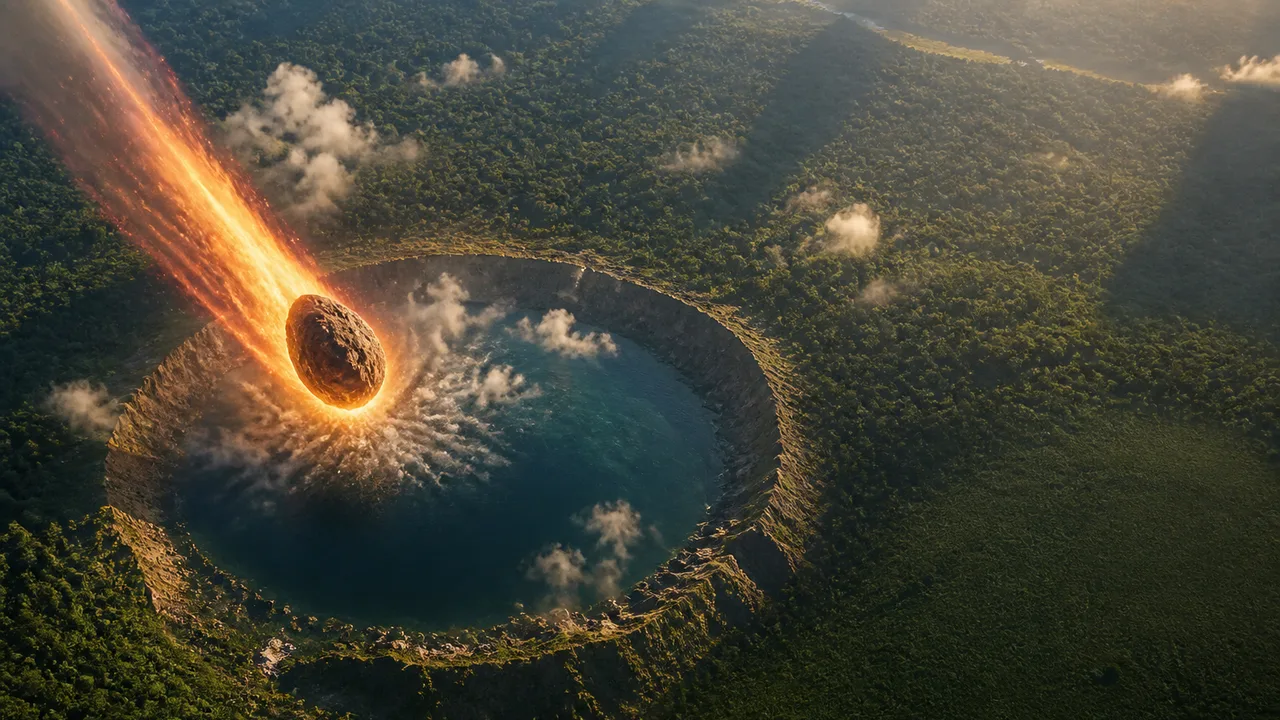
Photo: AI. Rio Sanchez
The story most of us absorbed somewhere between a school textbook and a Spielberg film goes like this: giant asteroid hits Earth, dinosaurs die, end of chapter. Clean. Satisfying. Wrong — or at least, significantly incomplete.
A recent New Scientist video pulls together a growing body of research to argue that we've been misreading the Chicxulub impact on at least two counts simultaneously. The asteroid was more destructive than the simple "rock kills dinosaurs" framing suggests, and also — here's the genuinely strange part — more creative. The same event that ended the Cretaceous may have directly seeded one of the most biodiverse ecosystems on the planet today.
Let's take these one at a time, because they deserve it.
The world the asteroid hit was already wobbling
Before we get to the impact itself, there's a complication the Hollywood version conveniently skips. Dinosaur diversity had been declining for roughly 10 million years before the asteroid arrived. Species counts had dropped by around 50% from a peak approximately 77 million years ago. The climate was cooling. And about 250,000 years before impact, a surge of volcanic activity in what is now India — the Deccan Traps — was already stressing ecosystems that had taken hundreds of millions of years to build.
None of this means the asteroid was incidental. But it does mean the extinction wasn't a single clean blow delivered to a thriving world. It was a killing strike landed on something already under pressure.
There's an important caveat here, though. The fossil record for that final 10-million-year window is thin. As one paleontologist puts it in the video, the situation resembles "trying to do a jigsaw puzzle when you've only got half the pieces and you don't have a picture on front of the box." The richest data comes from western North America, where dinosaur communities actually appear to have been thriving right up to the impact. Generalizing that to a global story requires extrapolation the evidence doesn't fully support.
So: declining diversity is real, the data is uneven, and anyone who tells you the picture is settled is getting ahead of the science.
The geometry of catastrophe
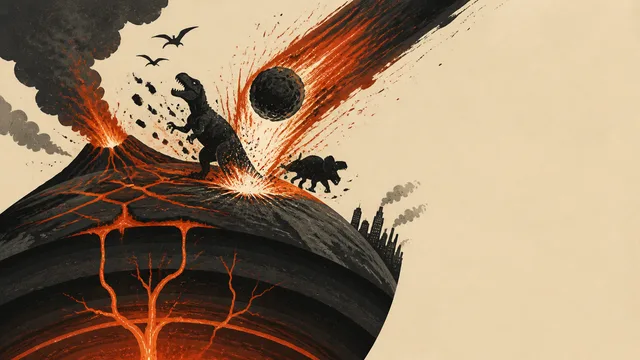
Here's where the research gets genuinely arresting. The scale of the Chicxulub impactor — roughly a trillion tons of rock — has always been the headline. But computer simulations of the crater's structure suggest the angle of impact may matter as much as the size.
The modeling indicates the asteroid struck at approximately 60 degrees to the horizontal. That turns out to be close to the worst possible angle from the perspective of anything living on Earth at the time. A steeper or shallower approach would have buried more energy into the ground, or skipped more across the surface. At 60 degrees, the physics optimized for something else entirely: maximum ejection of debris, vaporized rock, and greenhouse gases into the upper atmosphere.
A 2023 study cited in the video estimates that the resulting dust cloud blocked sunlight for around 15 years, driving a 15-degree drop in global temperatures. Photosynthesis collapsed. The plant-eating giants — animals like Patagotitan, which may have required up to 120 kilograms of vegetation per day just to sustain its body mass — had nothing left to eat. The predators that hunted them followed.
Then, once the dust cleared, the greenhouse gases the impact had liberated got to work in the opposite direction. A 2018 study tracking chemical isotopes in fossilized fish teeth found global temperatures lurched upward by around 5 degrees and stayed elevated for approximately 100,000 years. The one-two sequence — rapid freezing, prolonged warming — is increasingly the favored explanation for why the extinction was so total among non-bird dinosaurs, even on continents far from the impact site.
"All of this particulate matter," the video explains, "is gradually creating an envelope around the world that is creating some really unpleasant climatic conditions... certainly long enough to have a major and devastating effect on plant life... and then with obvious knock-on consequences for the animals that depend on that plant life, and then the animals that depend on those animals."
The mechanism wasn't the rock. It was what the rock did to the sky.
Not all dinosaurs died — and that matters
Worth pausing here, because the "dinosaurs went extinct" framing contains a substantial error. Birds are dinosaurs. Specifically, they're theropod dinosaurs — the same clade as Velociraptor and T. rex. That lineage survived.
The bird-dinosaur connection was first proposed in the 1860s by Thomas Henry Huxley, who noticed skeletal similarities between small theropods and living birds — hollow bones, shared hip architecture, analogous leg structure. The idea fell in and out of fashion for over a century before exceptionally preserved fossils from China in the 1990s settled the question. Soft tissue impressions. Feathers. The link became undeniable.
What this means for the extinction story is subtle but real. The event 66 million years ago didn't wipe out an entire lineage — it filtered it. Something about the theropod body plan, or behavior, or ecological position, allowed one branch to thread through a bottleneck that killed everything else in its class. What gave birds that edge is a question New Scientist says it plans to address directly in a follow-up piece. It's genuinely open, and genuinely interesting.
The asteroid that built a rainforest
The creative argument is the one I find most surprising, and it rests on two separate mechanisms working together.
The first is ecological release. Sauropods like Patagotitan weren't just large — they were landscape-scale forces. Herds of 60-ton animals migrating hundreds of kilometers annually, consuming entire forests as they went, would have made dense closed-canopy rainforest structurally impossible to sustain. Remove them, and the land could reorganize. Studies of the North American geological record show exactly that transition: post-impact, floods became less frequent, roots locked soil in place, and rivers settled into stable, meandering channels. The physical geography shifted when the megafauna disappeared.
But the second mechanism is the one that surprises. A 2021 analysis of 6,000 fossil leaves and over 50,000 pollen grains from northern South America found that pre-impact tropical forests in the region were sparse-canopied, conifer-dominated, and fern-heavy — nothing like the Amazon we know. After the impact, that changed completely. Conifers and ferns gave way to fast-growing flowering trees, angiosperms, and the canopy thickened into something recognizably modern.
Why? The old forests were dominated by conifers, which grow slowly and thrive in low-nutrient soils. The post-impact forests were dominated by fast-growing angiosperms. That shift in competitive advantage points toward a soil fertility change. And the leading theory is that the asteroid delivered it directly: the debris layer that settled across the tropics was rich in phosphorus and other minerals — essentially a planetary-scale fertilizer application. Fast-growing trees could exploit that sudden nutrient windfall; slow-growing conifers couldn't keep up.
"The Amazon didn't just rise up from the ashes," as the New Scientist framing puts it. "It may have actually fed on them."
The Amazon as we know it — home to roughly 10% of all species on Earth, 3,000 fish species, 16,000 plant species — may be only tens of millions of years old. Younger than we assumed. And potentially nonexistent without the impact.
The clean version of this story — asteroid arrives, dinosaurs die, mammals inherit the Earth — isn't wrong exactly. It's just operating at a resolution that obscures everything interesting. The asteroid hit a world already stressed by climate change and volcanism. Its angle, not its size, was the primary driver of atmospheric catastrophe. Its debris fertilized soils that had never been fertile before. And the lineage it "exterminated" is currently represented by approximately 10,000 living species of birds.
The question that sits with me after all of this: if birds survived when nothing else in their class did, what exactly made them different? The physics of the impact is becoming clearer. The biology of survival is still, 66 million years later, an open case.
More Like This

The Simplest Question Mathematics Still Can't Answer
Fields Medal winner James Maynard explains why prime numbers—the atoms of arithmetic—remain deeply mysterious despite centuries of study.
How the Asteroid Impact Ended the Dinosaur Era
Explore the catastrophic asteroid impact that ended the dinosaurs, its immediate aftermath, and the long-term environmental changes.
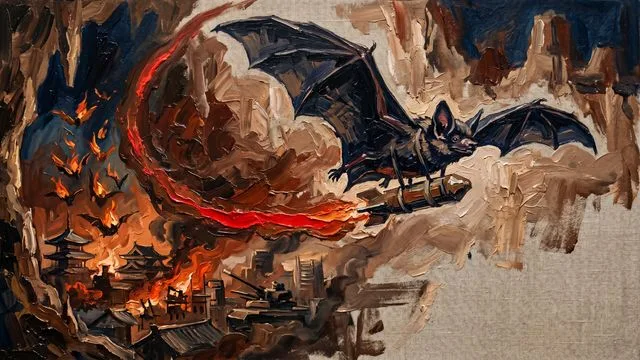
Project X-Ray: The WWII Bat Bomb That Almost Worked
In WWII, the U.S. military spent $2 million strapping incendiary bombs to bats. The plan was absurd. It was also, frustratingly, not entirely wrong.
Is the Autism Spectrum Broken? One Pioneer Says Yes
Uta Frith, who shaped modern autism science, now argues the spectrum has been stretched so far it no longer holds. Here's what she means—and why it matters.
Mass Extinction Risk: How Overdue Are We?
Joe Scott surveys Earth's extinction history—supervolcanoes, asteroid strikes, a 2023 Greenland megatsunami—and asks which catastrophe is statistically nearest.

The Most Sensitive Dark Matter Detector Might Find Nothing
LUX-ZEPLIN sits a kilometer underground, waiting for dark matter. But success might look like silence—and that would tell us something huge.

SpaceX Hits 600 Falcon 9 Booster Reuses
SpaceX reached 600 flight-proven Falcon 9 booster launches on July 13-14, 2026. Here's what that number actually means for spaceflight economics.
How the Speed of Light Became a Definition
The speed of light wasn't just measured—it was defined into existence. Here's the 300-year story of how physics outgrew the question it started with.