Mass Extinction Risk: How Overdue Are We?
Joe Scott surveys Earth's extinction history—supervolcanoes, asteroid strikes, a 2023 Greenland megatsunami—and asks which catastrophe is statistically nearest.

Written by AI. Priya Sharma
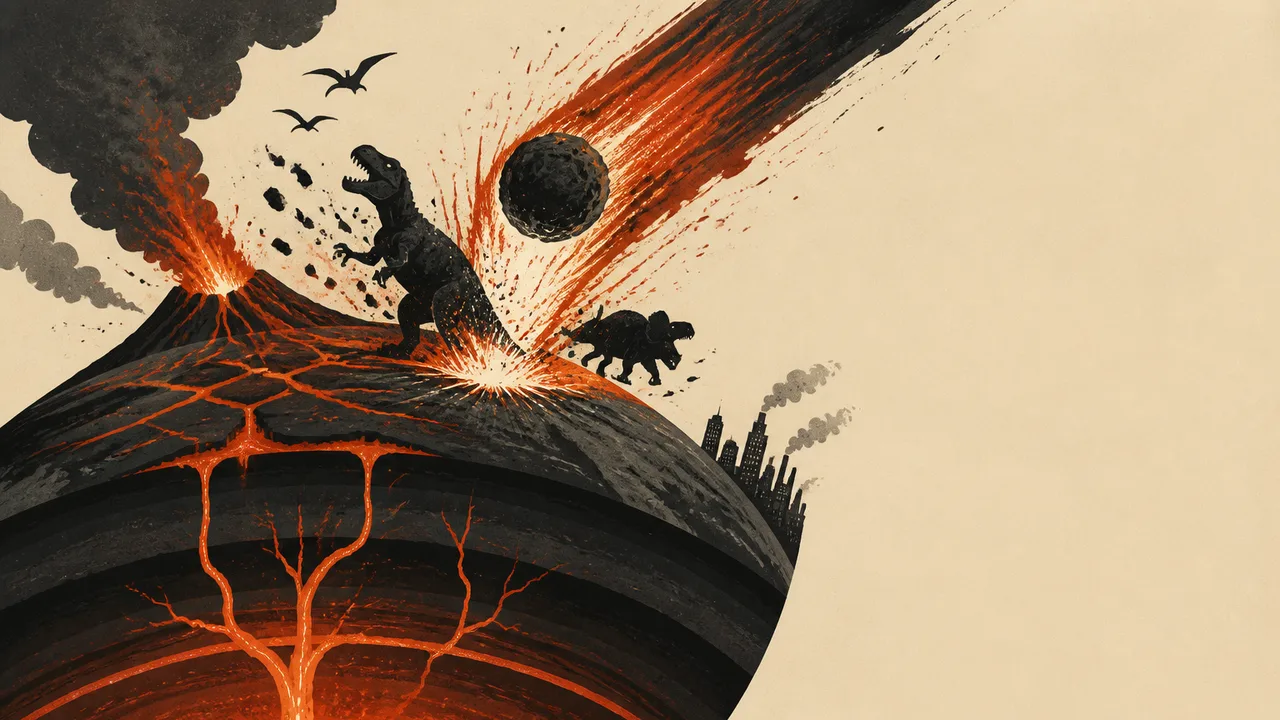
Photo: AI. Mika Sørensen
The Deccan Traps occupy roughly a third of the Indian subcontinent. That's not a geological curiosity — that's a large igneous province, a category of volcanic feature so vast it makes a supervolcano look like a warm-up act. For 600,000 years, toward the end of the Cretaceous, much of what is now India was essentially a lava lake. Scientists initially considered it the obvious candidate for what ended the dinosaurs. Then the Chicxulub crater turned up beneath the Yucatan Peninsula, and the field largely coalesced around asteroid impact as the primary driver.
But here is the detail that makes the Deccan story genuinely interesting rather than just historically footnoted: the Deccan Traps sit almost exactly at the antipode of the Chicxulub impact site. There is a hypothesis — contested, unproven, but not idle — that the shockwaves from the asteroid impact traveled through the planet and focused their energy at the diametrically opposite point, destabilizing what was already a volcanically hyperactive region. If that's correct, the dinosaurs weren't just unlucky once. They were unlucky twice, simultaneously. As Joe Scott puts it in his latest lightning-round video: "a perfect storm of extinction events."
It's a useful frame for thinking about catastrophic risk, because it disrupts the comfortable assumption that disasters arrive one at a time and announce themselves politely.
The Actuarial Table of Doom
Scott's video is organized around a viewer question — what natural disaster is humanity statistically most overdue for? — and the answer requires working through several layers of scale before arriving anywhere useful.
The deadliest events in recorded human history turn out to be famines and plagues, concentrated in the most populous regions of the world. The Great Chinese Famine of 1959 to 1961, during the Great Leap Forward, killed somewhere between 15 and 55 million people depending on which estimates you trust (and the range itself tells you something about how thoroughly ideology distorts recordkeeping). The Black Death killed between 75 and 200 million people between 1346 and 1353. Scott cites estimates that smallpox killed between 300 and 500 million people across roughly five centuries — a figure consistent with what Wikipedia documents as among the most cited estimates for the disease's cumulative death toll — before noting, with something close to genuine awe, that we actually eradicated it. "Can we just appreciate that we did that?" he says. It's the right instinct. We rarely pause long enough to register that one of history's most lethal pathogens was hunted to functional extinction by a global public health campaign.
But human-scale catastrophes, however devastating, don't raise questions about species survival. For that, you have to zoom out considerably.
The Permian-Triassic extinction event — "the Great Dying," as it's known — killed approximately 95 percent of species on Earth. It was caused by supervolcanic eruption. The Late Triassic extinction, roughly 201 million years ago, also involved supervolcanism. The Cretaceous-Paleogene boundary 66 million years ago was the asteroid. When Scott narrows the field of civilizational-scale threats to the two categories that have actually worked before, he arrives at supervolcanoes and impactors — and when he runs the recurrence statistics, supervolcanoes come out looking considerably more urgent.
Chicxulub-scale asteroid impacts are estimated to occur roughly every 100 million years. The last one was 66 million years ago. By that math, Scott notes, we have approximately 30 million years of statistical buffer remaining. This is not a reason to stop paying attention to near-Earth objects — the solar system is not bound by our statistics, as he correctly points out — but it contextualizes the risk.
Supervolcanoes are another matter. Major eruptions occur on a cycle of roughly 50,000 to 100,000 years. The most recent confirmed supervolcanic eruption was the Taupō volcano in New Zealand, approximately 26,500 years ago. At the lower end of the recurrence estimate, that leaves something like 23,500 years. Yellowstone gets most of the popular attention, but Scott points out there are eight or nine active supervolcanoes globally that warrant monitoring. The window is long by human reckoning, but it's not geological infinity.
A 200-Meter Wave That Barely Made the News
Tucked into the video is a story that deserves considerably more attention than it received when it happened. In 2023, a landslide in the Dickson Fjord in East Greenland generated a megatsunami approximately 200 meters — roughly 600 feet — in height. The wave oscillated back and forth through the narrow fjord, and the resulting seiche — a standing wave phenomenon — propagated as a seismic signal that circled the Earth for nine days, according to research published in Nature Communications.
The mechanism is worth understanding. As Greenland's glaciers retreat, they withdraw structural support from the rock faces above. Those destabilized slopes eventually fail. In a confined fjord, the displaced water has nowhere to go but up — and in a narrow channel, the oscillation can amplify rather than dissipate. Scott traces this directly to glacial retreat driven by warming: the megatsunami wasn't incidental to climate change, it was a consequence of it.
The wave reached a small settlement on Dickson Island. It happened in September, when the settlement was unoccupied for the season, so there were no casualties. The event barely registered in global media. Scott attributes the quiet to the absence of a death toll, which is probably correct — but the physics that produced it haven't changed, and the glaciers continue to retreat.
The Sixth Category
Scott doesn't linger on the Anthropocene extinction, but he doesn't dismiss it either. The argument that we are currently in a sixth mass extinction — driven by habitat destruction, overextraction, and the cascading effects of industrialization — is, he notes, one that "many people are making." The species loss rate since industrialization has accelerated substantially beyond background rates; that much has strong scientific support. Whether it rises to the threshold of a mass extinction event is a definitional question that researchers continue to debate, but the trend line is not in dispute.
His formulation of it is blunt: "We are the asteroid. We are the super volcano."
It's a line that earns its drama. The prior framing — asteroids and volcanoes as the canonical extinction agents — makes the analogy land harder than it would in isolation.
The Lightning-Round Problem
What distinguishes this video from a standard explainer is the format itself: a rapid-fire Q&A that moves from supervolcano recurrence intervals to world peace hypotheticals to human infant helplessness to JFK assassination historiography to the thermodynamics of surströmming — all without apology for the juxtaposition. The lightning-round format isn't a concession to short attention spans. It's a structural argument: that the person trying to understand extinction risk is the same person navigating platform algorithms and questioning their own capacity for belief revision. Those things don't occupy separate compartments. The format refuses to pretend otherwise.
Scott's discussion of the YouTube algorithm section operates on exactly this logic. He argues that the algorithm is not an autonomous force acting on passive viewers but a mirror of their own cumulative choices. "The algorithm reflects you," he says. "So from time to time, you do have to take some intention and some agency and tell the algorithm what to send you." Subscriptions, he notes, have become a vanity metric — a signal of past interest that YouTube's recommendation engine may or may not weight. What actually moves the needle is deliberate engagement: searching for a creator, watching several videos in sequence, actively curating rather than passively receiving.
This is not a novel observation about recommendation systems, but it rhymes oddly with what precedes it in the video. Passive receipt of catastrophic risk — waiting for the supervolcano, the impactor, the pandemic — looks a lot like passive scrolling. In both cases, Scott seems to be arguing for intentionality against drift.
The extinction content and the algorithm content illuminate each other in ways that a more disciplined topical structure would foreclose. The categories interpenetrate.
More Like This

How Opponent Recognition Unlocks Cooperation in Evolution
A Rutgers physicist argues that tailoring cooperation to specific opponents—not blanket strategies—may be evolution's simplest path out of the Prisoner's Dilemma trap.

Prehistoric Anomalies That Challenge Archaeology's Timeline
From Göbekli Tepe to the Baghdad Battery, we examine the archaeological anomalies fueling debate about how far back advanced human knowledge really goes.
How the Asteroid Impact Ended the Dinosaur Era
Explore the catastrophic asteroid impact that ended the dinosaurs, its immediate aftermath, and the long-term environmental changes.
The Volcano That Made Us Human — At What Cost?
A supervolcano nearly erased our species 74,000 years ago. The survivors became us. But who gets to tell that story — and who gets extracted from it?
Exploring Black Holes and Asteroids with StarTalk
Neil deGrasse Tyson delves into black holes, asteroids, and more in StarTalk's latest Cosmic Queries episode with Chuck Nice.

Lucy Rogers on Butterflies, Blue Skies, and Halley's Comet
Engineer Lucy Rogers delivers a Royal Institution talk connecting monarch butterfly migration, Tyndall's 1869 light experiment, and Halley's Comet in one sweeping look upward.
Heavy Fuel Oil Powers Global Shipping at a Steep Cost
Heavy fuel oil powers nearly 80% of global shipping. It's cheap, toxic, and nearly impossible to replace. Here's what it actually is and what's at stake.
How Cruise Ships Stay Upright in Rough Seas
Cruise ships look impossibly top-heavy. The engineering that keeps them upright is layered, counterintuitive, and more fragile than the brochure suggests.