Ancient Dogs Were Already Weird Before Victorians
A 2025 skull study of 600+ canines upends the tidy story that Victorian breeders invented dog diversity. Ancient dogs were already strange—and varied.

Written by AI. Amelia Nwofor
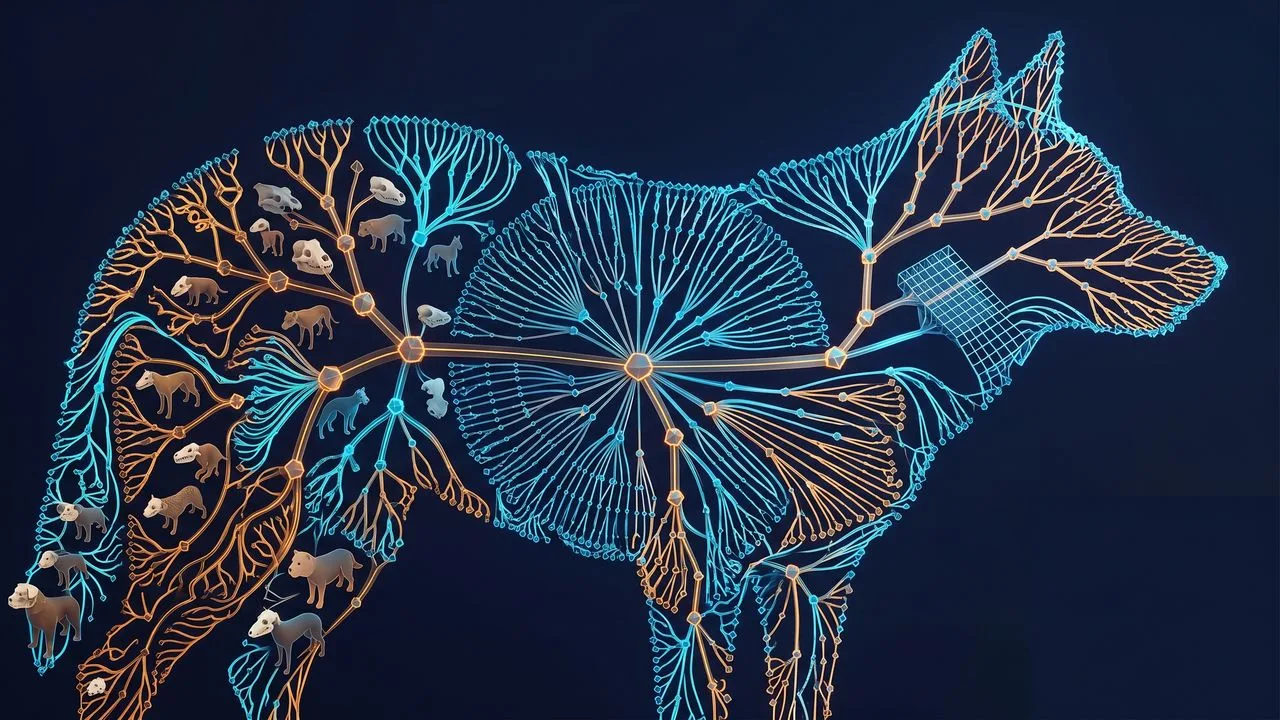
Photo: AI. Dante Nwosu
There's a satisfying story we tell about dogs and humans. Wolves came in from the cold. We fed them, they guarded us, and for roughly 10,000 years, everyone just kind of muddled along with generic medium-sized dogs until some Victorian gentleman pointed at a pointer named Major and said: that is what a dog should look like. Standardized breeds followed. The modern smorgasbord of dogs—flat-faced pugs, elongated dachshunds, spectacularly unnecessary Borzois—was born. Story over.
The problem with satisfying stories is they tend to collapse under scrutiny. A 2025 study examining over 600 skulls from modern dogs, modern wolves, and ancient canines as old as 50,000 years has done exactly that. The dogs, it turns out, didn't wait for the Victorians. They were already doing their own thing, morphologically speaking, thousands of years before anyone wrote a breed standard.
The Victorian Origin Myth
The kennel club story is grounded in real history, which is precisely what makes it sticky. In September 1865, English sports writer John Henry Walsh published a detailed description of a pointer named Major in Field Magazine—enumerated specs, anatomical benchmarks, the whole thing. As SciShow's Madelyn Leembruggen explains in a recent episode, Walsh "outlined standards for many dog breeds, as did other dog enthusiasts of the time. This was the beginning of dog breeds as we know them."
That part is accurate. Formalized breed standards—the codified, policed, show-ring version of dog diversity—really did crystallize in the 19th century. But there's a gap between "Victorian breeders formalized breed standards" and "Victorian breeders invented morphological diversity," and that gap turns out to be enormous.
The implicit assumption embedded in the kennel club origin story is that prior to the 1800s, dogs were a relatively uniform blob. If domestication goes back at least 11,000 years—the age of the oldest genetically confirmed domestic dog, from an archaeological site called Veretye in Russia—that's a very long plateau of sameness before the Victorians presumably switched things up. DNA comparisons between dogs and wolves push the split even earlier, somewhere around 30,000 years ago. Which would make the presumed pre-Victorian blandness an extraordinarily long one.
The new skull study suggests that assumption was wrong.
What 600 Skulls Actually Show
The study's methodology is worth pausing on, because it's doing serious heavy lifting here. Researchers used morphometrics—a technique for quantifying the geometry of biological structures—to create a standardized data set of measurements and landmark coordinates across more than 600 skulls. That data then ran through statistical software designed to identify clustering patterns.
The first, relatively uncontroversial finding: the analysis could distinguish dog skulls from wolf skulls, though not perfectly. Dogs and wolves have substantial physical overlap, and plenty of modern breeds are wolf-like enough to blur the line. Still, the analysis identified more than 80 ancient skulls that aligned more closely with modern dogs than with modern wolves. These were classified as "morphological dogs"—a category that bundles the genetic evidence with the physical.
The more striking finding came when researchers looked at diversity within that ancient dog group. The 43 oldest morphological dogs in the sample exhibited roughly half the physical diversity of modern dogs—but twice the diversity of even older skulls. And some of those ancient skull shapes resembled what we now call whippets and dachshunds. Not identical, and the study was limited to crania (so the famously disproportionate dachshund body remains unconfirmed in antiquity), but recognizably similar.
As Leembruggen puts it: "the evidence is clear that early domestic dogs already came in a range of shapes several thousand years ago."
Half the diversity of modern dogs, before formal breeds existed, is not a small finding. It doesn't support the Victorian invention narrative. It suggests something messier and more interesting was happening across millennia of human-dog cohabitation.
The Multi-Causal Shape of a Dog
The study doesn't argue that humans played no role in shaping early dogs—quite the opposite. It proposes that early morphological diversity probably reflects "differences in the dogs' environments and diets, plus the preferences of humans they lived with." These weren't show dogs. Nobody was chasing a ribbon. But humans had wants and needs that influenced which dogs reproduced and under what circumstances, and those preferences left traces in bone.
This is less glamorous than the kennel club story, but it's also more epistemically honest. Informal selection pressure is still selection pressure. Humans hunting in different terrains, keeping dogs for different purposes, living in different climates—all of that would exert force on dog bodies over generations, without anyone writing it down.
There's also a second thread in the research that tends to get less attention: the wolf ancestry angle. The study found that ancient wolf skulls, while less variable than dog skulls, were more morphologically diverse than modern wolves. The likely explanation is population collapse—wolf numbers have declined precipitously over recent centuries, and with them, genetic and morphological diversity. Dogs may have inherited some of their early variety directly from a more diverse ancestral wolf population, before we did that damage.
That complicates the narrative further. Dog diversity isn't purely a human achievement, however we choose to frame it. Some of it is a wolf legacy we've been carrying forward—and in some cases, erasing in its original form.
What This Doesn't Settle
It's worth naming what the study can't tell us. Skull morphometrics is a powerful tool, but it's a window, not a panorama. We're working with crania only, which means body proportions, coat types, behavioral traits—all the things that make a dog visually distinct to a casual observer—remain largely invisible in the fossil record. The ancient dogs identified as whippet-like may have had whippet-ish skulls while looking quite different overall.
There's also the perennial problem of ancient dog identification: the earliest domestic dogs would have been nearly indistinguishable from wolves. The Bonn-Oberkassel site in Germany has a grave around 15,000 years old containing two dog-like skeletons buried alongside a human—suggestive evidence of domestication, but not genetically confirmed. Archaeological preservation is systematically biased; large carnivores are rare in the record to begin with, skull bones are fragile, and as Leembruggen dryly notes, an early dog that died near humans "was pretty likely to become dinner, which can also be a hindrance to long-term preservation."
So there are real limits to what 600 skulls, however carefully measured, can tell us about 30,000 years of canine evolution. The sample is skewed by what survives, and what survives is skewed by circumstances we can't fully reconstruct.
A More Complicated Partnership
What the study does do—convincingly—is dislodge the tidy story. Victorian breeders didn't invent dog diversity; they codified, formalized, and in some cases pushed to extremes a diversity that was already present. The kennel club origin myth turns out to be, at best, a story about intensification rather than creation.
There's something genuinely interesting in that reframe. It suggests the human-dog relationship has always been a two-way negotiation—informal, distributed across thousands of years and as many human cultures, shaped by ecology and diet and proximity as much as by deliberate preference. Dogs were already being pulled into different shapes by the varied lives of the people they lived with, long before anyone thought to write down what a proper pointer was supposed to look like.
Genetic evidence supports this picture: multiple lineages of domestic dogs had already diverged across Europe and Asia before 5,000 years ago. The morphological diversity the skull study found isn't anomalous—it fits.
The open question, now, is how much older it goes. If dogs were already morphologically varied by the time our oldest confirmed specimens appear, what did the very first domestic dogs look like? The search gets harder from here, not easier—because if early dogs were already diverse, they'd be even more difficult to distinguish from the wolves they came from.
Maybe someday we'll find an ancient corgi-equivalent and have to revise the story again. At this point, I wouldn't rule it out.
More Like This

Three Biology Breakthroughs That Rewrote Evolution's Rules
New research reveals intelligence evolved twice independently, fathers pass traits through sperm RNA, and evolution happens in bursts—not gradual change.

YouTube's 'Niche Bending' Strategy: Gaming Formats Meet Biology
Creators are combining viral formats from one market with content from another—turning nature documentaries into gaming videos and fitness into finance.

Space Developments: Tech Triumphs and Challenges
Exploring recent space missions, tech innovations, and their broader impacts on humanity's cosmic ambitions.

Science Spent Millions on Blue Roses and Failed Spectacularly
Decades of genetic engineering haven't produced a true blue rose. The quest reveals fascinating limits of plant biology—and human obsession.

Is Our Evolutionary Past Becoming Our Downfall?
Exploring how rapid modern changes might be misaligning with our evolutionary adaptations.

Why 'Vibe Coding' Is Software's Instagram Moment
AI tools have dropped software creation costs to nearly zero. The result isn't what you'd expect—it's playful, weird, and occasionally profitable.

Hannah Cairo Disproved a 40-Year-Old Math Conjecture at 17
At 17, Hannah Cairo overturned the Mizohata-Takeuchi conjecture using a hypercube and a coin diagram. Here's what she actually did—and why it matters.

How Language Shapes Thought, According to Lera Boroditsky
Cognitive scientist Lera Boroditsky explains how the language you speak shapes memory, color perception, and thought—and what's lost when languages disappear.