Nuclear Clocks Are Now Real — Here Is What That Means
Two independent teams built working nuclear clocks in 2026. Here's what the thorium-229 breakthrough actually achieved — and what it hasn't yet.

Written by AI. Priya Sharma
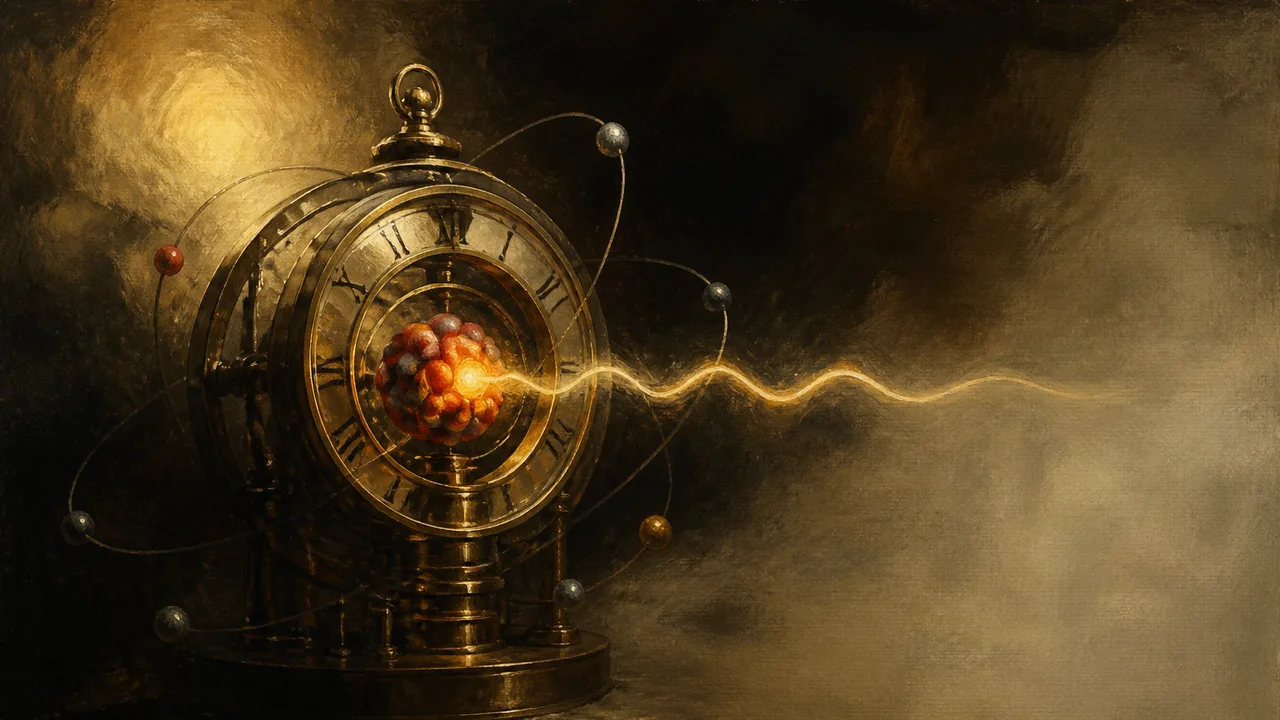
Photo: AI. Henrik Solberg
There is a version of this story where the headline writes itself: scientists build the world's most accurate clock, physics will never be the same. That version is not wrong, exactly. It is just incomplete in ways that matter.
What actually happened in June 2026 is more interesting and more nuanced than the press-release rendering. Two independent research teams — one at the Vienna Center for Quantum Science and Technology, another led by Tsinghua University in China — published results demonstrating, for the first time, a working nuclear clock. Not a theoretical model. Not a simulation. A functioning device that uses the nucleus of an atom to keep time, and that does so in a way both teams could reproduce independently. As science milestones go, that reproducibility detail is doing a lot of quiet work.
Why the nucleus, and why now?
The best atomic clocks we have today — including those built around ytterbium and strontium atoms — are genuinely extraordinary instruments. Science communicator Anton Petrov, whose video covers both June 2026 papers, describes them as losing "1 second over the entire age of the universe or approximately 14 billion years." That is not a rounding error; that is a number that should stop you mid-sentence.
And yet the atomic clock has a structural vulnerability baked into its design. It measures electron transitions — the movement of electrons between energy states as they orbit the nucleus. Because electrons sit on the outside of the atom, they are exposed. Electric fields, magnetic fields, temperature fluctuations: all of these can nudge an electron just enough to introduce drift. The clock stays remarkably accurate, but it is not immune to its environment, and keeping it isolated from that environment is expensive.
The nucleus is a different proposition. It sits 100,000 times smaller than the atom itself, shielded from the outside world by the very electron cloud that atomic clocks depend on. As Petrov puts it: "the strength of the nuclear clock is also its kind of weakness — it's insensitive to interference and is not affected by the external electric or magnetic fields, but as a result, it's also kind of difficult to measure because it's difficult to detect what it's actually doing."
That tension — the nucleus is stable precisely because it's hard to reach — is what made nuclear clocks theoretically appealing for decades and practically impossible for most of that time. What changed the calculus was thorium-229.
The Goldilocks isotope
According to reporting by The Brighter Side of News, early observations identified a remarkable anomaly in thorium-229: it contains a nuclear transition with an energy level close enough to its ground state that modern laser technology can actually interact with it directly. This is not a small thing. For virtually every other element, triggering a nuclear transition requires x-rays or gamma rays — energies that are orders of magnitude beyond what a precision laser can deliver. Thorium-229 is, as of 2026, the only known nuclear transition across all elements that current laser technology can directly access and manipulate.
In 2003, physicists Eckhart Peik and Christian Tamm formally proposed using this quirk for timekeeping — the starting gun for what became a multi-decade, multi-continent race. In 2019, two international teams successfully measured the exact energy of the thorium-229 transition, providing the precise data needed to target it with lasers. Then in 2024, teams from Germany, China, and the United States demonstrated they could actually excite the atoms using vacuum ultraviolet lasers — with a wavelength of 148 nanometers, according to CU Boulder Today — proving that laser-based control of a nuclear transition was physically achievable, not just theoretically plausible.
More recently, work in 2025 and early 2026 showed the process could be performed with thorium atoms on simple metal surfaces like stainless steel, dramatically simplifying what had previously required exotic containment setups.
What the two teams actually built
The approach both teams converged on — independently — is a solid-state design. Rather than trapping individual ions in vacuum the way conventional atomic clocks do, they embedded billions of thorium-229 nuclei inside calcium fluoride crystals. The nucleus oscillates between its ground state and its excited state, functioning as the pendulum. Vacuum ultraviolet lasers drive that oscillation, and then — this is the critical innovation — the system creates a feedback loop where the nuclei themselves correct the laser's frequency if it drifts.
"A clock isn't just a laser hitting a crystal," Petrov explains, "but instead, it's a system where the nucleus essentially tells the laser what frequency to stay at." That feedback mechanism is what elevates the device from an interesting physics demonstration to an actual clock.
The two teams divided the proof-of-concept labor in a useful way. The Vienna team demonstrated that the thorium nucleus could successfully steer the laser — that the feedback loop works. The Tsinghua team focused on reproducibility: two crystals grown by different methods produced nearly identical frequencies. Both results are necessary. One shows the principle works; the other shows it's not a fluke.
What it hasn't done yet — and why that's fine
Here is where the responsible version of this story diverges from the headline version. The 2026 prototypes do not yet outperform the best existing atomic clocks. Petrov is direct about this: "this first prototype still does not outperform the best atomic clocks in terms of accuracy." Atomic clocks have a roughly 70-year engineering head start. Nuclear clocks are, at this moment, a working proof of concept rather than a deployable instrument.
That framing matters. The significance of these papers is not that we now have a superior clock sitting in a laboratory somewhere. It is that we have confirmed the operating principle works, and that two groups in different countries with different crystals got the same answer. From an engineering standpoint, that is the foundation everything else gets built on.
What a mature nuclear clock could change
Assuming the technology develops as the physics suggests it should, the downstream implications are substantial — though worth holding with appropriate tentativeness, since "could" and "will" are doing very different epistemic work here.
The most immediate institutional consequence would be a redefinition of the second. Since 1967, per Resolution 1 of the 13th General Conference on Weights and Measures (CGPM), one second has been defined by the frequency of electron transitions in cesium-133 atoms — specifically, 9,192,631,770 transitions. That definition was itself a replacement of less stable timekeeping standards. A nuclear clock based on thorium-229 vibrations could offer a more stable reference, prompting the first revision of that definition in six decades.
The sensor applications are arguably more immediately interesting. Gravitational time dilation — the fact that time runs slightly slower near massive objects, a consequence of general relativity — means an extremely precise clock can function as a gravitational sensor. Nuclear clocks, if they reach their theoretical precision ceiling, could detect height differences of just a few millimeters. The gravitational mapping applications for geology and geodesy alone justify serious attention.
The Austrian team, characteristically, used their very first prototype run to search for ultra-light dark matter. The reasoning is elegant: thorium-229's nuclear transition sits in a delicate balance between electromagnetic and nuclear forces, making it theoretically sensitive to certain kinds of particle-based fluctuations that would be invisible to atomic clocks. They did not find dark matter — no surprise there, given how little we understand about what we're looking for — but they established a new sensitivity limit for what instruments of this class can constrain.
For theoretical physics, the stakes extend to questions about whether the fundamental constants of nature are actually constant. The fine structure constant — which governs the strength of electromagnetic interactions — could be measured with unprecedented precision, and potentially checked for drift over time. Some peer-reviewed proposals suggest it may not be fixed. A nuclear clock offers a way to test that claim directly, rather than debate it theoretically.
The historical rhyme
There is a pattern worth noting here. Atomic clocks, when they first emerged, were laboratory curiosities that seemed academically interesting and practically distant. They became the backbone of GPS, financial transaction timestamps, internet synchronization, and telecommunications infrastructure. The practical applications were not fully imagined in advance; they emerged as the technology matured and engineers got creative about what extraordinary precision enables.
Nuclear clocks are at the stage atomic clocks were at in the early 1950s — the operating principle confirmed, the engineering work just beginning. What that ultimately produces, and for whom, remains genuinely open. The history suggests the honest answer is: more than we currently expect, in directions we aren't fully predicting yet.
More Like This

How Opponent Recognition Unlocks Cooperation in Evolution
A Rutgers physicist argues that tailoring cooperation to specific opponents—not blanket strategies—may be evolution's simplest path out of the Prisoner's Dilemma trap.
Can Quantum Physics Really Send Messages to the Past?
An MIT group published a paper in Physical Review Letters claiming messages can be sent to the past. The math works. The interpretation is where things get complicated.
Subcritical Reactors: Nuclear Power's Safety Fix?
A new generation of subcritical reactors promises to make nuclear meltdowns physically impossible. But can they deliver on cost, scale, and timeline?

Why a Theory of Everything Is Centuries Away
Fermilab physicist Don Lincoln says a theory of everything is at least 100 years away—and his reasoning is harder to dismiss than it sounds.
How Fermilab Proved Einstein's Speed of Light Theory
Particle physicist Don Lincoln explains how Fermilab experiments confirmed Einstein's constant speed of light — and why c is now a defined value, not a measured one.
Exploring Black Holes and Asteroids with StarTalk
Neil deGrasse Tyson delves into black holes, asteroids, and more in StarTalk's latest Cosmic Queries episode with Chuck Nice.
The Quantum Twin Paradox and the Nature of Time
A new trapped-ion experiment may finally reveal whether time is a quantum property—bridging the long-standing gap between quantum mechanics and general relativity.

Homo Erectus Survived 1.9 Million Years. We've Managed 300,000.
Homo erectus outlasted us by six to one. A new look at the fossil record asks whether our big brains are an advantage—or a liability with a slow fuse.