How Japan Industrialized in the 19th Century
Japan's Meiji-era industrialization combined state investment, free markets, zaibatsu corporations, and labor exploitation into a development model still visible today.

Written by AI. Sofia Ramirez
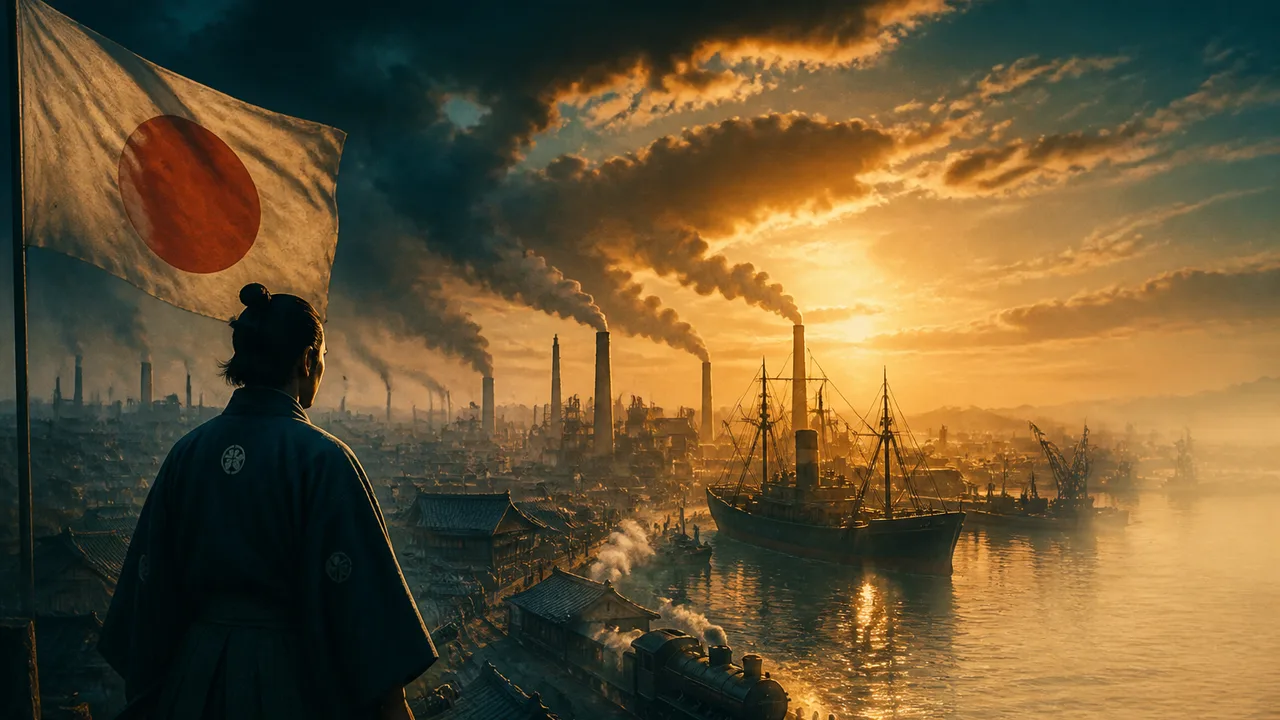
Photo: AI. Astrid Lehmann
In 1868, Japan was staring down the barrel of Western colonization. American gunboats had already forced the country to sign unequal treaties capping import tariffs at just 5%. China was being carved up. Egypt would soon follow. The question facing a small group of samurai reformers wasn't really about economic theory — it was about survival.
That's the frame Dr. Joeri Schasfoort uses in a recent Money & Macro deep dive into Japan's 19th-century industrialization, and it's the right one. When you understand that the Meiji reformers were not ideologues but pragmatists trying to avoid becoming a colony, their seemingly contradictory policy mix — free markets and state factories, austerity and subsidies, open trade and covert protectionism — starts to make a different kind of sense.
The carpenter's son who wasn't supposed to matter
Sakichi Toyota was born in 1867, the son of a humble carpenter, in a Japan where your father's occupation was essentially your life sentence. Every night, Schasfoort tells us, he fell asleep to the sound of his mother working a primitive wooden handloom. Under the old Tokugawa feudal structure, that would have been the whole story.
The Meiji government shattered it. By 1901, school attendance had climbed from an estimated 45% in 1870 to over 98%. National literacy followed. But the government understood — and this is what separates the Meiji approach from other modernization attempts — that basic literacy and industrial technical knowledge are two entirely different things. So the home ministry created an industrial promotion bureau specifically tasked with translating Western technical literature into Japanese.
Schasfoort cites research by economists Sakabe and Weinstein showing that by 1910, technical books in the Japanese language ranked behind only French and English globally — a transformation that required not just translation work but the systematic invention of new Japanese vocabulary to accommodate an entirely foreign industrial lexicon. The word for "telegraph" had to exist before you could teach someone to build one.
Toyota himself was a direct product of this infrastructure. He read technical magazines made possible by that translation effort. He visited a national industry exposition in Tokyo — a Meiji government showcase designed explicitly to put Western machinery in front of entrepreneurs — and built his first patented wooden loom afterward. When he later struggled to upgrade to steel looms and had to hire an expensive American machinist out of his own wages, the government-built railroad network was what let him ship those looms to customers across the country.
Smart, ambitious young people existed in Qing China too. What they didn't have was this.
The Argentina problem
Here's where Schasfoort's analysis gets genuinely interesting, because he refuses to let the story settle into a comfortable narrative.
The standard textbook version of the Meiji miracle goes: government built infrastructure, abolished the feudal class system, secured property rights, passed patent protections, and then stepped back to let markets work. Nobel laureate Simon Kuznets reportedly quipped that there are four kinds of countries in the world: developed, undeveloped, Japan, and Argentina — because 19th-century Argentina also did all the "right" things by free-market standards and still failed to industrialize.
What Argentina lacked, Schasfoort argues, was a coordinated big push across interdependent industries simultaneously. Sakichi Toyota needed coal and iron to make steel looms. But who opens a coal mine when there are no factories to buy the coal? And who builds a factory when there's no coal? In a pure market, neither happens fast enough. The Meiji government built model factories, constructed shipyards and coal mines directly, and used state procurement — buying ships and railroads only from Japanese companies — to give domestic heavy industry guaranteed demand while it was too young to compete internationally.
The state-run enterprises were, by most accounts, money pits. Schasfoort is not romantic about this. When the Satsuma Rebellion of 1877 forced the government to print money and set off a hyperinflationary spiral, the project nearly collapsed with Okubo Toshimichi, its architect, who was assassinated the following year carrying a letter from his former friend who had led the rebellion against him.
What came next was a pivot, not an abandonment. Okubo's successor Matsukata Masayoshi slashed spending — millions of poor farmers went bankrupt, and Schasfoort notes he became "the most hated man in Japan" — but, as Schasfoort argues drawing on historian Steven J. Ericson's characterization, Matsukata practiced what Ericson called "expansionary austerity": targeted cuts to genuine inefficiencies while preserving the developmental infrastructure that still functioned. Then he sold the failing state enterprises at fire-sale prices to wealthy merchant families, who bundled them into the diversified mega-conglomerates known as zaibatsu — Mitsubishi, Mitsui, Sumitomo.
The zaibatsu received private banking licenses and monopolies over shipping routes and mines. But, and this is the part that distinguishes Meiji Japan from the crony capitalism that has derailed so many development stories since, those monopolies were conditional on performance. Schasfoort cites economists Randall Morck and Masao Nakamura's argument that the zaibatsu were not a parasitic oligarchy — they were a more efficient vehicle for delivering the coordinated push that state enterprises had attempted but couldn't sustain.
When Toyota's textile exports to China collapsed after the Boxer Rebellion and threatened to bankrupt his young firm, it was Mitsui zaibatsu backing that let him absorb the losses and keep going. As Schasfoort recounts, Toyota eventually sold the patent rights to his revolutionary automatic loom to the British firm that had humiliated his prototypes decades earlier — a remarkable reversal. On his deathbed, Schasfoort tells us, Toyota turned to his son Kiichiro and said: "I did my part with textiles. Now you use this money to build the Japanese automobile."
Financing without drowning
Egypt is the ghost haunting the Meiji monetary story. Egypt borrowed heavily to fund industrialization, pegged its repayment to cotton exports, and when cheap American cotton flooded back onto global markets after the Civil War, Egyptian cotton prices crashed. Western powers used the unpaid debts as pretext to colonize it. That was precisely the fate the Meiji samurai were trying to prevent.
So Japan mostly refused to borrow foreign currency. Instead, Okubo replaced the old rice-denominated tax system with a cash land tax — not a trivial shift. Peasant families who had never needed a bank account now did. That cash flowed into state-backed banks with tightly directed lending mandates: agricultural development loans from state banks, mines and shipping from zaibatsu banks. Every newly created yen pointed at productive capacity rather than consumption. A farming family forced into the cash economy was also, whether they understood it or not, being conscripted into the monetary architecture of industrialization.
The parallel risk was that as Japanese workers got richer, they'd spend their new money on cheaper, better Western imports — draining the gold and silver reserves Japan needed to buy machines and expertise. Tariffs, the obvious solution, were banned by the unequal treaties.
What followed was a set of workarounds. Direct export subsidies to shipping companies. State procurement policies that kept foreign competition out of key sectors for years. And then something that Schasfoort describes as possibly accidental: when Matsukata kept Japan on the silver standard while most of the Western world shifted to gold, the resulting collapse in silver's value relative to gold automatically depreciated the yen. Japanese exports became cheaper on world markets without anyone explicitly engineering it. A merchant watching the price of Japanese silk in London would have noticed before any official in Tokyo announced a policy.
The foundation the miracle was built on
The piece of this story that tends to get dropped from the triumphalist version — the one where Japan proved that a non-Western nation could match the industrial powers — is who paid for it at the bottom.
Japanese factory workers, many of them young women recruited from rural villages and housed in factory dormitories, worked 14-to-16-hour shifts. Unions were suppressed. Strikes were outlawed. Low wages weren't a side effect of development; they were a mechanism — keeping export prices competitive and import demand suppressed simultaneously, preserving the foreign reserves that financed the machines and expertise that made the whole system run.
Schasfoort doesn't flinch from where that leads. The same export-dependent, low-wage workforce that powered the miracle became economically devastated by the Great Depression. That devastation created the political conditions in which military factions could violently target the zaibatsu's own leadership, the public could cheer, and civilian government could ultimately surrender authority to the army. Japan's industrialization didn't just end with World War II. The social contradictions built into the original model helped produce it.
The Meiji miracle is genuinely remarkable — a poor, feudal nation that faced colonization and instead industrialized fast enough to defeat a European power in open warfare within a generation. It created a development playbook that South Korea, Taiwan, and China would later adapt. But it worked by keeping one set of costs visible — the foreign debt Japan refused to take on, the colonies it avoided becoming — while making another set nearly invisible: the women in the dormitories, the farmers bankrupted by austerity, the workers whose poverty eventually destabilized the state that had built itself on their labor.
That's not a reason to dismiss the miracle. It's a reason to look at it clearly.
More Like This
Douglas MacArthur and the People He Left Behind
MacArthur is remembered as a military legend. But what about the veterans he gassed, the soldiers he abandoned, and the Japanese citizens who built a new democracy?
Ray Dalio's Framework for Tracking Empire Decline
Ray Dalio argues empires follow measurable, repeating cycles of rise and fall. His framework deserves scrutiny—and raises questions relevant to today's geopolitics.
The Bari Disaster: Mustard Gas, Secrecy, and 1943
On December 2, 1943, a German raid on Bari killed over a thousand people—and released mustard gas that officials spent decades trying to erase from history.

Attila the Hun: Scourge of God or Economic Strategist?
Attila never sacked Rome—yet he's history's ultimate barbarian. The real story is stranger, and more familiar, than the legend.
Taiwan Spent Billions on DRAM and Lost Every Time
Taiwan dominates logic chips but repeatedly failed in DRAM memory. Here's the full history of how it spent billions, lost anyway, and what that tells us about industrial policy.
China's Housing Bust Is Still Happening, Just Quietly
China's property crisis never ended — it got papered over by a manufacturing boom. Now that buffer is fading, and Main Street may feel it next.
Roosevelt's 1936 Peace Promise: What He Really Meant
In 1936, FDR ran on "peace" — but he meant three different things by it. Unpacking that word reveals a political strategy still worth examining today.

The Anaconda Plan Was Right. People Paid for It.
Winfield Scott's Anaconda Plan was strategically vindicated — but the years it took to work were paid for in hunger, death, and bondage by ordinary people.