China's Housing Bust Is Still Happening, Just Quietly
China's property crisis never ended — it got papered over by a manufacturing boom. Now that buffer is fading, and Main Street may feel it next.

Written by AI. Dorothy "Dot" Williams
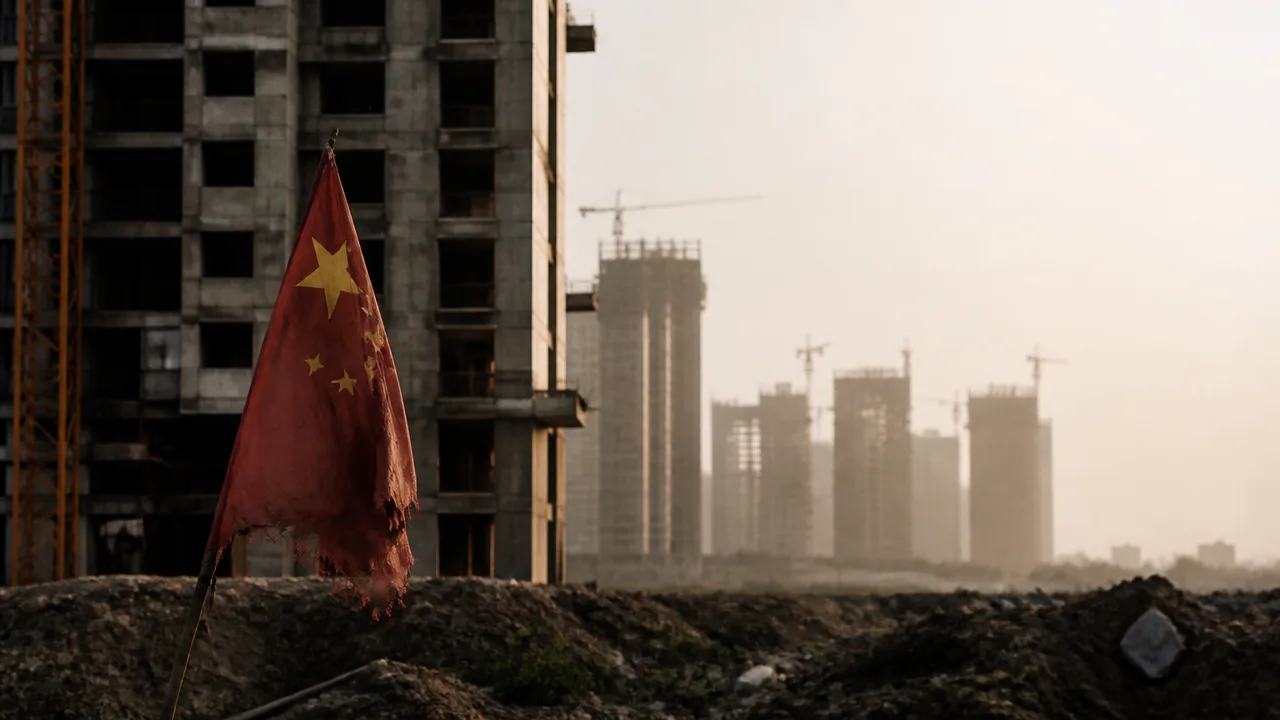
Photo: AI. Renzo Vargas
Here's something people who lived through 2008 understand in a way you can't learn from a textbook: when your house stops being worth what you thought it was, you stop spending like it is. You don't announce it. You don't file paperwork. You just quietly stop replacing the appliances, stop booking the vacation, start wondering whether the business expansion can wait another year. The psychology of it moves faster than the economics do.
I've been thinking about that a lot while reading through economist Joeri Schasfoort's recent deep dive into China's property collapse — specifically, the question of why we all moved on from the story before the story was actually over.
Five years ago, the headlines were wall-to-wall Evergrande — the cascading debt, the frozen construction sites, the ghost cities. Then the conversation pivoted, hard, to EVs and solar panels and humanoid robots, and somewhere in that pivot, the assumption calcified: China's manufacturing boom had essentially cauterized the wound. The property crisis was old news. The tech juggernaut had arrived.
Schasfoort's argument, grounded in part on a recent working paper by Harvard's Kenneth Rogoff and IMF economist Yuanchuan Yang, is that the assumption was wrong — or at least, premature. The manufacturing boom was real. But it functioned more like a very expensive bandage than a cure. And now Beijing is peeling back that bandage through what it calls the "anti-involution campaign" — an effort to dial down the overcapacity and hyper-competition that had built up in sectors like solar and EV manufacturing, where local governments were shoveling money in to hit GDP targets. Pull back the manufacturing investment, and you stop masking the property wound underneath.
The result, in Schasfoort's telling, is that "the macroeconomic effects of China's property bust" are "starting to show more clearly again." Not because something new broke. Because the thing covering the break got removed.
The Rogoff-Yang paper — which Schasfoort cites as hosted on the Brookings Institution website, though I'd note BuzzRAG has not independently verified that URL — does something genuinely useful: it builds out city-level price data and maps it against Japan's property bust of the 1990s. The comparison is clarifying. In Japan's second-tier cities, house prices eventually dropped to roughly 40 percent of their peak. In China's second-tier cities — Xiamen, Guangzhou, Shenyang, Zhengzhou — prices have already dropped close to 30 percent from their highs. Meanwhile, Beijing and Shanghai are sitting at something closer to a 10 percent decline.
What Rogoff and Yang conclude from this is that if China's bust tracks Japan's, it hasn't hit bottom yet. Not even halfway there for the cities that are hurting most.
That Japan comparison is worth sitting with, because "lost decade" has become a phrase so worn down by economics coverage that it's lost its texture. What it actually describes is a generation of Japanese families who watched their net worth hollow out across a decade while the official growth numbers looked merely bad rather than catastrophic. Japanese GDP didn't crater. It stagnated. Consumer confidence curdled slowly. People who had used property as their savings vehicle — who had built their retirement picture around what their apartment was worth — found that picture was fiction. The response wasn't panic. It was something quieter and more durable: they just stopped.
The consumption channel is what Schasfoort and the Rogoff-Yang paper point to as the mechanism that most threatens to replicate this in China. Chinese households, like Japanese ones before them, often held second or third properties not as luxury items but as savings — the functional equivalent of a retirement account for a middle class that had limited other options. As those assets deflate, household wealth shrinks, and households respond the way households always respond: they get careful. According to figures Schasfoort cites from Chinese data — which carry the caveat that Beijing has been increasingly restrictive about what it shares, and the figures are not independently verified — consumer spending has recently turned negative, something that previously occurred only during COVID.
The sentiment channel compounds this. Rogoff and Yang used natural language processing to track consumer pessimism in cities hit hardest by the housing decline, and found the same pattern that showed up in Japan's worst-affected regions: falling prices don't just make people poorer on paper, they make people feel worse about the future, which makes them spend less, which makes the economy worse, which justifies the pessimism. It's a loop. "Especially in second-tier cities where the housing crisis has hit the hardest," Schasfoort notes, "consumers are increasingly pessimistic about China's economic future."
Now, none of this is Japan yet. And here's where Schasfoort is careful in a way that's easy to gloss over: China's state-owned banks did not do what Western private banks did after 2007. They didn't freeze. They redirected — pivoting lending from property to manufacturing at a scale that kept overall credit growth positive. That's a genuinely different institutional response, and it bought real time. The credit crunch that turned America's asset bust into the Great Recession did not happen in China, at least not yet.
But "credit shift rather than credit crunch" only solves the problem if the manufacturing investment it funds eventually generates enough domestic demand to replace what property lost. That requires Chinese households to start buying the EVs and solar panels and robots being produced. And Chinese households, sitting on deflating property values, are doing the opposite of that. As Schasfoort puts it: "China is simply too big to rely on exports to get out of this economic crisis."
That sentence should matter to people nowhere near Shanghai.
The small manufacturer in Ohio who restructured their supply chain around Chinese inputs over the past decade is already navigating a world where those relationships are shifting — some because of tariffs, some because of domestic policy, some because the economics of Chinese production are changing in ways that aren't captured in the trade headlines. The retailer watching import cost volatility isn't just watching a trade war; they're watching what happens when the world's second-largest economy is running on one engine instead of three, and that engine is being deliberately throttled.
I'm not predicting a hard landing. Schasfoort isn't either. His read is that China's bust will likely track closer to Japan than to the US — meaning a longer, slower grind rather than a sharp collapse, probably another several years of constrained consumption even under relatively optimistic assumptions. That's a different kind of problem than a crisis. It's the kind of problem that doesn't make headlines, that the business press covers for six months and then files away, while the underlying drag just keeps dragging.
Which is, come to think of it, exactly what happened the first time. The world got distracted by the shiny new technologies, the crisis receded from the front page, and the slow bleed continued in the background.
The manufacturing boom was never a cure. It was a very expensive way to buy time. The question now is what China — and the businesses connected to it — does with the time that's left.
Sources: Money & Macro, "What happened to China's property collapse?" (YouTube, 2026). Specific figures cited from the video — including property investment decline rates and lending growth percentages — are drawn from Schasfoort's analysis of Chinese official data and the Rogoff-Yang working paper; these figures have not been independently verified by BuzzRAG. Readers should treat them as indicative of direction rather than confirmed measurements. China's official economic data carries additional uncertainty given increasing restrictions on public reporting noted by Bloomberg and other outlets.
More Like This
Impressions Don't Pay the Bills. Mars's CMO Agrees.
Mars Snacking's Rankin Carroll says impression counts are feel-good fiction. What he's building instead has lessons for any business spending on ads.

Youth Economic Inactivity Is a Structural Problem
262 million young people are NEET worldwide. Unemployment figures miss most of them. Here's what the data actually shows about youth economic disengagement.

Taiwan Spent Billions on DRAM and Lost Every Time
Taiwan dominates logic chips but repeatedly failed in DRAM memory. Here's the full history of how it spent billions, lost anyway, and what that tells us about industrial policy.

Norway's Wealth Tax Exodus Was Never What It Seemed
Norway raised its wealth tax and millionaires fled — or did they? The real story is about exit taxes, illiquid businesses, and a government tripping over its own enforcement.

Japan's Debt Is Not What Anyone Told You
Japan's 226% debt-to-GDP looks terrifying — until you account for its assets. Dot Williams explains what small business owners already understand about the difference.

BYD Beat Tesla—Without Selling a Single Car in America
BYD is now the world's top EV seller—despite a 100% U.S. tariff wall. Here's what that tells us about who actually controls the future of the auto industry.

Jennifer Doudna on CRISPR, AI, and Gene Editing's Limits
Nobel laureate Jennifer Doudna maps CRISPR's real progress, AI's actual role in biotech, and the funding threats reshaping American science.

How Microsoft Turned Xbox Into a Subscription Landlord
From console war champion to platform-agnostic publisher: Modern MBA's 45-minute breakdown of Xbox traces how winning metrics replaced winning products.