Impressions Don't Pay the Bills. Mars's CMO Agrees.
Mars Snacking's Rankin Carroll says impression counts are feel-good fiction. What he's building instead has lessons for any business spending on ads.

Written by AI. Dorothy "Dot" Williams
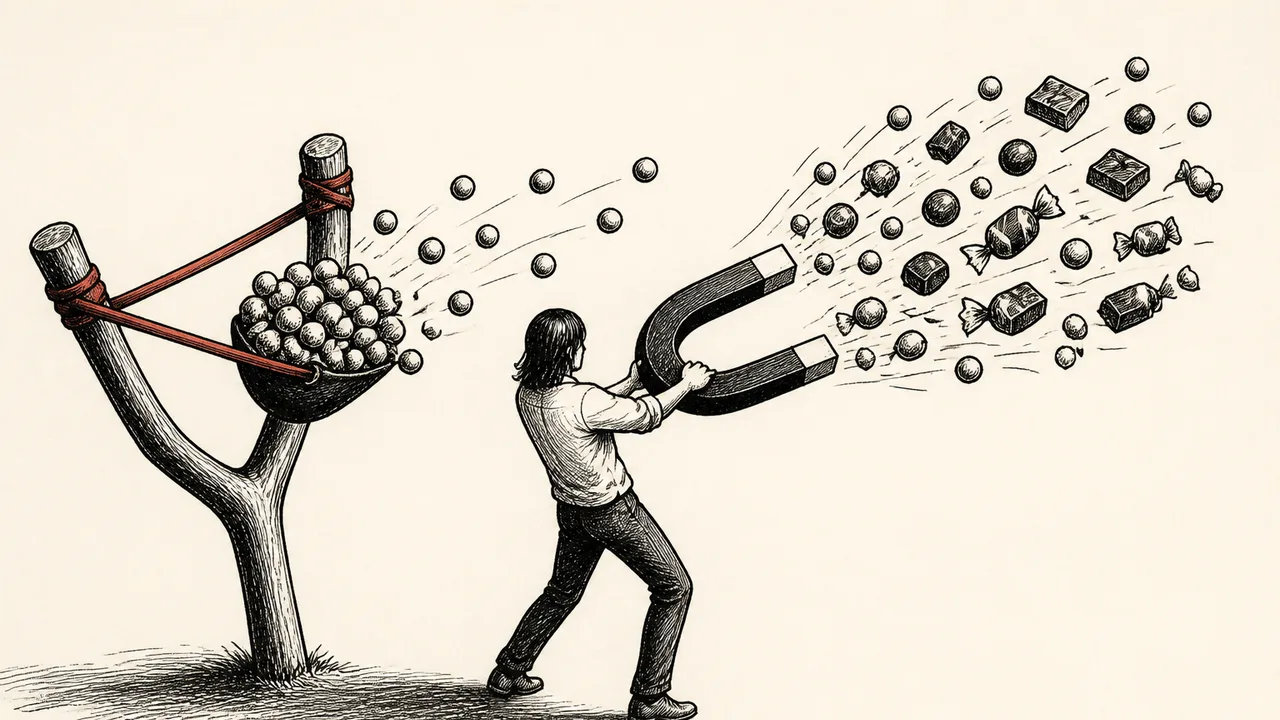
Photo: AI. Eira Pendragon
Every small business owner I've ever talked to who has run a Facebook ad campaign knows the specific feeling Carroll is describing — even if they don't have a name for it. You spend $200, you get back a report that says 14,000 people "saw" your ad, and you stand there behind the counter wondering whether a single one of them actually walked in. The number is large. The meaning is unclear. You move on.
Rankin Carroll, Chief Brand Officer of Mars Snacking, had the same problem — just with more zeros attached. Speaking on Business Insider's CMO Insider podcast with host Lara O'Reilly, Carroll described what happened when Mars fired its M&M's spokes-characters a few Super Bowls back and watched the metric machine do its thing: "It was 25 billion impressions. So it's like three times the global population. What does that even mean? And so you would be quoting these numbers and thinking, I don't know what that means for the business."
Mars has a $35.9 billion acquisition (Kellanova, formerly Kellogg's) to justify. Carroll has brands like Snickers, Skittles, Pringles, and Cheez-Its to grow. He does not have the luxury of a number that sounds impressive in a boardroom but tells him nothing about whether anyone bought a candy bar. And so, after what appears to be roughly two decades at the company — his tenure was described in the interview as approximately 23 to 24 years, though Buzzrag has not independently verified that figure — Carroll has arrived at something most small business owners already feel in their gut but rarely hear validated from a stage: impressions are not outcomes.
That validation matters. Because the platform that sold you those 14,000 "views" would very much like you to believe they are.
What Carroll is actually building — and what it means when you're not Mars
Carroll's alternative to impression-counting has a few moving parts that are worth separating out, because not all of them require a nine-figure budget.
The first is audience precision over mass reach. Mars used to do what Carroll calls "one channel, big reach, and hope for the best — do it for three months and then move on." Now they're running multiple, personalized messages to different audience segments across different channels simultaneously. The Snickers/Jose Mourinho campaign during the Euros is the example Carroll keeps returning to: they identified that the dominant fan behavior around European football is banter, built an interactive experience around Mourinho delivering personalized "own goal" roasts to users who admitted to hungry mistakes, and let the sharing mechanics do the distribution. It spread.
For a local business, "audience precision" doesn't require a data science team. It means knowing that your Tuesday lunch crowd is different from your Friday dinner crowd, and that a post aimed at one probably doesn't land with the other. It means that if you run a hardware store and you're advertising on Instagram, a reel aimed at weekend DIYers hits differently than one aimed at contractors — and you probably shouldn't use the same creative for both. Carroll's version is scaled up by several orders of magnitude, but the underlying logic is the same: stop broadcasting to everyone and start talking to someone.
The second piece is measurement that connects to actual commercial activity. This is where Carroll gets genuinely interesting — and genuinely honest about how hard it is. Mars is working with a technology partner (identified in the podcast as "Olympic," though the transcript audio quality makes the exact name uncertain and Buzzrag has not independently confirmed the company name) that uses large language models to trace earned media chains: a Snickers mention during a WWE broadcast leads to a podcast reference, leads to a purchase in Texas. Their system tries to attribute value to that whole chain rather than just the broadcast impression.
That's a sophisticated capability Carroll himself calls "a journey" and explicitly notes requires independent auditing — "don't trust me, trust the expert" is how he puts it. The honest answer is that Mars is still figuring this out. But the direction of travel — stop measuring reach, start measuring commercial effect — is something any business can adopt as a principle even before they have the tools to do it perfectly. Before you pay for the next ad, ask yourself: what would it look like if someone actually responded to this? And will I know if they did?
The third is cross-functional buy-in from the start. Carroll's description of how they approved the Mourinho campaign is worth sitting with: they didn't present a finished idea and wait for sign-off. They brought lawyers, brand safety teams, security teams, agency partners, and the brand team into the room from the beginning. "You don't show up and sort of it's a big reveal. Tada. And having 14 people go, 'No, you don't.'"
For a business where the owner is also the legal team and the brand team and the creative director, this maps differently. But the principle holds: the people who have to live with the consequences of a marketing decision should be part of making it. If you're a sole proprietor, that might mean your most trusted customer, your accountant, or the person behind the counter who hears what customers actually say. The Don Draper model — genius alone in the room, dramatic reveal — doesn't work at Mars. It doesn't work on Main Street either.
On staying in your lane (when you ARE the lane)
Carroll spent some time in the podcast on the M&M's backlash — when the brand leaned into a more inclusive visual identity and got torched in certain quarters of U.S. culture. The short version: they didn't fold, and they didn't get preachy about it. The Green M&M character responded to the controversy on social media with something along the lines of "Did my shoes just break the internet?" — Carroll described the post as a tweet, though Buzzrag has not independently sourced the exact quote or confirmed the original platform. The point was that they reacted the way the character would react, not the way a nervous PR team would react.
Carroll's frame: brands get into trouble when they step into conversations that have nothing to do with who they are. Skittles has supported LGBTQ causes for about ten years because that's genuinely part of what that brand is. M&M's made a choice consistent with its characters' personalities. The problem isn't taking a position — it's taking a position that has no relationship to your actual identity and then being surprised when it looks opportunistic.
For a local business owner, this is probably the most portable insight in the whole conversation, because on Main Street, there's no gap between the brand and the person. You are the brand. Which means the "stay in your lane" question isn't about protecting a character's voice — it's about whether the thing you're saying or doing reflects what people actually experience when they walk through your door. Consistency between who you say you are and how you operate is, as Carroll notes, "the bedrock." An independent coffee shop that posts about supporting local farmers and then quietly switches to commodity beans is not staying in its lane. A restaurant that speaks up for its neighborhood on a zoning issue is probably doing exactly what its customers expect.
The AI piece, without the hype
Carroll describes Mars using AI across what he calls three areas — in reaching consumers, in making content, and in measurement. That framing is his description of their applied areas, not a formal named framework. On the creative side, he's clear-eyed: "AI isn't originating anything. It's replicating what's come in the past and it does a brilliant job." He's also honest that consumer backlash against AI-heavy marketing is already starting, and he doesn't claim to know how that plays out.
On jobs, Carroll pushes back on the "replace people" assumption: "I think you take out the work that drags people down and elevate and give them an opportunity to do much more interesting and creative things." Whether that optimism proves out across the industry is an open question. But the principle — use the tool for the part of the job that wastes human attention, and free people up for the part that requires it — is a reasonable way for a small business owner to think about any new tool, AI or otherwise.
Carroll's own answer to what he's most excited about right now is measurement. Not a new campaign, not an acquisition integration, not an AI feature. The unglamorous work of knowing whether what you're doing is actually working.
Most small business owners don't need a $35.9 billion acquisition to understand that priority. They've been living it every time they look at a dashboard full of impressions and have no idea whether to keep running the ad.
Dorothy "Dot" Williams covers small business and Main Street economics for Buzzrag.
More Like This
How One Developer Automated Marketing With AI Agents
Brian Casel built four AI agent skills to handle his marketing. Here's what that actually looks like when you open the hood and examine the process.

Uganda Vanilla Could End the Price Chaos
Madagascar's vanilla monopoly has wrecked small business budgets for decades. Uganda's emerging industry might finally offer the stable supply chain Main Street needs.
Meta Pixel Misconfiguration Is Quietly Draining Ad Budgets
How a single tracking setup decision caused Ridge's travel ads to fund wallet sales instead. What it means for brands, consumers, and Meta's growing power over both.

When Trending Foods Leave Producers Behind
Oxtail now costs $14/lb. Acai farmers earn 20 cents/lb. A look at who actually profits when food goes viral—and who gets left out.
What 21 Global Jobs Reveal About Work and Worth
From Louisiana shrimp docks to Everest base camp, Business Insider's job profiles reveal a pattern: the harder and more essential the work, the thinner the margin.
Turkey's Olive Oil Soap Maker Bets on Patience
Doktoroğlu Soaps makes 8 million bars a year the old way. The real story is what a year-long production cycle does to your cash flow—and your nerve.

US Airlines Are Profitable and Getting Worse
US airlines make billions but deliver miserable service. Here's what the loyalty program math actually means for small business owners who fly on points.

Indonesia's Stock Market Slide and What It Costs
Indonesia's market is down 19%, the rupiah is near record lows, and "deep-fried stocks" are spooking global investors. Here's what's actually happening — and who feels it.