What 21 Global Jobs Reveal About Work and Worth
From Louisiana shrimp docks to Everest base camp, Business Insider's job profiles reveal a pattern: the harder and more essential the work, the thinner the margin.

Written by AI. Dorothy "Dot" Williams
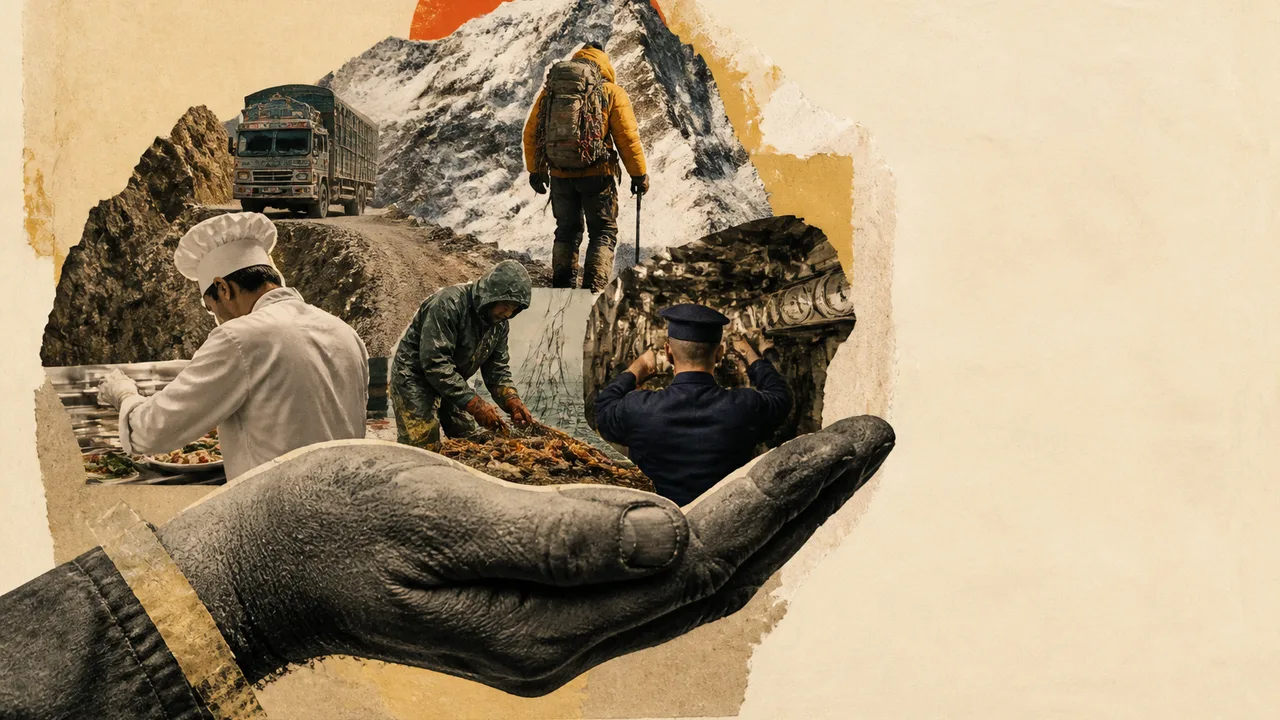
Photo: AI. Wren Sugimoto
Dean Blanchard was born on a shrimp dock. His family has been buying and selling Gulf shrimp for five generations. When Business Insider filmed at his operation — two hours south of New Orleans — not a single shrimp boat came in all day. The dock smelled like salt and old diesel and nothing. That particular silence, the kind that should be filled with engines and boots on wood planking and men calling out weights, is one of the loudest sounds in American small business right now.
"Right now is the cheapest I ever seen in my life," Blanchard told the camera. "I'm sick to my stomach. I ain't never seen nothing like this. Never. Never in my life seen it this bad."
He estimates 96% of the docks that were operating when he started out have since closed. He doesn't think anyone will buy his company when he retires. "The property is worth more than the business." That sentence should be cross-stitched on something and hung in every policy office in Washington.
Business Insider's nearly four-hour documentary, 21 Fascinating Jobs Around The World, bills itself as a tour of remarkable vocations — airline catering chefs in Doha, Sherpa guides on Everest, ballet shoe makers in London, NFL football preppers in New Jersey. And it is all of that. But if you watch it long enough, a different kind of document emerges. It's a catalog of what happens when essential, irreplaceable human skill collides with a market that has decided not to pay for it.
The Louisiana shrimp section hits hardest because the people in it are so plainly not victims of their own choices. Captain Lonnie "Knuckles" Mayu Jr. — his name as reported in the documentary — is 82 years old and still hauling nets. He bought and fixed up his boat for $45,000. It was supposed to be his retirement plan. The math no longer works. A block of ice that cost $14 in the 1980s costs $26 today. New nets more than doubled. Gas more than tripled. The price he gets per pound has not kept pace with any of it. "For this boat to leave the dock, it going to cost me over $1,000," one shrimper says flatly. "They killing us."
What's killing them, specifically, is that imported shrimp — the documentary cites approximately 90% of US consumption as imported, a figure that fluctuates year to year — enters the market at price points that make Gulf-caught shrimp economically uncompetitive. Blanchard's dock price has to undercut fully-processed imported product landing at just over $4 a pound, which means he's making 2022 money on 2000 prices. The processor Kristen Bomber, whose family has worked Gulf shrimp for over 130 years, puts it without decoration: "It's become more of a volume game because the margins are so tight."
I've sat in enough dock offices over the years — different industries, same smell of institutional coffee and old invoices — to know what that sentence costs the person saying it. Volume games are what you play when you've already lost the margin game. You're not building anything at that point. You're bleeding slowly in a building that needs a new roof.
The gear economics on Everest follow the same logic, just at altitude. Fura Wangchu has summited Everest 14 times. That is a staggering résumé. His agency pays certified guides up to $10,000 per climb, with a $1,500 bonus for a successful summit — but most guides work only one expedition per year, because the majority of summits cluster in a single spring window. Annual income from guiding: somewhere between $4,000 and $11,500, before costs.
Before costs is the part that matters. Guides buy their own gear — an investment of up to $7,000, per the documentary, covering clothing, boots, and backpacks engineered for conditions that will kill you if the equipment fails. The down suit alone can run $2,000, and some pieces need replacing every few years. Think about that the way you'd think about a general contractor who has to buy new tools every season out of pocket, then bill for labor at rates set by the client. The contractor analogy is imperfect but the structure is the same: the person absorbing the capital cost of doing the work is the person with the least pricing power in the arrangement.
Nepal issued a record 478 permits in spring 2023, up from 409 two years prior. More climbers, more guides needed. The documentary notes that spring 2023 also saw approximately 18 deaths — 15 confirmed and three presumed, according to the reporting, though trackers note the "deadliest season on record" designation is disputed depending on how missing persons are counted. What is not disputed: six of those who died were Sherpa guides. The industry is growing. The risk is growing with it. The compensation has not grown proportionally. Wangchu openly questions whether it's worth it, and says more guides will ask the same question.
The documentary also profiles Anku, a Himalayan truck driver who makes the 107-mile run to Pangi Valley — a region cut off by snow for roughly six months a year — hauling government-supplied wheat over a road that is, in places, eight feet wide with no guardrails and a drop of nearly 11,000 feet on one side. He earns about $4 US per day. He could earn two and a half times that as a personal driver in Delhi or Mumbai. He stays because the mountains are his. He vlogs the drives and has around 50,000 YouTube followers.
Here's my honest read on Anku, since I'm not going to pretend otherwise: I find the vlogging detail both genuinely moving and a little uncomfortable. He's found a way to extract meaning and modest visibility from a job that could kill him for wages that won't build a life. That's a real human adaptation, and I respect it. I also notice that the documentary, and this genre generally, can slide toward framing that kind of adaptation as its own reward — as if the beauty of the mountains and the YouTube following are compensation for the absence of guardrails and retirement savings. They're not. The mountains are free. The danger is not.
Not everything in this documentary is a story about exploitation. Some of it is genuinely about craft and the market that sustains it.
The Freed of London section — the company is identified in the transcript as having been founded around 1929, with its signature shoe-box paste developed by Friedrich Freed, though readers seeking to verify those specifics should consult the company's own records — is one of the more hopeful portraits in the film. Twenty-four hand makers, booked through 2026, building pointe shoes for the Royal Ballet, the American Ballet Theater, and the Paris Opera Ballet. The New York City Ballet spends nearly a million dollars a year on shoes alone. The supply is constrained by the skill; the skill takes years to develop; the market pays for the scarcity. That system, rare as it is, actually functions.
Faber-Castell, per figures the company provided to Business Insider, produces 2.3 billion pencils a year at its Stein, Germany facility and says its professional Polychromos line costs five times more to produce than student-grade pencils. The premium colored pencil market — sets running around $350 — is a niche where quality translates directly into price because the buyers are professionals who know the difference and will pay it. Same with Dan Coulson, who runs Gridiron Football Prep out of his New Jersey home and charges up to $70 per ball to condition footballs for NFL and college programs. He built a business out of a rule change — in 2006, following advocacy by quarterbacks including Tom Brady and Peyton Manning, the NFL allowed teams to use their own game balls — and out of the gap between what a factory can do and what a specific quarterback's hands require.
These are bright spots, and they're real. But they survive precisely because they've found niches where the market hasn't yet figured out how to commoditize them.
The Iowa 80 truck stop in Walcott, Iowa — 900 parking spots for semis, 350,000 meals a year, a dentist on site, a movie theater — is presented as a success story, and it is. It's also one of the last independently owned major truck stops in the country. Lee Mayor, third-generation owner, explains the philosophy: "When our customers are at home, they should be with their family, not running all these errands." That's a small-business value proposition — you serve the whole person, not just the transaction — that chains have never been able to replicate. They're thriving. And their continued existence is remarkable enough to be the subject of a documentary segment.
What Business Insider assembled here, probably without intending to, is a field guide to who pays the freight when something essential gets done. The Qatar Airways kitchen in Doha turns out 200,000 fresh meals a day — handmade pasta in economy class, custom desserts designed quarterly — and wins awards for it. The culinary specialists on the USS South Dakota cook Thanksgiving dinner for 150 sailors in five hours, on a submarine, earning a base salary the documentary pegs at around $26,000 (figures for military pay grades shift annually; readers should verify against current DoD pay tables). The shrimpers go out at sunset and come back at dawn and sometimes the nets are full of catfish.
The people doing the most consequential, least-replaceable work are frequently the ones least insulated from the consequences when the market turns. The Sherpa guide carries three times what the client carries and buys his own gear. The Louisiana shrimper owns the boat and the debt and the risk and watches the dock price fall to match an import price he has no power over. When I cover small business on Main Street, I see this pattern in quieter forms — the florist who does wedding flowers for less than her own labor costs because she loves it and can't afford not to, the machine shop owner who holds down prices for longtime customers while his own costs climb, the restaurant that survived the pandemic only to get squeezed by ingredient inflation and still prices the lunch special at $12 because that's what the neighborhood can carry.
The jobs in this documentary are fascinating. What makes them worth watching is that the fascination is inseparable from the question they collectively raise: when the work is irreplaceable, why is the person doing it so often replaceable in the math?
Dorothy "Dot" Williams covers small business and Main Street economics for Buzzrag.
More Like This
Uganda Vanilla Could End the Price Chaos
Madagascar's vanilla monopoly has wrecked small business budgets for decades. Uganda's emerging industry might finally offer the stable supply chain Main Street needs.
Fast Food Price Increases and the Data Strategy Behind Them
Fast food prices have surged well past inflation—but labor costs are only part of the story. The bigger driver is a deliberate shift in business strategy and data.

Blackstone's Career Ladder, From Analyst to Partner
From a $90K analyst seat to Schwarzman's billion-dollar paycheck: how Blackstone's career ladder works—and why private credit is quietly rewriting it.
When Trending Foods Leave Producers Behind
Oxtail now costs $14/lb. Acai farmers earn 20 cents/lb. A look at who actually profits when food goes viral—and who gets left out.

US Airlines Are Profitable and Getting Worse
US airlines make billions but deliver miserable service. Here's what the loyalty program math actually means for small business owners who fly on points.
Inside the $65M Car Carrier Crossing the North Atlantic
The Faust carries $65M in luxury cars across a winter North Atlantic. What the documentary reveals about the people and systems keeping it all afloat.
Impressions Don't Pay the Bills. Mars's CMO Agrees.
Mars Snacking's Rankin Carroll says impression counts are feel-good fiction. What he's building instead has lessons for any business spending on ads.
Indonesia's Stock Market Slide and What It Costs
Indonesia's market is down 19%, the rupiah is near record lows, and "deep-fried stocks" are spooking global investors. Here's what's actually happening — and who feels it.