Fast Food Price Increases and the Data Strategy Behind Them
Fast food prices have surged well past inflation—but labor costs are only part of the story. The bigger driver is a deliberate shift in business strategy and data.

Written by AI. Marcus Tate
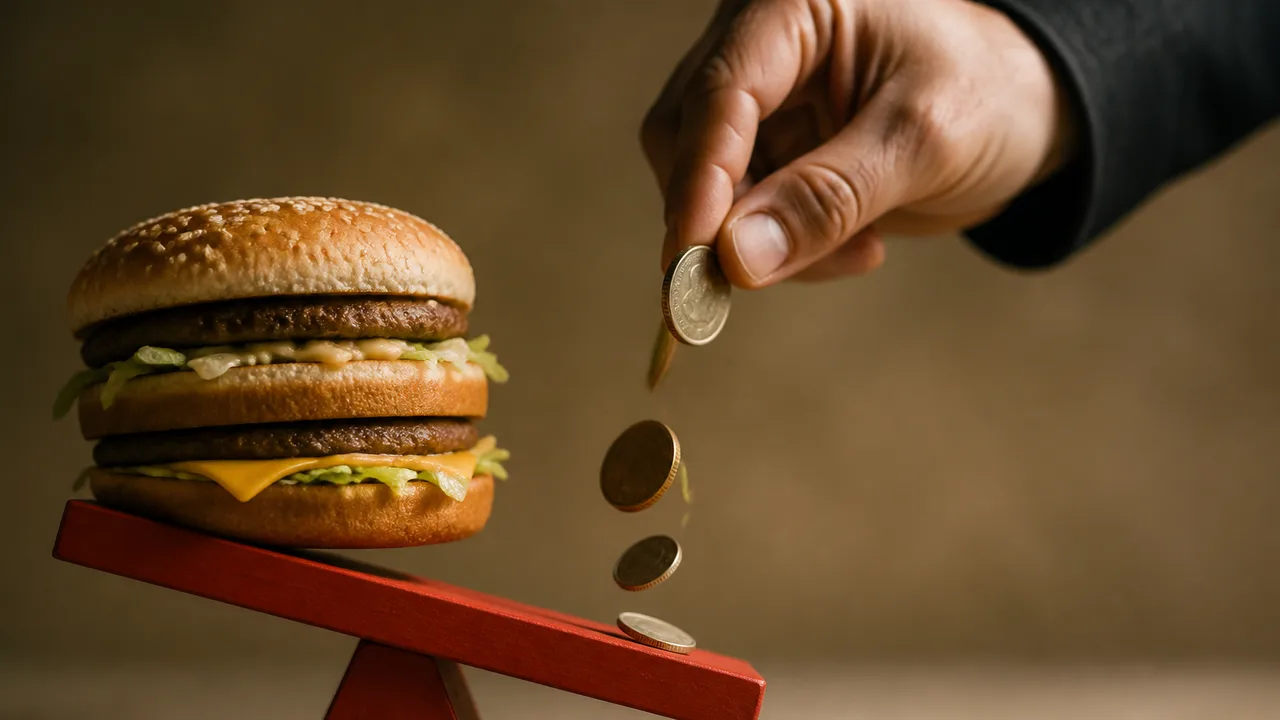
Photo: AI. Naia Iwarra
A photo taken at a highway rest stop in Darien, Connecticut set off a national conversation that the fast food industry probably wishes had never started. The year was 2023. A traveler, confronted with a Big Mac meal priced at nearly $18, did what people do now: skipped the purchase, took a picture, and posted it online. The image went viral. McDonald's issued a statement. Economists weighed in. Politicians found a talking point.
What made the image land so hard was not the number itself — it was the cognitive dissonance. Fast food was invented as cheap food. The entire category exists on the premise that a working person can get a hot meal without doing arithmetic first. Eighteen dollars for a burger, fries, and a drink violated something closer to a social contract than a menu price.
The industry's explanation arrived quickly and was, as Wendover Productions documents in a recent video on the subject, broadly true but incomplete. Labor costs had risen. California had legislated a $20-per-hour minimum wage for fast food workers. Ground beef prices had climbed across the decade. Paper cups, packaging, and supply chain inputs had all gotten more expensive in the post-pandemic stretch. Trade policy added pressure. The message from the chains, delivered through earnings calls and carefully worded press releases, amounted to: we had no choice.
That framing deserves scrutiny, and the Wendover piece applies it.
The Counterevidence Sitting Right Off the I-5
If rising costs were the whole story, then every chain would be raising prices at roughly the same rate, constrained by the same input environment. The comparison that complicates this narrative is In-N-Out Burger.
At a pair of locations in Burbank, California — one In-N-Out, one McDonald's, on opposite sides of the same interstate — the Double Double and the Big Mac sit at nearly identical price points: $6.10 and $6.49 respectively, according to the Wendover video. That price parity is where the resemblance ends.
In-N-Out pays its Burbank staff a starting wage of $22 an hour with benefits. It staffs its locations far more heavily than McDonald's — 10 to 15 employees on a regular shift, up to 25 during peak hours, compared to McDonald's's 5 to 10. Its ingredients have never been frozen. Its supply relationships with vendors — bun suppliers, drink concentrate providers — have in some cases held since the 1950s. It owns its locations rather than renting them. It processes its own meat and runs its own trucking.
And it generates $6 million in annual revenue per location, against McDonald's's $4 million average — while operating roughly two and a half hours fewer per day.
The operational model is expensive, vertically integrated, and stubbornly analog. There is no In-N-Out app. You cannot order ahead. The menu is essentially unchanged from its founding era. And yet the chain manages to undercut or match McDonald's on price while producing a demonstrably fresher product and outperforming it on customer satisfaction metrics.
The Wendover framing here is sharp: "The very fact that it competes with and in many cases out-competes the larger fast food chains on price while providing equal to better quality shows that pricing is a tool, a choice, an extension of strategy rather than something simply forced upon the industry."
That is worth sitting with. In-N-Out operates in the same California labor market. It faces the same beef prices. It is subject to the same tariffs. And it prices its flagship burger at $6.10. The implication — that pricing decisions at McDonald's and its peers reflect more than cost pass-through — is not a fringe argument.
The Data Pivot
To understand what McDonald's is actually optimizing for, the Wendover video traces the chain's transformation back to a specific inflection point: the introduction of all-day breakfast under CEO Steve Easterbrook in the 2010s, when year-over-year U.S. sales had been stagnating or falling against the encroachment of fast-casual competitors.
The move itself was not a hunch. McDonald's modeled it through a partnership with Applied Predictive Technologies, ran regional trials, and collected receipt data through the NPD Group. The analysis showed that all-day breakfast would pull back lapsed customers while nudging existing midday diners to add a McMuffin or hash brown to their orders — increasing average ticket size without requiring them to trade up on the main item.
It worked. And it revealed something more valuable than McMuffin revenue: it showed that data-driven decision-making could reshape consumer behavior at scale.
From there, the company's tech investment accelerated. In 2019, McDonald's acquired Dynamic Yield — its largest acquisition in two decades — an AI company specializing in personalized digital experiences. The acquisition formalized what had been building: McDonald's was not just a real estate company (which it still is, collecting rent from franchisees on land it largely owns) but increasingly a data company.
The mechanics are now embedded in the physical ordering experience. Drive-through menu boards no longer list the full menu. Kiosks and the app request login credentials, then serve a curated interface built around high-margin items and personalized upsells. As the video notes: "If you're planning on just ordering a Big Mac and not the meal, you're going to have to ask. And if you want to know the exact price before committing, you'll have to ask for that, too."
This is not incidental. Fountain drinks and french fries carry margins that a standalone Big Mac does not. The structural objective of every customer touchpoint — screen, kiosk, app — is to move the customer from a low-margin item to a bundled purchase with a better return. The personalization layer — order history, location data, behavioral patterns — allows the company to calibrate which nudge works on which customer, and at what price.
Perception Is the Product
After the $18 photo went viral and began showing up in McDonald's earnings calls as an actual business problem — the company was measurably losing lower-income customers — the corporate response was a value push: the $5 meal deal in mid-2024, followed by the McVal menu. Both performed.
And yet if you pulled into that same Darien, Connecticut rest stop today, a Big Mac meal would still cost you nearly $18.
The resolution to that apparent contradiction is in a phrase the Wendover video uses deliberately: perceived value. McDonald's is not, the video argues, primarily in the business of cheap food or quality food. It is in the business of convenient food at a price the customer decides is acceptable. The $5 deal and the $18 Big Mac coexist because they serve different customers in different contexts, and the data helps the company understand exactly where those thresholds sit.
This is the structural tension in the fast food category right now. The industry's cost-driven explanation for rising prices is not false — labor, beef, and packaging costs did rise, and they did flow through to menu prices. But the explanation stops well short of accounting for the degree of the increases, or for the fact that pricing is now a sophisticated, data-backed tool rather than a simple function of inputs.
The next frontier is more unsettling. Wendy's found itself in a public relations problem when it floated the idea of digital menus that could shift prices across the day — what customers immediately labeled surge pricing. The company walked it back. But as the Wendover video notes, the infrastructure exists. The data exists. The processing capacity exists. Prices already change — just quarterly rather than hourly, and quietly enough that no one tweets a photo about it.
"Customers have come to stomach rising costs," the video observes. "So perhaps if slowly and quietly implemented, they'll come to embrace dynamic ones, too."
That is either a prediction or a warning, depending on which side of the drive-through window you're on.
More Like This
MyFitnessPal Bought CalAI. Here's Why That's Telling.
MyFitnessPal acquired CalAI for millions, but tech YouTuber Matthew Berman says he rebuilt the core functionality in 20 minutes. What does that tell us?
Sports Media Executive Skills Are Being Redefined
Rick Alessandri of ZRG Partners breaks down what sports media executives need now: DTC fluency, data analytics, AI literacy, and a global footprint.
GoFundMe's CPTO on Marketplace Failure & AI Growth
GoFundMe's CPTO Arnie Katz breaks down 3 marketplace failure modes and how AI agents are driving real revenue—not just dev productivity.

The Enhanced Games' Real Business Isn't Sports
The Enhanced Games look like a doping Olympics. The actual business model is a $1.2B pharmaceutical marketing engine. Here's how it works.

Ford vs. Chevy: A Century of Automotive Rivalry
From the Model T to the Mustang, Ford and Chevy have spent 100+ years pushing each other. Here's how that competition actually played out.

Who Really Profits From the 2026 FIFA World Cup
FIFA projects $11B in revenue and $80B in global economic activity for 2026. But host cities are quietly getting cold feet. Here's where the money actually flows.

Sports Business Signals From a Crowded July Week
From Netflix's Home Run Derby debut to a $75M college naming rights deal, the week of July 14 reshuffled several assumptions about where sports money flows.

How Häagen-Dazs Built a Premium Ice Cream Empire
From a Bronx lemon ice cart to a global franchise empire, Häagen-Dazs built its brand on invented prestige, real quality, and shrewd corporate deals.