Ford vs. Chevy: A Century of Automotive Rivalry
From the Model T to the Mustang, Ford and Chevy have spent 100+ years pushing each other. Here's how that competition actually played out.

Written by AI. Marcus Tate
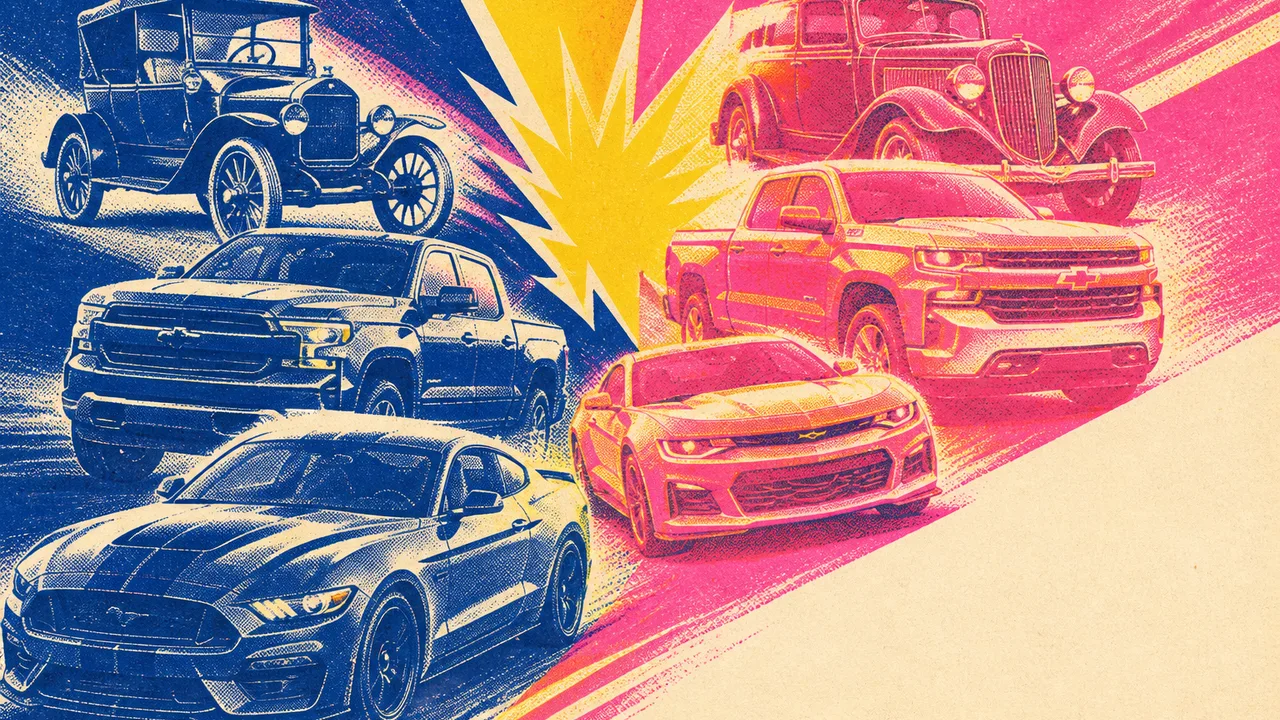
Photo: AI. Jorah Maktoum
Most corporate rivalries live in quarterly earnings calls and analyst reports. The Ford-Chevrolet rivalry lives in driveways, tailgates, and the kind of brand allegiance that gets passed down like a surname. It is, by most measures, one of the longest-running competitive duels in American commercial history — and it has been running hot since before the First World War.
A recent video from the YouTube channel Company Man maps five decades-spanning vehicle matchups to answer a question that sounds simple and turns out not to be: between these two American giants, who has actually been leading, and who has been following?
The answer, at least through this particular lens, leans Ford. But the supporting evidence is more textured than a scoreboard.
A Rivalry That Is Not Quite What It Appears
Before unpacking the matchups, there is a structural asymmetry worth naming. Ford versus Chevy is not, strictly speaking, a company versus company contest. Ford Motor Company competes as a single entity. Chevrolet is a brand inside General Motors — one flag in a much larger fleet that includes GMC, Cadillac, and others. That distinction matters when the unit sales get complicated, as they do in the truck segment.
As Company Man notes in the video, when you combine Chevy Silverado and GMC Sierra sales, GM as a corporate entity actually moves more pickup trucks than Ford. The F-Series outsells the Silverado head-to-head — by a substantial margin, over 800,000 units in 2025 against Silverado's second-place finish — but the Sierra quietly absorbs share that never shows up in the Ford-versus-Chevy frame. Brand loyalty studies track Chevy owners and Ford owners. They do not track corporate structures. That gap between perception and corporate reality is worth keeping in mind throughout.
The Innovation Pattern
The organizing framework Company Man applies is straightforward: one brand launches something category-defining, the other responds with a competitive alternative. Repeat across a century. What makes this framework useful is that it holds up across product categories that have almost nothing in common — economy cars, muscle cars, off-road SUVs — suggesting the pattern is structural rather than coincidental.
The first instance is also the most consequential. Ford's Model T, entering production in 1908, did not simply sell cars. It restructured who could own one. Henry Ford's assembly-line innovations drove the price low enough that working-class buyers could participate in a market previously reserved for wealth. Ford himself distilled the philosophy with characteristic bluntness: "Any customer can have a car painted any color that he wants so long as it's black." Efficiency over choice, access over aspiration.
Chevrolet's initial response — the 1912 Classic 6 — went in precisely the wrong direction, targeting affluent buyers and getting swallowed by the Model T's volume. The correction came in 1915, when William Durant (after Louis Chevrolet had departed the company bearing his name, preferring to build race cars) launched the Series 490. The name was the price. At $490, it came in slightly below the Model T, and that single positioning decision gave buyers a genuine choice for the first time. Durant's Series 490 sold well enough that he used the proceeds to acquire General Motors outright, with Chevy becoming its mass-market division.
Ford, meanwhile, ran the Model T until 1927 — longer, by most accounts, than the market warranted. The shutdown of production to retool for the Model A handed Chevy its first year atop the bestseller charts. Ford recovered quickly, moving roughly 5 million Model A units, but Chevy reclaimed the lead again by the early 1930s. The pattern was set: Ford innovates, Chevy calibrates its response, Ford occasionally stumbles by holding a winning hand past its expiration date.
The Mustang Problem
Of all the matchups Company Man covers, the Mustang versus Camaro contest is the one where the competitive gap is hardest to argue away. The 1964 Mustang did not just outsell a competitor — it created the category its competitors would have to join. "Pony car" is Ford's invention, in the sense that no such market segment existed until the Mustang proved one could.
The Camaro arrived as a direct response after the Mustang crossed a million units sold. In its first year, the Camaro moved less than half the Mustang's volume. It took over a decade — until 1977 — to outsell the Mustang in a single model year. The Camaro has since gone through discontinuation and revival cycles. The Mustang has never left continuous production.
That longevity is not sentimental. It reflects sustained commercial demand, which in turn reflects how completely the Mustang defined its own market terms.
The Thunderbird-Corvette matchup is the one case where the standard narrative gets complicated. Chevy's Corvette arrived first, in 1953, as a European-influenced two-seat sports car. Ford's Thunderbird followed in 1954 — not as a direct counter, Company Man is careful to note, but as a recognition of the same underlying market opportunity. The Thunderbird added comfort features and eventually a four-seat option, outselling the Corvette by positioning itself as personal luxury rather than performance-first. Chevy's Monte Carlo eventually outsold the Thunderbird nearly three to one in 1970. And the Corvette is the only vehicle across all five matchups that has outlasted every competitor it ever faced — the Thunderbird, the Monte Carlo, and the Impala are all discontinued. Whatever the Corvette's early sales struggles, its institutional staying power is unambiguous.
The SUV Category: Where the Script Flips
The Bronco-versus-Blazer lineage is the matchup that most resists the "Ford leads, Chevy follows" template. Chevy's Suburban, dating to the 1930s, has a credible claim to being the first SUV. Ford's Bronco, launched in the mid-1960s as an off-road-focused vehicle, is often credited as the first truck marketed explicitly as an SUV. From there, the lead changes hands repeatedly: the K5 Blazer outsold the Bronco; the S10 Blazer (the "Baby Blazer") outsold Ford's Bronco II response. Ford pivoted to the Explorer as family SUVs became dominant in the 1990s, discontinued the Bronco entirely in 1996, and brought it back a quarter-century later. The Blazer nameplate followed a similar arc of dormancy and revival.
"When it comes to SUVs," Company Man observes, "it has been much more of a back and forth than the other categories." That assessment seems right. Neither brand sustained a durable edge; both were reactive to the same demographic shifts — families in the suburbs, the collapse of the station wagon, the rise of the crossover.
What the Scorecard Actually Measures
Company Man's conclusion — that Ford has been the more revolutionary brand across these five matchups — is defensible on the evidence presented. Four of the five categories show Ford arriving first with something category-defining. The F-Series has held its truck sales lead for going on half a century. The Mustang remains in unbroken production. These are not small achievements.
But the framework has a selection effect built into it. These are five matchups chosen, as Company Man acknowledges openly, because they are among the most significant. A different selection — say, the Suburban's longevity, or the Corvette's endurance, or GM's corporate-level truck volume advantage — would generate a different scorecard. The question of which brand has been more innovative and which has been more successful also separates more than the analysis sometimes allows. Chevy has won market share in multiple categories where Ford moved first, which is its own kind of competitive discipline.
What this century of back-and-forth actually demonstrates is something less satisfying than a winner's podium: that both brands have been shaped as much by each other as by their own internal roadmaps. The Series 490 exists because of the Model T. The Camaro exists because of the Mustang. Whether that makes Ford the protagonist and Chevy the responder, or simply confirms that sustained competition produces better vehicles than monopoly would have, depends on what you think the story is actually about.
More Like This

The AI Race Nobody's Winning: 15 Models in 8 Weeks
Google, OpenAI, and Anthropic release 15 AI models in two months. The real question isn't who's ahead—it's whether anyone can keep up.

Sports Media Executive Skills Are Being Redefined
Rick Alessandri of ZRG Partners breaks down what sports media executives need now: DTC fluency, data analytics, AI literacy, and a global footprint.

GoFundMe's CPTO on Marketplace Failure & AI Growth
GoFundMe's CPTO Arnie Katz breaks down 3 marketplace failure modes and how AI agents are driving real revenue—not just dev productivity.

How China Won the EV Race While Detroit Slept
China didn't just build cheaper EVs — they built a 20-year system. Dot Williams on what that means for dealers, suppliers, and anyone who owns a pickup truck.

The Enhanced Games' Real Business Isn't Sports
The Enhanced Games look like a doping Olympics. The actual business model is a $1.2B pharmaceutical marketing engine. Here's how it works.
BYD Beat Tesla—Without Selling a Single Car in America
BYD is now the world's top EV seller—despite a 100% U.S. tariff wall. Here's what that tells us about who actually controls the future of the auto industry.

Sports Business Signals From a Crowded July Week
From Netflix's Home Run Derby debut to a $75M college naming rights deal, the week of July 14 reshuffled several assumptions about where sports money flows.

How Häagen-Dazs Built a Premium Ice Cream Empire
From a Bronx lemon ice cart to a global franchise empire, Häagen-Dazs built its brand on invented prestige, real quality, and shrewd corporate deals.