Sports Media Executive Skills Are Being Redefined
Rick Alessandri of ZRG Partners breaks down what sports media executives need now: DTC fluency, data analytics, AI literacy, and a global footprint.
Written by AI. Marcus Tate

Photo: AI. Eira Pendragon
The executive search business functions as a kind of pressure gauge for an industry's stress levels. When the roles being filled start changing shape—when the job descriptions look nothing like they did five years ago—that tells you more about structural disruption than any analyst deck.
Rick Alessandri, managing director of sports media technology at ZRG Partners (formerly Turnkey ZRG), sat down with Sports Business Journal's Austin Karp recently to map what that pressure gauge is currently reading. The conversation runs about four minutes, but it carries a useful cross-section of where the talent market is moving and, by extension, where the money and leverage in sports media are moving with it.
The short version: the old model of the single-discipline media executive—the rights negotiator who could focus purely on rights, the distribution specialist who only had to understand cable architecture—is no longer what the market is asking for.
"It's really a full five-tool player now," Alessandri told Karp, "as opposed to being focused in one particular vertical and sector."
That framing deserves some unpacking, because it points to something more specific than generic calls for "versatility" usually do.
The Structural Pressure Behind the Skill Shift
Legacy media's contraction is not a surprise to anyone who has been tracking affiliate fee erosion, bundle unbundling, and the slow-motion restructuring of the cable ecosystem. What is worth examining is where the replacement demand is actually materializing—and it is not uniform.
Alessandri identifies direct-to-consumer platforms as the clearest zone of hiring activity right now. His firm has done placement work with Monumental Sports Network, Tennis Channel, and Victory Plus, all of which represent different expressions of the same underlying logic: rights holders and leagues deciding that the distributor relationship is a cost center they would rather own than pay.
That is a meaningful capital-allocation signal. When a team like Monumental invests in building its own streaming infrastructure rather than licensing its content to a regional sports network, it is making a bet that the long-term value of the direct audience relationship—the data, the subscription revenue, the sponsorship yield from first-party targeting—outweighs the upfront cost and complexity of running a media operation. Whether that bet pays off at scale is still an open question, but the bet is being placed with enough frequency that it is reshaping what skills teams need in-house.
Here is the tension Alessandri does not fully surface, but which sits underneath his observations: the same forces that are creating DTC opportunity are also eliminating the middle-tier media jobs that trained the executives now being asked to fill those roles. When ESPN's "Main Street" operation shutters and his former colleagues at the network find themselves on the market, the institutional knowledge those people carry is genuinely valuable—but the organizations now hiring for it are smaller, less financially stable, and operating under different incentive structures than the legacy networks those executives grew up in. The career path has contracted even as certain job categories have expanded.
International Markets: Opportunity, With Caveats
The international dimension of Alessandri's comments is worth treating carefully. ZRG had a record year in 2025 by his account, and a substantial portion of that growth traces to international executive placements—work with Relevant Football Partners (the Steven Ross-backed group that holds Bundesliga commercialization rights in the U.S.), engagements across Premier League clubs, work in Qatar, and a notable presence in India through the Indian Basketball League.
"The UK—we've done a lot of work over the last 12 months," Alessandri noted, pointing to placements with MotoGP and Tottenham Hotspur among others.
The India mention is particularly interesting. Basketball is not a natural fit for the Indian sports market, which has been dominated historically by cricket and, to a lesser extent, football and kabaddi. The Indian Basketball League's search for broadcast partners is essentially a market-creation exercise—the kind of early-stage infrastructure build that requires executives who understand both media distribution mechanics and the particular dynamics of introducing a sport to an audience that has not been conditioned to consume it. That is a different skill set than managing an established rights relationship, and it is the kind of role where a North American executive's technical media expertise might be genuinely additive rather than merely transplanted.
The broader international opportunity Alessandri describes is real, but it is also largely dependent on continued appetite from sovereign wealth vehicles, private equity, and ambitious ownership groups willing to fund the infrastructure needed to professionalize sports media operations in markets where the infrastructure is still being built. That appetite has been robust. Whether it sustains through a tighter capital environment is a question the executive market will eventually have to answer.
AI and the Unsettled Question
When Karp asked Alessandri what storyline had his attention for the rest of 2026, the answer was AI—which is, at this point, the answer nearly everyone in every industry gives, and that ubiquity is itself worth noting.
"You have to embrace it. You have to learn how to accept it and figure out ways to further your business opportunities," Alessandri said.
That is an honest answer, if not yet a precise one. The more interesting question—which neither Alessandri nor Karp had time to pursue—is what AI actually does to the executive talent market specifically. If AI tools compress the labor required for content production, rights analytics, audience measurement, and distribution logistics, do organizations need fewer senior media executives, or do they need different ones? Do the five-tool players Alessandri is looking for become six-tool players, with AI literacy as the additional requirement? Or does AI eventually commoditize enough of the technical skill set that the remaining premium attaches entirely to relationships and judgment—the things machines cannot yet replicate?
Alessandri's recruiting firm has obvious incentives to frame AI as augmentation rather than displacement, and that framing may well be correct. But the honest answer is that the impact on executive roles specifically is still being worked out in real time.
The Team-Level Inversion
The most structurally significant point in the conversation may be the one that comes last. Alessandri sees teams increasingly building their own media and distribution capabilities—following Monumental's model—and that means the talent pipeline is inverting. Sales executives who historically might have worked for a regional sports network are now going to work directly for teams, but they need to arrive understanding the media and distribution mechanics that previously lived on the RSN side of the relationship.
This is, in effect, vertical integration happening at the franchise level. The team becomes the content producer, the distributor, and the ad sales operation simultaneously. That is a more complex management challenge than what most franchise front offices have historically been built for, and it requires executives who can hold all three functions in their heads at once.
Whether most teams have the operational sophistication—and the patience for margin compression during the build phase—to execute that model as well as Monumental has is an open question. The financial profile of running a streaming platform is fundamentally different from the financial profile of receiving an affiliate fee check. The ones that get there will have needed to hire very differently than their predecessors did.
The executive search market, as Alessandri describes it, is already pricing in that reality. The rest of the industry is still catching up.
More Like This
America's Economic Cycles: Reinvention or Stagnation?
Examining America's economic pivots every 80-90 years and their impact.

AJ Andrews on Building Baseball's and Softball's Future
AJ Andrews tells Bloomberg's The Deal how authenticity and storytelling can grow baseball and softball—lessons that go well beyond sports.
iGaming Retention: Loyalty in a Shifting Landscape
Explore how iGaming retention strategies adapt to shifting player behaviors and tighter regulations.
The Economic Cost of Singlehood
Exploring how the rise in singlehood leads to higher costs and challenges modern economies' adaptability.
Block Just Cut Half Its Staff. Here's What That Means.
Jack Dorsey's Block laid off 4,000 employees despite growing profits. The reason reveals something fundamental about how AI is reshaping tech work.
When Software Developers Stop Writing Code for $1K Daily
StrongDM's three-person team spends $1,000/day on AI tokens with no handwritten code. What happens when the unit of work shifts from instructions to tokens?
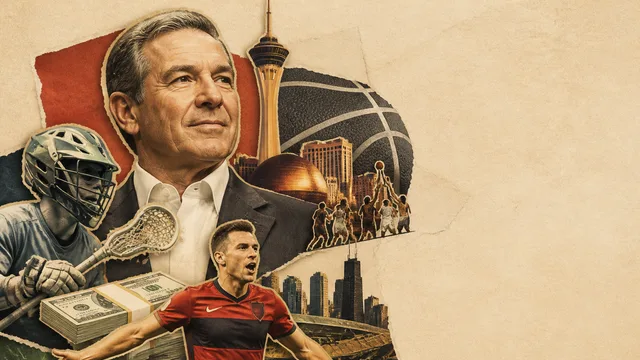
PLL Raises $100M, Iger Eyes NBA Vegas Bid
PLL lands $100M Series E, Bob Iger and Josh Kushner explore a Las Vegas NBA bid, and Chicago Fire sign Lewandowski before McDonald's Park opens.

Nashville, Waltons, and a World Cup Verdict
Nashville's sports boom, Lukas Walton's Bulls stake, the World Cup's record attendance, and Wimbledon's player labor standoff—the week's key sports business signals.