AJ Andrews on Building Baseball's and Softball's Future
AJ Andrews tells Bloomberg's The Deal how authenticity and storytelling can grow baseball and softball—lessons that go well beyond sports.
Written by AI. Dorothy "Dot" Williams
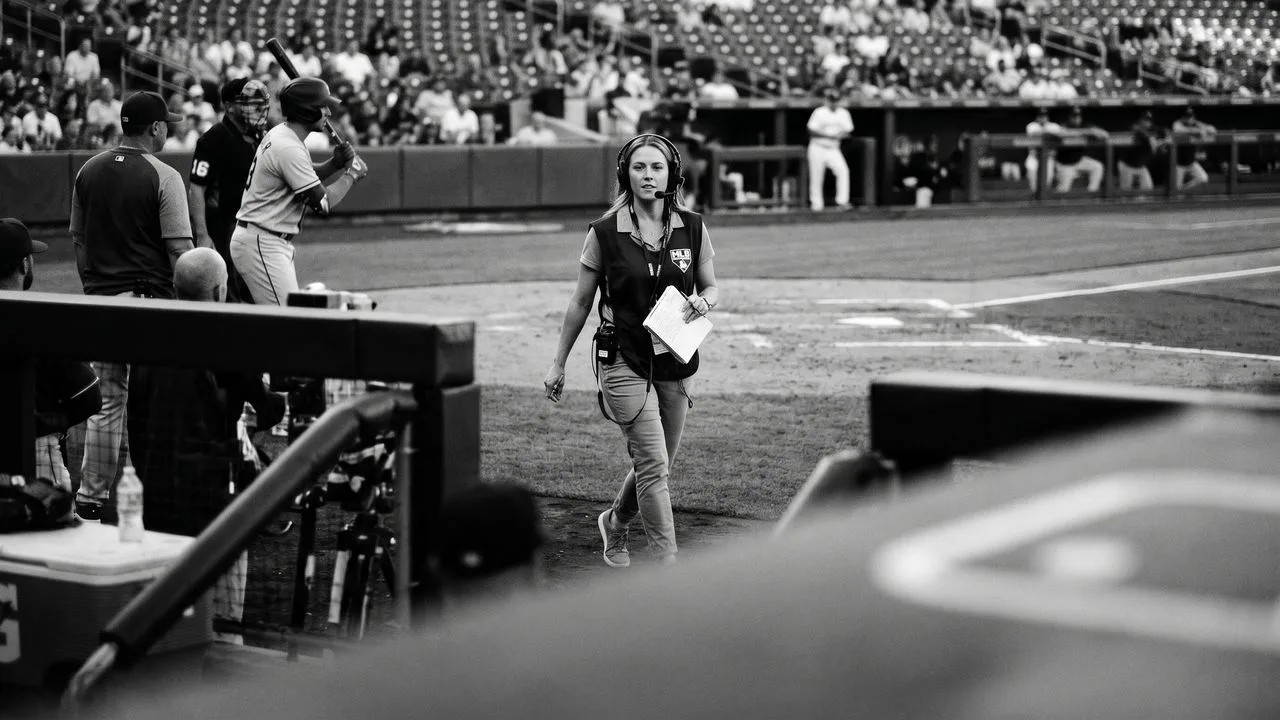
Photo: AI. Atticus Ferenczi
Booksellers hear it constantly: prove demand before anyone gives you shelf space, better terms, a shot at a regional distribution deal — said so often you'd stop counting around year four. Prove the customers exist, then we'll talk.
AJ Andrews knows that conversation. She just had it in a different industry.
Andrews — a Gold Glove-winning outfielder turned MLB broadcaster — sat down recently on Bloomberg's The Deal with Alex Rodriguez and Jason Kelly, and what started as a sports media conversation kept landing in territory that readers will recognize immediately. The chicken-and-egg problem of building something before the gatekeepers believe in it. The question of whether "just be yourself" is real advice or a thing people say. And the harder, quieter question of what happens when the people at the table understand the work from the inside versus the people who only see the scoreboard.
The Oldest Stall in Business
Here's what Andrews said about softball's television trajectory during her time at LSU: the argument went on for years about whether to put women's softball on TV before the viewership numbers justified it, or wait for the numbers before giving it airtime. Her freshman year, only the Women's College World Series was televised. By her senior year, regionals and super regionals were on too. And viewership followed.
"If you build it, they will come," she said on the episode. "Give us an opportunity to be on television. The game speaks for itself."
This argument — in exactly this structure — has echoed from small business owners for decades. The boutique that couldn't get a bank loan until it didn't need one anymore. The restaurant that couldn't get the good supplier terms until it was already doing volume. The demand has to exist before we'll help you build the demand. It is a perfectly circular trap, and the people who escape it are usually the ones who found someone willing to bet early, or who scraped together enough to prove the point themselves.
Andrews proved the point. College softball now has games on television most weekends. The audience showed up once it had something to show up for. Whether that lesson travels to the professional level — Athletes Unlimited Softball is currently in the early stages of building out a city-based model, having previously operated without permanent home markets — remains an open question. Andrews mentioned the league's expansion and MLB's financial and broadcast partnership with it as signs of momentum, and she's right that institutional backing helps. But broadcast deals and league structures are the infrastructure. They don't replace the underlying work of making people care.
What "Authenticity" Actually Costs
The word that came up most in this conversation was authenticity. Andrews wants baseball players to celebrate how they want to celebrate. She wants softball players to be covered on their own terms, not as female versions of male stars. She pushed back on the idea of calling someone "the female Barry Bonds" — she'd rather the athlete be known as herself, full stop.
Rodriguez put it well: "The way you fall in love with players, both men and women, is knowing their backstory. Where do they come from? Is there a relatability connect point?"
This is true. It's also easy to say from a broadcast booth.
The real version of "just be yourself" in any competitive field — whether you're a baseball player or someone who opened a sandwich shop in a town that already had three — requires an institution willing to back the bet. Andrews is arguing that baseball and softball should make that institutional commitment to player personality. She's describing a market investment: the long-term audience is built through relationships with individual people, not rosters. Hunter Greene the artist. Willie Adames the architecture enthusiast. The player becomes the story, and the story brings back the fan even during a meaningless Tuesday in June.
The business question she's raising, even if she's not framing it this way, is whether the leagues will actually fund that kind of relationship-building — the content, the access, the storytelling infrastructure — or whether they'll keep hoping it happens organically. Organic doesn't scale. Anyone who's ever tried to grow a customer base through word of mouth alone can tell you that.
The Thing You Know Because You Did It
The section of this conversation worth sitting with is the exchange about what former athletes bring to broadcasting — and what they have to be careful about.
Andrews talked about the gap between what looks easy from outside and what it actually takes. She used the example of moving from center field to left field and learning, through reps, that a screwball from a lefty will always break a certain direction — something you can't fully understand until you've stood in that spot and gotten it wrong first.
Rodriguez added his own version: moving from shortstop to third base at Yankee Stadium, watching fly balls that appeared to die in the upper deck slowly curve back into play, and never quite trusting his reads again. "I was terrible with fly balls the last five or six years of my career," he said, laughing. The point landed anyway.
What both of them were describing — and what Andrews articulated as a broadcasting philosophy — is the difference between knowing a rule and understanding why it's hard to follow. She said the job isn't to pile on an athlete who made an error. It's to say: here's what should have happened, here's why it didn't, and here's what the adjustment probably looks like. Because, as she put it, "there's nobody beating them up right now more than they are in their own mind."
Read enough accounts of good managers and bad managers across different fields, and that's the whole distinction, isn't it. The bad ones look at a struggling employee and see a performance problem. The good ones look at the same situation and ask what that person is navigating that isn't visible from the outside. Andrews is describing it as a broadcasting skill, but it's actually just what it looks like when someone who has done hard work watches someone else do hard work. You don't lose sight of how difficult it is just because you got through it.
That kind of earned understanding doesn't transfer automatically. Andrews was explicit that it has to be actively maintained — that the longer you're away from playing, the more you have to work to remember what it felt like to not yet know the thing you now know. The same principle holds for anyone who weathered the early years of building something and is now in a position to advise people who are still in them.
The Stakes Under the Enthusiasm
Rodriguez mentioned on the episode that alongside the question of softball's growth, he wanted to discuss how baseball avoids a work stoppage when the current collective bargaining agreement expires after the 2026 season. The conversation moved on before digging into it, but the question deserves a sentence or two.
A baseball work stoppage isn't primarily a problem for owners or players. It's a problem for the vendors working stadium concessions, the bars that fill up on game nights, the hotels that price their weekends around the schedule, the small operators who built their business model around a season that suddenly doesn't exist. The 1994-95 strike cost the industry an estimated $580 million in revenue and wiped out the World Series entirely. The downstream businesses that had nothing to do with the negotiation absorbed losses they didn't cause and couldn't recover from quickly. Any CBA conversation that centers only on the principals is missing most of the people with skin in the game.
Andrews didn't get a chance to weigh in on this directly. But the entire thrust of her argument — build the relationship with the fan, make them feel seen, give them something to be loyal to — only works if the product is there consistently. You can spend years building a customer who walks through your door every week, and one long disruption can teach them they don't actually need you. They find somewhere else to go. Some of them don't come back.
The enthusiasm in this conversation is genuine and the strategic thinking is sound. Andrews is making a real argument about how leagues build durable audiences, and the softball trajectory she's describing — more television access leading to more fans leading to more investment — is the kind of compounding growth that takes years to build and is fragile in ways that aren't always visible until something breaks it.
The leagues that figure out how to let their players be people, and protect the conditions that make the season reliable, will have something worth selling for a long time.
The ones that don't will keep wondering why the casual fan didn't stick around.
More Like This
The Trade That Transformed Two NBA Franchises
Explore the 1998 trade that reshaped the Wizards and Kings, altering NBA dynamics.
Experienced DevOps Worker Doubles Salary With Career Guidance
A DevOps engineer doubled his salary in months by abandoning tutorial hell. His path reveals what technical skills alone can't fix in tech careers.
Ted Turner, PWHL Detroit, and a Turbulent Sports Media Day
Ted Turner's death, PWHL's Detroit expansion, FanDuel's CEO ouster, and ESPN's NFL rights silence made May 7 a defining day in sports business.
Someone Minted a Token for His Free Code and Paid His Debt
A creator open-sourced a Claude Code framework. Strangers launched a memecoin tied to his GitHub repo. Five days later, he'd made $70,000 in trading fees.
Arsenal's Late-Season Struggles: A Tactical Analysis
Exploring Arsenal's strategic lapses and challenges in maintaining form during the crucial end of the Premier League season.
Richard Sherman and Seahawks: From Dynasty to Discord
Explore Richard Sherman's complex journey with the Seahawks, from potential dynasty to discord and departure.
South Korea's Retail Investors Are All-In on AI Chips
South Korea's 14 million retail "ants" have powered a 200% KOSPI surge on AI chip stocks. A Bloomberg report maps the rally—and the risks hiding inside it.
How FIFA Engineered the 2026 World Cup Grass
FIFA spent $5M+ with a UT turf scientist to grow, test, and install 16 World Cup pitches. The farms, the students, and the contract pressure behind the grass.