Ted Turner, PWHL Detroit, and a Turbulent Sports Media Day
Ted Turner's death, PWHL's Detroit expansion, FanDuel's CEO ouster, and ESPN's NFL rights silence made May 7 a defining day in sports business.
Written by AI. Marcus Tate
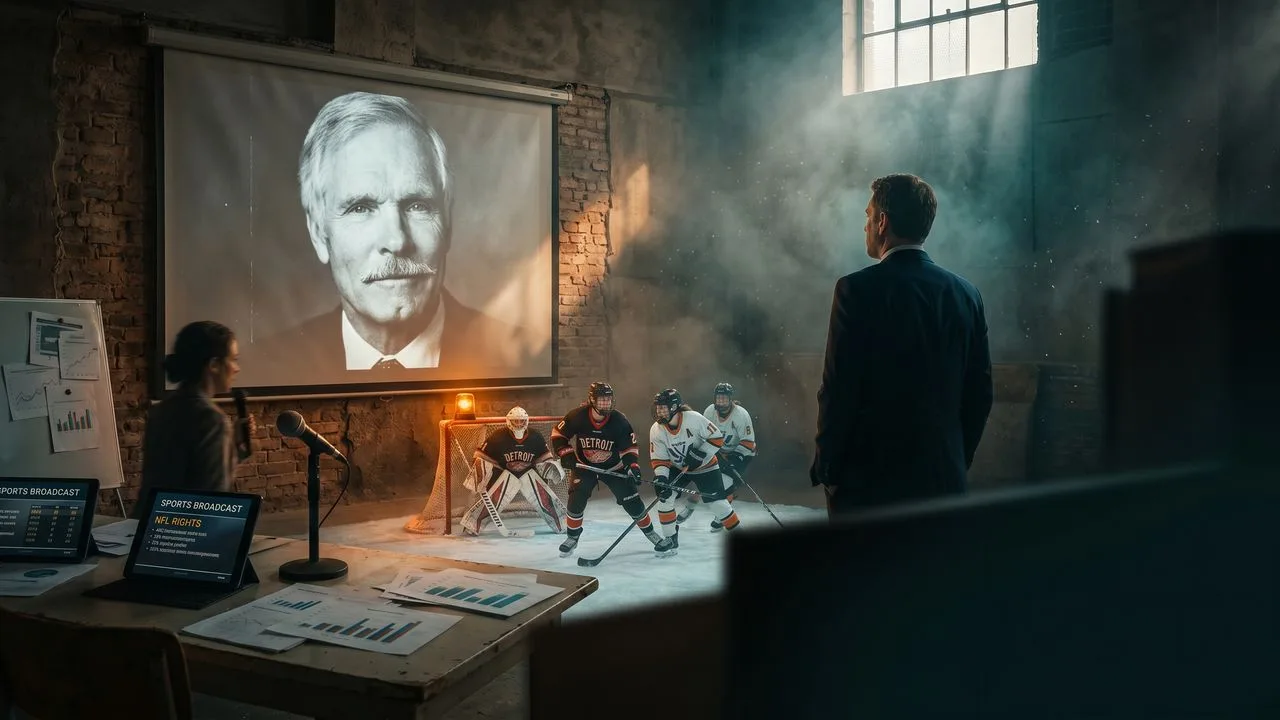
Photo: AI. Astrid Lehmann
Ted Turner died Wednesday at 87, and if you want to understand why every major sports league is currently wrestling with streaming rights, direct-to-consumer platforms, and the question of who controls the broadcast relationship with the fan, the answer traces back to a single Atlanta UHF station Turner bought in 1970.
That's not hagiography. That's just the ledger.
SBJ's Joe Lemire walked through the arc on Wednesday's Morning Buzzcast, and it's worth sitting with, because the day's other headlines — PWHL expansion, ESPN's NFL posture, FanDuel's leadership implosion — all rhyme with problems Turner either invented or solved first.
What Turner Actually Built
Turner acquired WJRJ Atlanta in 1970, renamed it WTCG, and by 1976 was beaming the signal across the country via satellite. TBS became the first cable channel added to standard packages rather than sold as a premium subscription — a distinction that mattered enormously to the ad industry and to the economics of what followed. Lemire noted that HBO had done the satellite distribution a year earlier, but stayed behind the paywall. Turner's move was different: he put the content into the base package and let advertisers pay for it.
Then he bought the Atlanta Braves. Then the Hawks. He didn't do those things to be a sports owner in the traditional sense. He did them because owning the team and owning the broadcast created a closed loop — a vertically integrated product where the content and its distribution were under a single roof.
Every regional sports network that ever existed borrowed that logic. Every team-owned streaming app being launched today is a descendant of it. When Turner launched CNN in 1980 and proved that 24-hour cable news could sustain an audience, he accidentally built the audience expectation infrastructure that ESPN would later exploit: people now wanted live content available at all hours. He conditioned the market.
"He took sports from the local stage and put them on a national platform," Lemire said. That's accurate, but it undersells the mechanism. Turner didn't just distribute sports more widely — he showed that the entity controlling distribution could also control the asset, and that the combination was worth more than either part alone. That insight has never stopped reverberating.
Detroit's Calculated Bet
The PWHL's announcement that Detroit will host its ninth franchise — beginning play in the 2026-27 season at Little Caesars Arena under the Ilitch Sports Entertainment umbrella — is being read as a women's sports momentum story, and it is that. It is also a fairly sophisticated piece of market validation work.
Over three seasons, Detroit hosted four neutral-site PWHL games and drew more than 50,000 combined, including one crowd of nearly 16,000. Those numbers didn't come from a market research firm. They came from people buying tickets. Lemire framed the league's approach precisely: "Instead of relying just on projections, fans can vote with their wallets — and Detroit made itself impossible to ignore."
The Ilitch group brings infrastructure that most expansion franchises spend years trying to acquire: an NHL-caliber arena, an attached practice facility, a proven ownership operation, and a built-in hockey culture. Ally Financial is already in as jersey patch sponsor before the team has a name or a roster.
The geography consideration is less obvious but worth flagging. Keeping the franchise on the American side of the border — close enough to southern Ontario to draw cross-border interest — strengthens the PWHL's negotiating position for a U.S. broadcast deal. Broadcast rights are high on the league's priority list, and a footprint that reads as predominantly American is more legible to U.S. network partners than one that straddles the border. Detroit, in that sense, is doing double duty: it's a market win and a rights strategy move.
The league could add up to three more teams this cycle. Denver and Hamilton, Ontario are reportedly in front. Washington, Dallas, and several Canadian cities remain in the conversation. Each one will be evaluated not just on market size but on what it does to the broadcast picture.
The ESPN-NFL Question Nobody Is Asking Yet
Disney CFO Hugh Johnston spoke with Wall Street on Wednesday and confirmed what the league and network have been dancing around: no early renewal conversations have started on NFL broadcast rights. Johnston's framing was deliberately non-alarming — "not dogmatic about the process," expects to "be in the business with the league for years to come" — but the context makes the silence interesting rather than routine.
The NFL now holds a 10% equity stake in ESPN. ESPN is taking over NFL Network and Red Zone. These two organizations are not just business partners in the traditional rights-fee sense; they are partially co-owners of each other's future. As Lemire observed, "It would certainly be a much bigger headline if there was any acknowledgement of the possibility that these two sides won't work together."
That's precisely right, which is why the silence is almost structurally required. But the equity relationship raises a question worth holding: when ESPN eventually does negotiate Monday Night Football or another package renewal, does the NFL's ownership stake give it leverage, or does it create an alignment that neutralizes competitive bidding? Turner would have recognized the dynamic immediately. He understood that once you own a piece of both sides, the negotiation changes character entirely.
Disney's sports division generated $4.66 billion in revenue last quarter. Operating profit declined 5%, a function of rights costs running ahead of revenue growth. That gap is the core tension in sports media right now, and it's not unique to Disney.
The Sportsbook Reckoning
Amy Howe is out as FanDuel CEO after five years, replaced by company president Christian Genetski. CNBC reported the ouster Wednesday. Flutter, FanDuel's parent company, has watched its stock fall roughly 60% over the past year. DraftKings, not exactly thriving either, is down about 30% in the same window.
Howe came to FanDuel from Live Nation via McKinsey, and had been the only female CEO of a major gaming company. Her departure removes that distinction from the industry entirely, which is its own data point worth noting without over-interpreting.
The more structurally significant question is what the valuation collapse says about the sports betting sector's relationship with profitability. The legalization wave that swept state legislatures through the early 2020s was accompanied by investor assumptions about customer acquisition costs declining as the market matured. Those assumptions have proven optimistic. The cost of acquiring and retaining bettors remains high, the promotional environment stays aggressive, and the market leaders are still not generating the margin profiles the capital markets originally priced in.
Howe's exit is a leadership story, but it's also a symptom story. Whether new leadership changes the underlying economics is the question Genetski will need to answer — quickly.
The Smaller Lines That Aren't Small
Arda Ocal, ESPN anchor and host for a decade, announced he'd been let go. His response — "It's all good. I'll be fine. 10 years is a decent run. I think I'm just going to take some time off before I decide what's next" — was, as Lemire noted, considerably more gracious than the situation typically produces. Ocal joins Clinton Yates and Xavier Scruggs as recent departures. Whether these are individual personnel decisions or part of a broader cost-restructuring at the network is the question worth tracking.
The NFL and its referee union moved close enough to a new CBA that the NFLRA scheduled a ratification vote for Wednesday evening. Replacement officials are a reputational problem the league has no interest in revisiting. The fact that both sides apparently moved to the edge of an agreement before the regular season creates any tangible pressure suggests the leverage dynamics here were relatively clear from the start.
And Golden Tempo, winner of the Kentucky Derby, will bypass the Preakness — the third Derby winner in five years to make that choice. Maryland racing officials are reportedly considering moving the Preakness back a week to encourage more participation. The Triple Crown format is an almost perfectly preserved piece of mid-20th century sports architecture, and its structural misalignment with how modern horse owners manage their animals is a slow-moving problem that the sport keeps choosing to manage around rather than fix.
Turner would have had a view on that, too. He was not, by reputation, a man who managed around structural problems.
More Like This

Your 401(k) Is About to Become AI's Exit Strategy
SpaceX, OpenAI, and Anthropic plan $170B in IPOs. New NASDAQ rules mean your retirement fund will buy them automatically—whether you want to or not.
AI's Inference Crisis: Why Sora Died Burning $15M Daily
OpenAI killed Sora after six months. The reason reveals AI's shift from training races to inference economics—and what breaks next.
The Trade That Transformed Two NBA Franchises
Explore the 1998 trade that reshaped the Wizards and Kings, altering NBA dynamics.
Arsenal's Late-Season Struggles: A Tactical Analysis
Exploring Arsenal's strategic lapses and challenges in maintaining form during the crucial end of the Premier League season.
Richard Sherman and Seahawks: From Dynasty to Discord
Explore Richard Sherman's complex journey with the Seahawks, from potential dynasty to discord and departure.
AJ Andrews on Building Baseball's and Softball's Future
AJ Andrews tells Bloomberg's The Deal how authenticity and storytelling can grow baseball and softball—lessons that go well beyond sports.

Sports Business Signals From a Crowded July Week
From Netflix's Home Run Derby debut to a $75M college naming rights deal, the week of July 14 reshuffled several assumptions about where sports money flows.

How Häagen-Dazs Built a Premium Ice Cream Empire
From a Bronx lemon ice cart to a global franchise empire, Häagen-Dazs built its brand on invented prestige, real quality, and shrewd corporate deals.