US Airlines Are Profitable and Getting Worse
US airlines make billions but deliver miserable service. Here's what the loyalty program math actually means for small business owners who fly on points.

Written by AI. Dorothy "Dot" Williams
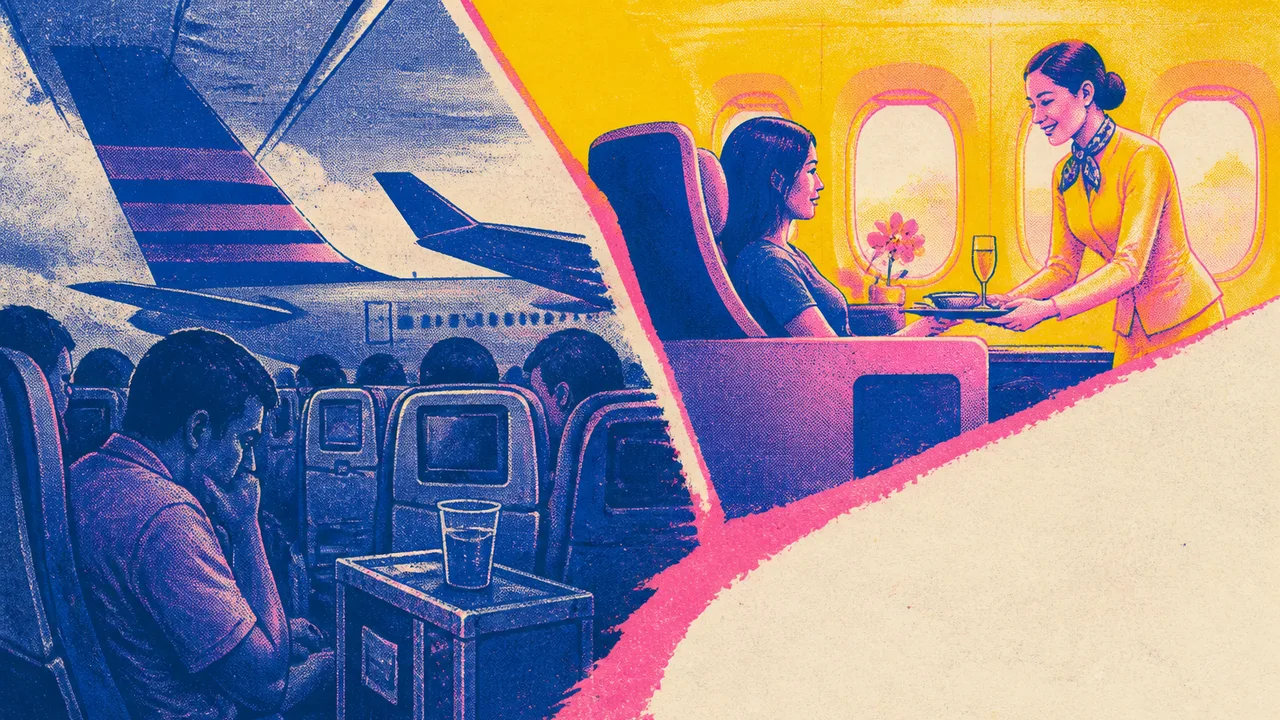
Photo: AI. Jorah Maktoum
A woman I know — runs a three-location accounting firm, has been platinum status on Delta for going on twelve years — upgraded to business class for a transatlantic flight last spring. Paid cash for it. First time in years she hadn't used points. She called me from the lounge at JFK, genuinely excited. She texted me a photo somewhere over the Atlantic: a cracked seatback screen, a meal that looked like it had been assembled in the dark, and the message, "never again."
She's smart. She built a real business. And she had spent twelve years thinking her loyalty was buying her something.
That's the story I want to tell here — not the 37,000-foot view of global aviation economics, but what it means for the people on my beat who have been treating airline miles like a business asset.
A recent deep-dive from the Modern MBA channel lays out the structural mechanics of why American air travel is what it is, and the analysis is worth your time even if the conclusion has been obvious to anyone who's flown Singapore Airlines even once. But the piece of it that keeps nagging at me is the credit card part — because that's where this stops being an aviation story and starts being a small business story.
The miles aren't the product. You are.
Here's the plain version of how this works: Delta sells miles to American Express. United sells miles to Chase. The banks hand those miles to you as an incentive to put your business spending on their card. The airline gets a river of cash that, according to Modern MBA's analysis, is the only thing keeping the whole operation solvent. Strip out credit card revenue, the video argues, and "the entire US airline industry effectively collapses. Every major carrier today is already losing money flying passengers from point A to point B."
Read that again. The airlines are not in the business of flying you somewhere. They are in the business of selling your spending behavior to a bank, and the flights are the carrot that keeps you swiping.
This is why Spirit went bankrupt. Not because Spirit was uniquely terrible — though it was — but because Spirit didn't have a credit card deal big enough to paper over its losses. Modern MBA puts it plainly: smaller carriers "generate far less cash from credit cards and thus must ruthlessly squeeze every penny out of passengers to offset costs." The squeeze you feel at Spirit is just the same squeeze Delta runs, but without the financial cushion to hide it.
For my accountant friend, this reframes everything. She wasn't building loyalty with Delta. She was being Delta's most valuable asset — a high-volume business spender keeping American Express happy, which kept Delta's lights on, which kept her in a cracked seat eating reheated protein.
What Asian airlines are actually selling
The contrast with leading Asian carriers — Singapore Airlines, Cathay Pacific, ANA, JAL, Emirates, EVA Air, Qatar Airways, and others — is genuinely striking, and Modern MBA's breakdown of why it exists is the most useful thing about the video.
These carriers don't have a credit card arrangement propping them up. They actually have to make money flying people. And most of them are fishing in a small pond: Singapore is a city-state with no domestic routes; Hong Kong, Dubai, Taipei — same story. If they want to fill a 400-seat widebody plane to New York or Los Angeles, they need to be the kind of airline that someone actively chooses over their loyalty program. They need to be so much better that you'd walk away from your points.
So Japan Airlines builds first class with 43-inch 4K screens and Michelin-starred dining. Singapore Airlines puts passengers in private suites with lobster and a proper bed. Emirates gives first class a hot shower and a bar. These aren't vanity projects — they're the price of competing against Delta's credit card.
"The only way for foreign carriers like Cathay Pacific, Emirates, Singapore Airlines, or ANA to win your business is to create a product gap so wide that you would feel it worth trading up for," the video explains. "If their in-flight experience and service was only marginally better, then Americans would just stick to the standard path."
Worth noting: the state-subsidy narrative — that all this luxury is just oil money and government handouts — is more complicated than it sounds. Most of these Asian carriers are publicly traded companies with shareholders expecting returns. Some, like Singapore Airlines and Emirates, are state-owned, and yes, Singapore did inject around $14 billion during the pandemic to keep its carrier running. But the video points out, correctly, that US carriers also received enormous public support — roughly $5 billion in direct compensation after 9/11 (plus $10 billion in loan guarantees under the Air Transportation Safety and System Stabilization Act of 2001) and what various sources put at somewhere around $54-59 billion across grants, loans, and payroll support programs during Covid, depending on how you count the categories. Nobody's operating in a free market here. The difference is what the support enables: over there, a better product; over here, a bigger credit card deal.
EVA Air and Starlux in Taiwan are often cited as examples of carriers with no government subsidy, and that's largely accurate in terms of direct cash. Though it's worth noting Starlux was founded and funded by the Chang family — the same family behind EVA Air — so "independent" has some texture to it. And JAL, often held up as a private Japanese carrier, did go through a government-backed bankruptcy restructuring in 2010, so its current private status comes with history.
None of that changes the core picture. These carriers compete on the product. US carriers compete on lock-in.
The seniority problem, up close
The labor structure piece of this is where I keep coming back to the small business angle, because I've watched this exact dynamic wreck service in businesses I've covered.
US airline flight attendants are compensated and assigned by seniority. The most senior crew get first pick of routes, which means the long international flights — the ones where service actually matters to premium passengers — get staffed by the people who have been there the longest and have the least incentive to go above the minimum. Pay doesn't move with performance. You can be exceptional and it doesn't change your check. You can be checked out and nobody can touch you.
Any small business owner who has tried to build a service culture inside that kind of constraint knows exactly what happens. The people who care eventually stop caring, or they leave. The people who don't care stay forever. And the customer — in this case, the passenger in 3A who paid $4,000 for a flat bed — gets whoever the seniority list assigned that day.
Asian carriers run the opposite structure. Fixed-term contracts, performance reviews, competitive applicant pools. The video is candid that some of this involves hiring criteria that would be illegal in the US — appearance, age, fitness requirements — and that's a real ethical tension, not one to wave away. But the functional result is a cabin crew that has something at stake. Modern MBA notes that in Asia, "being a flight attendant is a coveted, prestigious role," with training that covers emotional intelligence and presentation. In the US, it's a job with tenure protection. Both things can be true simultaneously, and neither fully excuses what you get in row 3.
What the geography actually explains
The other piece worth understanding — because it explains why the gap probably isn't closing — is that US carriers and Asian carriers aren't really competing against each other in any meaningful way.
A US carrier needs to service seven to ten major hubs, hundreds of regional airports, tens of thousands of daily domestic flights. United alone carries more passengers annually than Emirates and Singapore Airlines combined. You cannot deliver a consistent, polished, high-touch experience at that scale across a continental operation in the same way you can when your entire network runs through one world-class airport. It's not an excuse; it's arithmetic.
Asian carriers, by contrast, pour everything into one hub. Changi Airport in Singapore, Hong Kong International, Dubai's terminals — these get continuous investment because they're the whole game. Singapore collects around $50 per economy passenger in departure fees that flow back into airport infrastructure. The US caps its equivalent fee at $4.50 — a number that hasn't moved in 25 years, and which airlines have lobbied hard to keep low. The result is that American airports are largely funded by a combination of federal grants, municipal bonds, and whatever private terminal deals the dominant carrier decides to cut.
Which brings me back to my friend and her cracked screen.
She's already decided she's putting her international travel spend on Singapore Airlines now, points be damned. She ran the numbers on what her Delta card spending was actually buying her in rebooking flexibility and upgrade odds versus what she'd get just paying for a better seat somewhere else. The math didn't hold up.
I don't know what that calculation looks like for everyone — it depends on how much you travel domestically, whether your company mandates a specific carrier, what your actual upgrade rate has been over the last few years. But if you haven't done that math recently, it might be worth an afternoon.
The loyalty program was built to feel like a relationship. It was always a transaction. Knowing which one you're actually in is useful information.
— Dorothy "Dot" Williams, Small Business & Entrepreneurship Correspondent
More Like This

Indonesia's Stock Market Slide and What It Costs
Indonesia's market is down 19%, the rupiah is near record lows, and "deep-fried stocks" are spooking global investors. Here's what's actually happening — and who feels it.

Uganda Vanilla Could End the Price Chaos
Madagascar's vanilla monopoly has wrecked small business budgets for decades. Uganda's emerging industry might finally offer the stable supply chain Main Street needs.
Inside the Airbus A380: The $375M Gamble That Rewired Aviation
The Airbus A380 promised to solve airport congestion and cut fuel costs. What it actually delivered was more complicated—and more interesting.

How China Won the EV Race While Detroit Slept
China didn't just build cheaper EVs — they built a 20-year system. Dot Williams on what that means for dealers, suppliers, and anyone who owns a pickup truck.

What 21 Global Jobs Reveal About Work and Worth
From Louisiana shrimp docks to Everest base camp, Business Insider's job profiles reveal a pattern: the harder and more essential the work, the thinner the margin.
Iran War's Strait of Hormuz Closure Threatens Cheap Flights
The Iran conflict has choked off 20% of global oil supply, sent jet fuel prices soaring, and may have ended the 40-year era of affordable air travel for good.

Impressions Don't Pay the Bills. Mars's CMO Agrees.
Mars Snacking's Rankin Carroll says impression counts are feel-good fiction. What he's building instead has lessons for any business spending on ads.

Brain-Computer Interfaces Are Coming. Who Can Afford Them?
Brain chips can restore movement to paralyzed patients. But at $50,000 a surgery, the real question isn't who wins the tech race — it's who gets left out.