Indonesia's Stock Market Slide and What It Costs
Indonesia's market is down 19%, the rupiah is near record lows, and "deep-fried stocks" are spooking global investors. Here's what's actually happening — and who feels it.

Written by AI. Dorothy "Dot" Williams
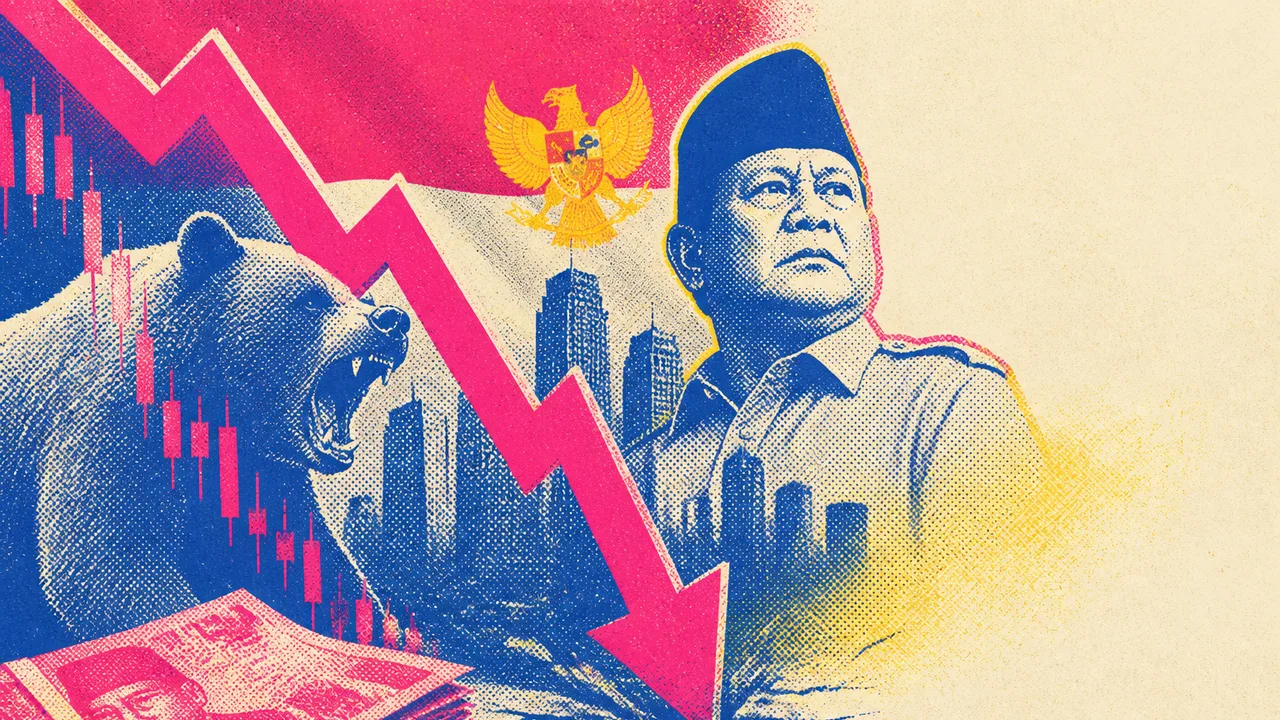
Photo: AI. Jorah Maktoum
There's a term making the rounds in Indonesian financial circles: deep-fried stocks. Sounds almost charming, until you understand what it means. These are shares concentrated in the hands of a few wealthy tycoons, with so little of the float available for public trading that a modest volume of buys or sells can whipsaw the price dramatically. They look sizzling on the way up. They look very different when the oil runs cold.
Deep-fried stocks are one symptom of a broader problem that Bloomberg Originals laid out recently in a detailed examination of Indonesia's economic slide — and the diagnosis is worth understanding if you have any exposure to Southeast Asian supply chains, commodity markets, or emerging market risk. Which, if you source palm oil, thermal coal, or nickel through a broker, you do.
The Setup: Everything Was Going Right
To understand how Indonesia got here, you have to appreciate how good the story used to be. The country's GDP sits at $1.5 trillion — more than Singapore and Thailand combined. It's the world's fourth most populous nation, with over 280 million people spread across an archipelago the length of the Atlantic. It is the world's largest exporter of palm oil and thermal coal, its largest producer of nickel, and — yes — the world's biggest manufacturer of Barbie dolls.
For two decades, according to World Bank data, Indonesia maintained roughly 5% annual growth outside of genuine crisis years. That consistency, combined with a post-Suharto democratic transition and a hard-coded 3% cap on budget deficit spending, made it look like a responsible, stable bet. Foreign direct investment surged through the 2010s, outpacing Vietnam, Malaysia, and Thailand. "Just three to four years ago, it was an investor's darling," one analyst noted in the Bloomberg piece. "There was so much buzz."
The Joko Widodo years — he served as president from 2014 through the handoff to Prabowo Subianto — accelerated market-friendly infrastructure investment and opened commodity sectors to international capital. The excitement was real, and it was grounded in something real.
Where It Started Coming Apart
The middle-class story, it turns out, was partly illusion. The share of Indonesians considered middle class has shrunk since 2018, while the number classified as vulnerable or poor has grown. Prosperity was accumulating, but not distributing. That tension erupted in protests over inequality and rising living costs in 2025 — not a blip, but a structural signal that the economy's growth metrics were papering over something.
President Prabowo Subianto, who took office after Widodo, responded with what Bloomberg describes as "deep beliefs in state capitalism." His approach has two main pillars: a sovereign wealth fund called Danantara, designed to consolidate and rationalize hundreds of state-owned enterprises, and tighter state control over commodity exports — palm oil, coal, select nickel products — through a new state-appointed body intended to crack down on under-invoicing, the practice of shipping profits offshore to avoid Indonesian taxation.
Both moves have a defensible logic. Under-invoicing is a real problem. Consolidating inefficient state enterprises under a single accountable structure could improve performance. But what foreign investors heard when they looked at the details was different: Danantara looks, from the outside, like a fund that can be tapped for politically popular social programs, including Prabowo's flagship free school meals initiative for children and pregnant women. "It's seen as some sort of a piggy bank to fund some of the president's social policies," one analyst told Bloomberg, "and that is creating some confusion among foreign investors."
That confusion has a cost. According to Bloomberg's analysis, Indonesia's 2025 budget deficit hit its highest point outside of pandemic years in roughly two decades — approaching the country's legally mandated 3% ceiling that has long been a signal of fiscal discipline to global markets. The 3% cap isn't just a number; it's the institutional credibility anchor that replaced the chaos of the 1998 Asian financial crisis, when the rupiah collapsed and the banking system nearly did too. International investors are watching that number like a lease covenant.
The Deep-Fried Problem, Explained
The stock market dysfunction compounds all of this. Most developed markets require companies to keep a meaningful percentage of shares available for public trading — the free float — to ensure liquidity and prevent price manipulation. Indonesia, until recently, had the lowest minimum free float requirement in the region. That low floor meant tycoon-controlled companies could list with most shares locked up, leaving a thin slice of tradable stock that could be moved dramatically by small players with the right positioning.
Bloomberg reports that in March, financial regulators doubled the minimum free float requirement, citing filings from Indonesia's Financial Services Authority, OJK. That's a meaningful structural step. But as one analyst put it in the Bloomberg piece: "The devil's in the details. How long will it take them to really increase transparency about who owns what stocks? And will they go after some of the big market players that might be guilty of market manipulation?"
That question matters because the consequences of inaction have already been severe. MSCI, the global index provider, warned it may reduce Indonesia's weight in its emerging markets index — and potentially downgrade the market to frontier status. "In the stock market, you saw a sell-off that you hadn't seen since the 1998 financial crisis," one source noted. The market is still down roughly 19% over the past year. Indonesian bond yields are among the highest in Asia, meaning the government is paying dearly to borrow. The rupiah has hit record lows against the dollar and analysts aren't optimistic about a near-term rebound — a currency under that kind of pressure signals something to global capital allocators that no press release can fully offset.
What This Costs Someone Who Isn't Running a Portfolio
Take someone like Renata — a composite drawn from conversations with small food importers and commodity buyers — who runs a 14-person specialty food operation outside of Minneapolis and has been sourcing refined palm oil through a Chicago broker for six years. She's not panicking. Palm oil flows through too many supply chains to dry up overnight, and her broker has relationships that span multiple sourcing regions. But she hasn't extended her contract beyond the current term, and she's watching what happens to rupiah stability before she makes any longer commitments on price. The export-control changes Prabowo has proposed — state-managed palm oil exports through Danantara — add a layer of uncertainty she didn't have two years ago. Not catastrophe. Just friction she has to price in.
That friction compounds when you add the global tariff environment. Indonesia's fuel subsidies are among the cheapest in the region, but sustaining those subsidies gets harder if oil prices climb. And broader emerging market currency pressure — the kind triggered by U.S. rate policy and geopolitical volatility — hits Indonesia alongside everyone else. "A lot of emerging market currencies have come under pressure," one Bloomberg source observed. "If we see continued selling of the rupiah, of its bonds, of its stocks, it shows that investor interest in some of the real growth stories in Asia is waning."
Is Indonesia Cooked?
My honest answer to that question, if someone asked me over bad coffee at a chamber breakfast: no, but it's not a simple story right now, and anyone telling you otherwise is selling something.
The fundamentals haven't evaporated. A two-decade track record of ~5% annual growth, according to World Bank data, doesn't reverse because one president made some investors nervous. The demographic tailwind is real. The commodity position is real. The post-1998 institutional guardrails — deficit caps, banking reforms, democratic accountability — are still mostly intact, even if they're being tested. The free float reform is a step. Governance-focused investors have seen worse recoveries.
What's genuinely in play is whether Prabowo can thread a needle that most leaders find very hard: redistributing enough to keep social peace without signaling to foreign capital that the rules are shifting underneath them. The sovereign wealth fund could be transformative or extractive — the structure allows for both, and what it becomes depends on decisions that haven't been made yet. The commodity export controls could reduce tax evasion or introduce a new layer of state-owned-enterprise inefficiency. "Indonesia wants to be on the world stage," one observer noted in the Bloomberg piece. "It wants to grow faster and it has all the ingredients for it."
The ingredients are still there. Whether the cook knows what to do with them is the open question.
More Like This
The Electrical Grid Is Being Rebuilt for AI—Now What?
AI and EVs are forcing a complete grid overhaul. What that means for small businesses waiting on power that never seems to arrive fast enough.

Nuclear's New Fuel Has 11,000 Empty Holes
Inside the nuclear fuel supply chain scramble — from Piketon, Ohio to Saskatchewan — and why the six-to-seven-year timeline deserves your skepticism.

Pawn Shop Stocks Are Booming. Read That Slowly.
FirstCash and EZCORP are outperforming the S&P 500. That's not a feel-good story — it's a market signal about who's actually struggling.

The SpaceX IPO That Could Land in Your 401(k)
SpaceX's $2 trillion IPO isn't just a Wall Street story. Thanks to index fund rules, it may already be headed for your retirement account.

Howard Marks: Why Not Losing Beats Winning
Howard Marks has made five major market calls in 50 years. That's not a confession—it's the strategy. Here's what retail investors get backwards.

4 Robotics Stocks Quietly Building the Next Wave
ARM, Symbotic, Teradyne, and BOTZ are positioned at the heart of physical AI. Here's what the robotics investment thesis actually looks like up close.

How Omakase Became New York's Mass-Market Dining Format
NYC omakase has evolved from a $950 luxury ritual into a $60 neighborhood staple. A new video report examines what that shift means for the people building these businesses.
Jensen Huang Built NVIDIA by Admitting He Was Wrong
Jensen Huang told Y Combinator's Startup School how NVIDIA survived its founding mistake — and what that story means for anyone building a business today.